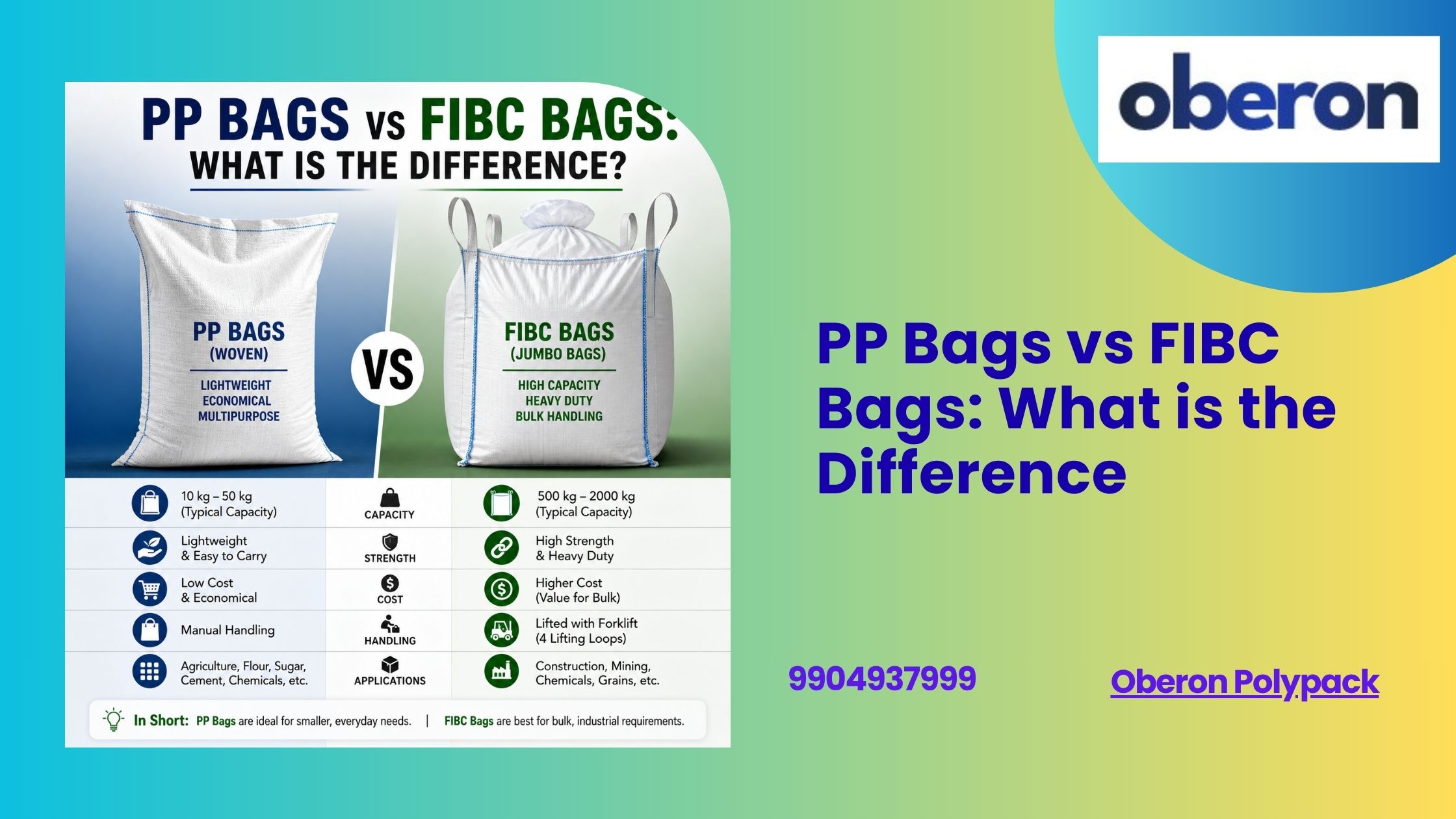
Walk into any warehouse, and you’ll notice one thing right away—bags are doing most of the heavy lifting. From agriculture to construction, packaging plays a bigger role than most people realize. When it comes to PP Bags vs FIBC Bags, the confusion is common because both are made from similar material and used across industries, yet they serve very different purposes.
In simple terms, the difference isn’t just about the bag—it’s about scale. PP bags are typically used for smaller loads and manual handling, while FIBC bags (bulk bags) are designed for transporting large quantities efficiently. Choosing the wrong one can impact your costs, storage, and overall operations more than you’d expect.
That’s why understanding PP Bags vs FIBC Bags matters. In this guide, I’ll break down their differences in a clear, practical way so you can choose the right packaging solution without second-guessing.
Understanding the Basics of PP Bags and FIBC Bags
Before we compare performance, cost, or capacity, it helps to get the basics right. Because when you strip away the industry jargon, both options are actually pretty straightforward—they’re just built for very different jobs.
What Are PP Bags?
PP bags, or polypropylene bags, are the everyday workhorses of packaging. They’re lightweight, flexible, and surprisingly strong for their size. You’ll usually see them used for packing products like grains, sugar, cement, and fertilizers—basically anything that needs to be moved in manageable quantities.
Think of them as the “manual mode” of packaging. Easy to carry, easy to stack, and ideal when your operations don’t rely heavily on machinery. They’re cost-effective and practical, especially for businesses dealing with smaller volumes or frequent handling.
What Are FIBC Bags?
FIBC bags—short for Flexible Intermediate Bulk Containers—are a different league altogether. These are large, heavy-duty bags designed to carry bulk materials, often ranging from hundreds to thousands of kilograms in a single load.
Instead of manual handling, these bags are built for forklifts and cranes, with strong lifting loops stitched into their structure. Industries like chemicals, mining, and large-scale agriculture rely on them to move massive quantities efficiently. If PP bags are about convenience, FIBC bags are all about scale and efficiency.
PP Bags vs FIBC Bags: Core Differences at a Glance
Now that you know what each bag is, let’s put them side by side. Because the real clarity comes when you compare PP Bags vs FIBC Bags on the factors that actually affect your business—capacity, handling, cost, and efficiency.
At a basic level, PP bags are built for smaller, manageable loads, while FIBC bags are designed for bulk movement. That single difference changes everything—from how you store goods to how quickly you can ship them. With PP bags, you’re often relying on manual labor. With FIBC bags, machinery does most of the work, saving time but requiring the right setup.
Here’s a quick breakdown to make things clearer:
| Feature | PP Bags | FIBC Bags |
|---|---|---|
| Capacity | 5 kg to 50 kg | 500 kg to 2000 kg |
| Handling | Manual | Forklift or crane |
| Strength | Moderate | High-duty |
| Cost | Lower upfront | Higher upfront, better for bulk |
| Efficiency | Slower for large volumes | Faster for bulk transport |
In the PP Bags vs FIBC Bags debate, there’s no “one-size-fits-all” winner. It really comes down to your scale of operations and how you handle your materials day to day.
PP Woven Sack vs Bulk Bag: Material and Construction
At first glance, both might look similar—woven plastic, sturdy feel, built to carry weight. But when you dig a little deeper into PP woven sack vs bulk bag, the difference in construction becomes pretty clear.
PP woven sacks are made from interwoven polypropylene tapes, giving them flexibility and decent strength for everyday use. They can be laminated for moisture resistance or left uncoated for breathability, depending on the product inside. The stitching is simple, the structure is light, and the focus is on practicality rather than heavy-duty performance.
Bulk bags, on the other hand, are engineered for serious load-bearing. The fabric is thicker, the weaving is tighter, and the overall design includes reinforced lifting loops that can handle extreme weight. Many FIBC bags also come with additional features like liners, baffles for shape retention, and discharge spouts. In short, while PP sacks are built for convenience, bulk bags are built for strength, structure, and scale.
FIBC Bag Capacity vs Standard PP Sack
This is where the difference really hits home. When you compare FIBC bag capacity vs standard PP sack, you’re not just looking at numbers—you’re looking at two completely different ways of handling materials.
A standard PP sack usually carries anywhere between 5 kg to 50 kg. It’s designed for easy lifting, stacking, and manual movement. That works well if your operations are smaller or if your workforce handles loading and unloading by hand. But once volumes increase, managing hundreds of small bags can quickly become time-consuming and labor-intensive.
FIBC bags flip that equation. A single bag can hold anywhere from 500 kg to 2000 kg, sometimes even more depending on the design. That means fewer units to handle, faster loading times, and better use of storage space. In the FIBC bag capacity vs standard PP sack comparison, it’s clear—if scale and efficiency matter, bulk bags dramatically reduce effort and streamline logistics.
Applications: Where Each Bag Type Works Best
Here’s where things get practical. Choosing between PP Bags vs FIBC Bags isn’t just about specs—it’s about where and how you actually use them. I’ve seen businesses pick the “stronger” option thinking it’s automatically better, only to realize they overcomplicated their entire process. The truth is, each bag shines in its own environment.
Let’s break it down in real-world terms.
Best Uses for PP Bags
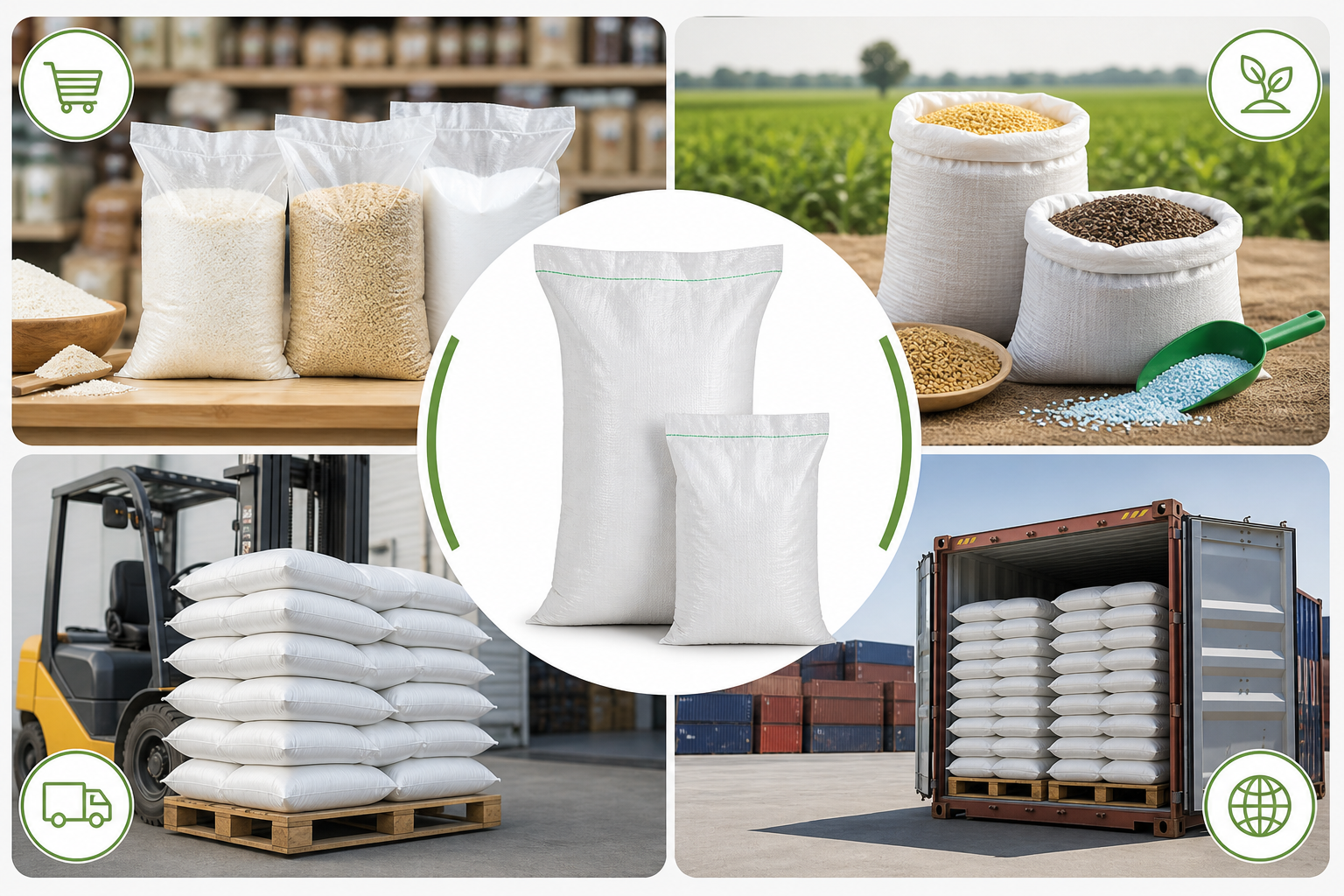
PP bags are all about flexibility and ease. If your operations involve frequent handling, smaller quantities, or quick distribution, they just make life simpler.
Retail packaging
This is where PP bags quietly dominate. Whether it’s rice, flour, sugar, or animal feed, these bags are perfect for shelf-ready products. They’re easy to print on, lightweight to carry, and convenient for end users. You don’t need forklifts—just hands and a simple supply chain.
Agricultural products
Farmers and distributors rely heavily on PP bags for seeds, grains, and fertilizers. Why? Because they’re breathable (when uncoated), cost-effective, and easy to transport in smaller batches. When you’re moving produce from field to market, simplicity wins.
Small-scale transportation
If your business deals with moderate volumes, PP bags keep things agile. You can load, unload, and rearrange shipments without specialized equipment. It’s a practical choice for local distribution or businesses that don’t operate on a massive scale.
Export-friendly packaging
For certain export scenarios—especially where goods are shipped in smaller units—PP bags work well. They’re stackable, customizable, and easy to handle during transit. Plus, they help divide large shipments into manageable portions, which can be useful for different buyers.
Best Uses for FIBC Bags
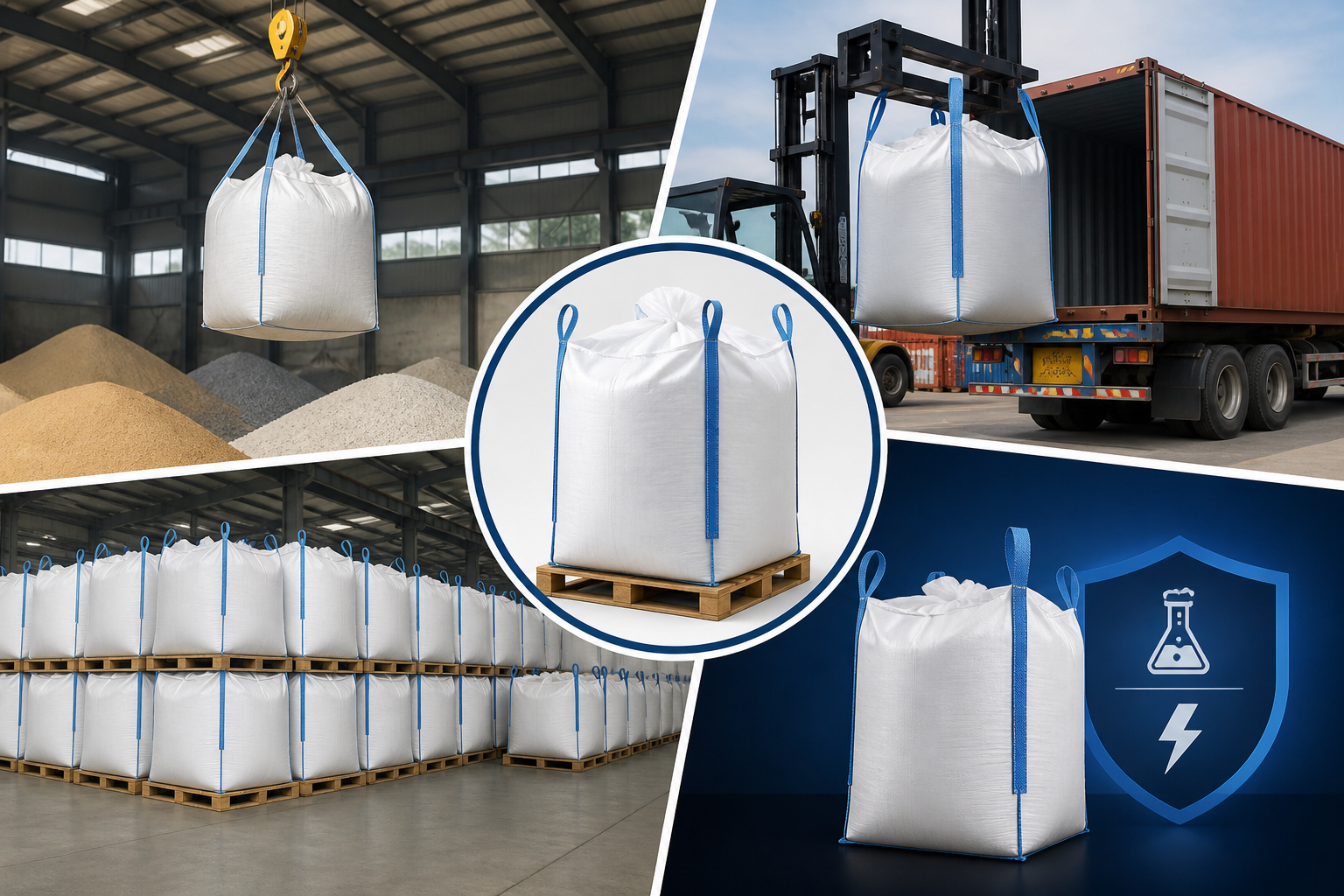
Now step into a large industrial setup, and the game changes. This is where FIBC bags take over—not because they’re fancy, but because they’re built for efficiency at scale.
Bulk material handling
When you’re dealing with tons of material, not kilos, FIBC bags are the obvious choice. Whether it’s sand, chemicals, or plastic granules, these bags reduce the need for handling hundreds of smaller units. One lift, one move—it’s that simple.
Industrial shipping
In industries where time equals money, speed matters. FIBC bags allow faster loading and unloading using forklifts or cranes. That means fewer labor hours and quicker turnaround times. For large shipments, this efficiency adds up fast.
Hazardous materials (with certifications)
Certain FIBC bags are designed with safety certifications for handling hazardous or sensitive materials. They can include anti-static properties, liners, and sealed designs to prevent contamination or leakage. This makes them suitable for chemical and pharmaceutical industries where safety isn’t optional.
Large-scale storage
Need to store bulk materials in a warehouse? FIBC bags are built for it. Their structure allows stable stacking, and options like baffle bags help maintain shape, maximizing storage space. Compared to hundreds of PP sacks, a few bulk bags can keep things far more organized.
At the end of the day, the decision in PP Bags vs FIBC Bags comes down to scale, handling, and efficiency. If your operation is hands-on and smaller in volume, PP bags keep things simple. But if you’re moving serious quantities and want to streamline logistics, FIBC bags are hard to beat.
Cost Comparison: Which Option Is More Economical?
Let’s talk about money—because this is usually where the real decision happens. On the surface, PP Bags vs FIBC Bags seems like an easy call. PP bags are cheaper, so they must be the better option… right? Not always.
PP bags definitely win on upfront cost. They’re inexpensive to produce, easy to buy in bulk, and ideal if your packaging budget is tight. For smaller operations or businesses dealing with limited quantities, this makes perfect sense. You spend less per bag and keep your initial investment low.
But here’s the catch—cost isn’t just about buying the bag. It’s about everything that comes after.
FIBC bags may look expensive at first, but they often reduce overall operational costs. Think fewer units to handle, lower labor requirements, faster loading and unloading, and better storage efficiency. Instead of managing hundreds of small sacks, you’re dealing with a handful of bulk bags. That saves time, effort, and in many cases, money.
So in the PP Bags vs FIBC Bags comparison, the cheaper option upfront isn’t always the most economical long-term. If you’re running large-scale operations, FIBC bags can quietly cut costs in ways that aren’t obvious at first glance.
Handling and Transportation Differences
This is where operations either run smoothly… or turn into a daily headache. When comparing PP Bags vs FIBC Bags, handling and transportation can completely change your workflow.
With PP bags, everything is hands-on. Workers lift, carry, stack, and move each bag individually. That’s fine when volumes are low or moderate. In fact, it gives you flexibility—you can split loads, adjust quickly, and manage shipments without heavy equipment. But as volumes grow, this manual process starts slowing things down. More bags mean more time, more labor, and more chances for inefficiency.
FIBC bags take a different approach. They’re designed for mechanical handling using forklifts or cranes. Those built-in lifting loops aren’t just for show—they allow you to move massive quantities in a single go. Loading and unloading becomes faster, cleaner, and far more organized. Instead of handling 100 small bags, you’re moving one bulk unit.
In the PP Bags vs FIBC Bags debate, this is a turning point. If your operation relies on speed and scale, FIBC bags simplify logistics. But if you don’t have access to machinery or prefer manual control, PP bags still hold their ground.
Durability and Strength: Which One Lasts Longer?
If you’ve ever had a bag tear mid-handling, you already know—strength isn’t a “nice to have,” it’s non-negotiable. And this is where the gap in PP Bags vs FIBC Bags becomes pretty noticeable.
PP bags are strong for their size, no doubt. They handle everyday loads well, resist minor wear and tear, and can be laminated for added protection against moisture. But they do have limits. Push them beyond their weight range or reuse them too many times, and you’ll start seeing fraying, stretching, or stitching issues.
FIBC bags, on the other hand, are built like tanks in comparison. The fabric is thicker, the stitching is reinforced, and the entire structure is designed to carry heavy loads safely. Many are tested with high safety factors, meaning they can handle stress far beyond their rated capacity. Plus, depending on the type, they can be reused multiple times without losing integrity.
So in the PP Bags vs FIBC Bags comparison, durability comes down to purpose. For light to moderate use, PP bags do the job just fine. But for heavy-duty, repeated, and high-volume operations, FIBC bags are built to last—and that extra strength can make a big difference over time.
Environmental Impact and Sustainability
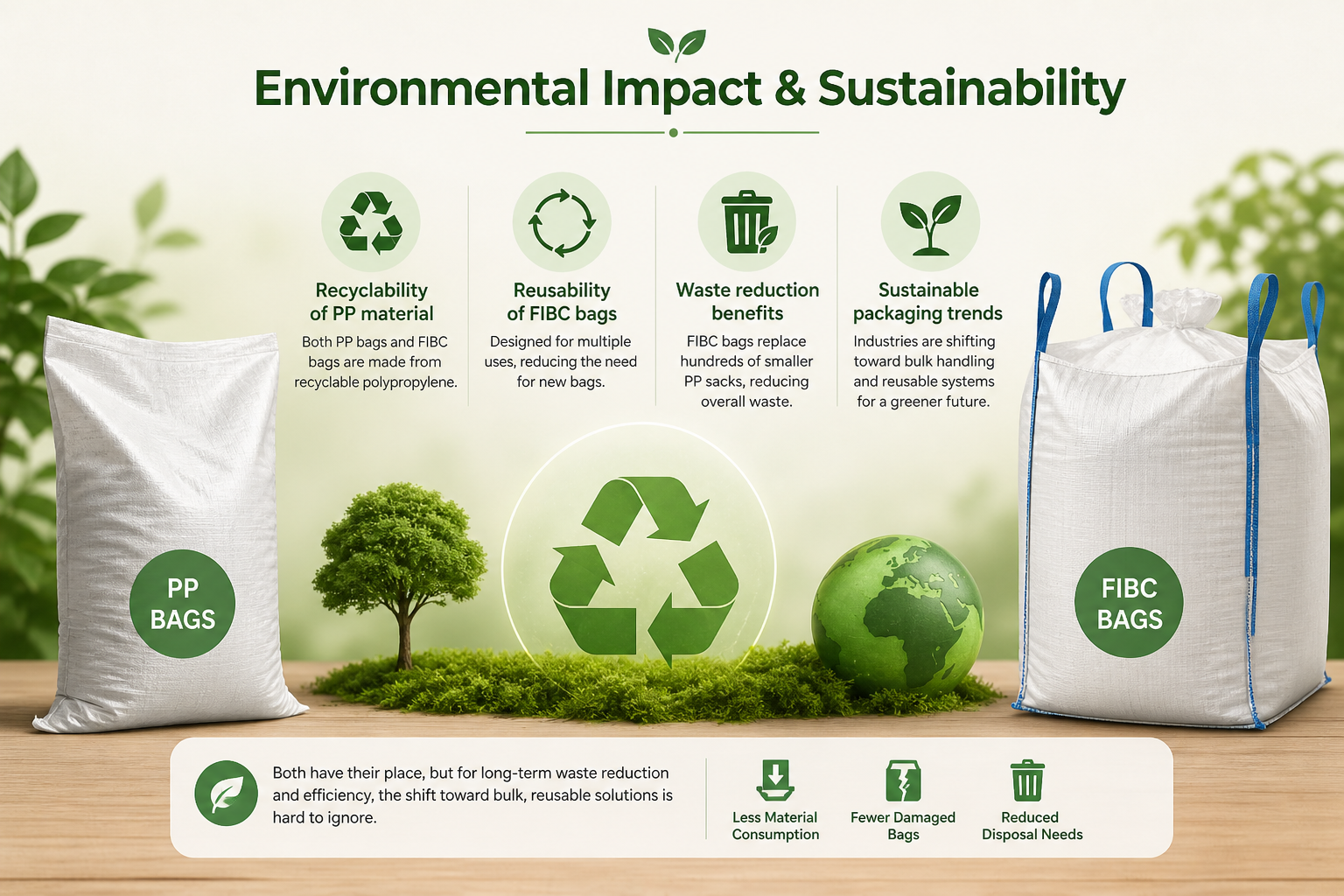
Sustainability isn’t just a buzzword anymore—it’s a real factor in packaging decisions. When comparing PP Bags vs FIBC Bags, both options have their pros, but the impact depends on how you use them.
Recyclability of PP material
Both PP bags and FIBC bags are made from polypropylene, which is recyclable. That’s a solid starting point. Used bags can be reprocessed into new plastic products, reducing the need for virgin material. The catch? Proper collection and recycling systems need to be in place. Without that, even recyclable materials can end up as waste.
Reusability of FIBC bags
This is where FIBC bags get an edge. Many of them are designed for multiple uses, especially those with higher safety ratings. Instead of disposing of packaging after one cycle, businesses can reuse the same bag several times. Over the long run, that significantly cuts down material consumption.
Waste reduction benefits
In the PP Bags vs FIBC Bags comparison, fewer units often mean less waste. FIBC bags can replace hundreds of smaller PP sacks for the same volume of material. That translates to less packaging overall, fewer damaged bags, and reduced disposal needs.
Sustainable packaging trends
More industries are now moving toward bulk handling and reusable systems. It’s not just about saving costs—it’s about reducing environmental footprint. While PP bags still play a vital role, especially in smaller operations, FIBC bags align better with large-scale sustainability goals.
In the end, both have their place. But if your focus is long-term waste reduction and efficiency, the shift toward bulk, reusable solutions is hard to ignore.
How to Choose Between PP Bags and FIBC Bags
By now, the PP Bags vs FIBC Bags debate probably feels less confusing—and more like a practical decision. Because it really comes down to how your business operates day to day.
Start with quantity. If you’re handling smaller loads and frequent shipments, PP bags keep things simple and flexible. But if you’re moving materials in bulk, FIBC bags save time and effort by reducing the number of units you deal with.
Next, think about your budget vs long-term cost. PP bags are cheaper upfront, no question. But if labor, time, and storage are eating into your margins, FIBC bags might actually be the smarter investment over time.
Then there’s infrastructure. Do you have forklifts or cranes? If yes, FIBC bags can transform your efficiency. If not, PP bags are the more practical choice for manual handling. Also consider storage space—bulk bags can help you organize and store large quantities far more efficiently.
One mistake I’ve seen often is businesses choosing based only on price. In reality, the right choice depends on your workflow, not just your budget. In the PP Bags vs FIBC Bags comparison, the best option is the one that fits seamlessly into how you move, store, and ship your products.
Final Thoughts: Choosing the Right Packaging Solution
At the end of the day, the choice between PP Bags vs FIBC Bags isn’t about which one is better—it’s about which one fits your operation. Both serve a purpose, and both can either simplify your workflow or complicate it, depending on how you use them.
If your business runs on smaller quantities, frequent handling, and flexibility, PP bags are reliable, cost-effective, and easy to manage. But if you’re dealing with bulk materials, larger volumes, and want to streamline logistics, FIBC bags bring efficiency, strength, and long-term value to the table.
The smartest approach? Look beyond just the price tag. Think about how you handle, store, and move your goods every day. Because in the PP Bags vs FIBC Bags decision, the right choice isn’t the cheapest or the strongest—it’s the one that works seamlessly for your business.
Common Questions About PP Bags vs FIBC Bags (People Also Ask)
1. What is the main difference between PP bags and FIBC bags?
The main difference in PP Bags vs FIBC Bags comes down to capacity and usage. PP bags are designed for smaller loads and manual handling, while FIBC bags are built for transporting large quantities using machinery like forklifts or cranes.
2. Are FIBC bags reusable?
Yes, many FIBC bags are reusable, especially those designed with higher safety factors. They can be used multiple times if handled properly, making them a cost-effective and more sustainable option for bulk operations.
3. Which is better for export packaging?
It depends on shipment size. PP bags work well for smaller, segmented shipments, while FIBC bags are ideal for bulk exports where efficiency and reduced handling are priorities.
4. Can PP bags carry heavy loads?
PP bags are strong, but they have limits. They typically handle up to 50 kg comfortably. For heavier loads, FIBC bags are a safer and more efficient choice.
5. Are FIBC bags cost-effective for small businesses?
Not always. If you’re dealing with small volumes and don’t have access to handling equipment, PP bags are usually more practical. FIBC bags become cost-effective when you scale up operations.