Introduction
When you buy packaging in bulk, a small difference in the PP Woven Bag Price can quickly become a big number on the final purchase order. A few extra grams of material, a custom print, a laminated surface or a different bag size can all change what you pay. That makes understanding the cost structure far more useful than simply comparing two quotations.
PP woven bags remain popular across agriculture, chemicals, construction materials, food products, animal feed and industrial packaging because they combine strength, relatively low weight and practical handling. However, manufacturers rarely use one universal price because every specification changes the production equation. If you are researching packaging options, start by understanding the different PP woven bag solutions available before comparing supplier quotations.
In 2026, buyers also need to look beyond the headline figure. Resin prices, bag dimensions, GSM, weaving requirements, printing, coating, order volume and delivery terms can all influence the final PP Woven Bag Price. I always recommend treating a quotation as a specification-based calculation rather than assuming the cheapest number represents the best deal.
What Is the PP Woven Bag Price Based On?
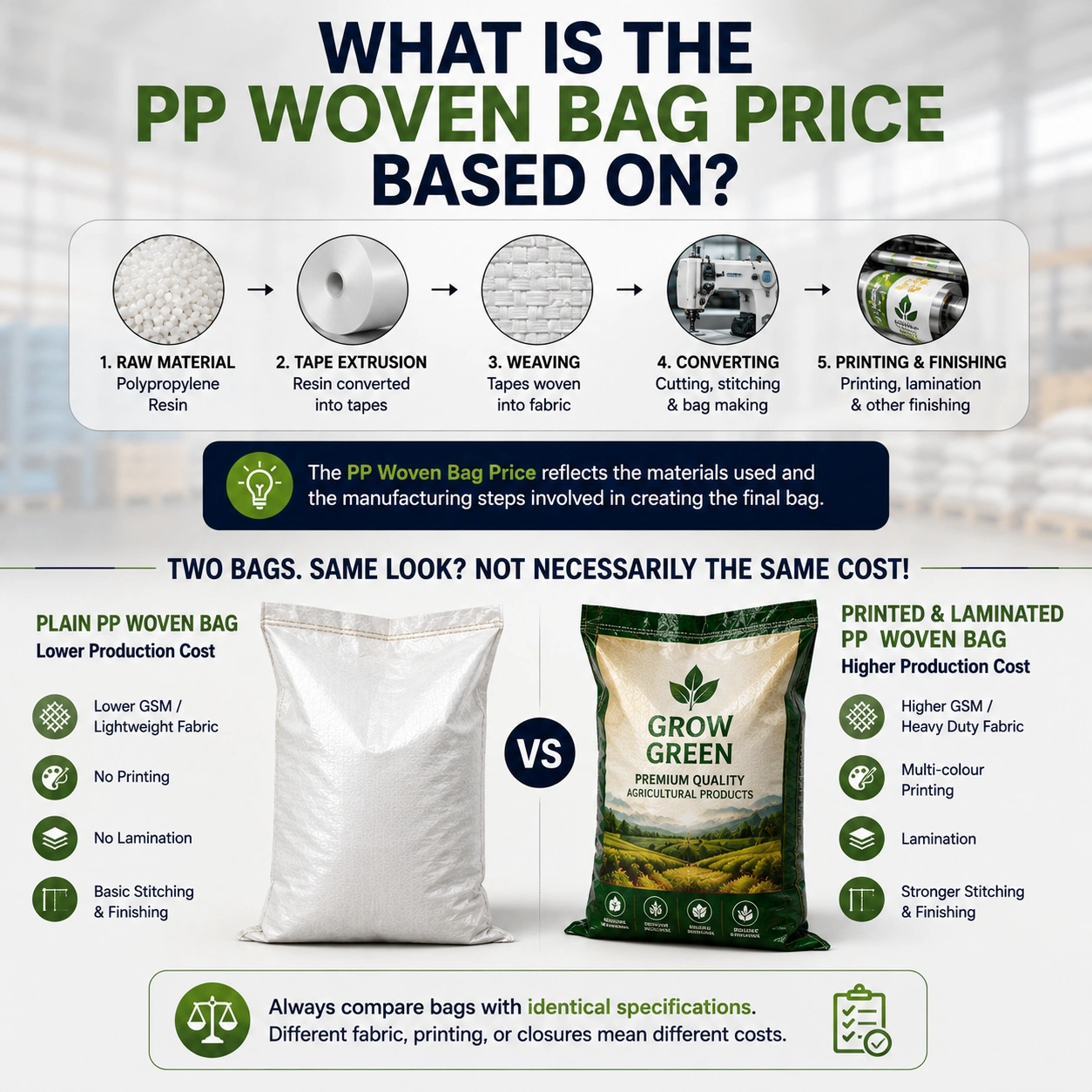
The PP Woven Bag Price primarily reflects the materials and manufacturing steps required to produce the finished bag. Polypropylene resin forms the starting point, but the manufacturer then converts that material into tapes, weaves the tapes into fabric, cuts and stitches the bags, and may add printing, lamination or other finishing processes.
That means two bags that look almost identical can have different production costs. A lightweight agricultural sack, for example, may require less polypropylene than a heavy-duty industrial sack. Similarly, a plain bag normally requires fewer production stages than a multi-colour printed and laminated design.
The most useful approach involves comparing bags with identical specifications. If one supplier quotes a lower price but offers a thinner fabric, fewer printing colours or a different closure system, the comparison is not really like-for-like.
How Polypropylene Resin Affects PP Woven Bag Cost
Polypropylene resin represents one of the most important components of manufacturing cost. Manufacturers convert polypropylene into flat tapes before weaving those tapes into fabric. Therefore, changes in resin pricing can eventually influence the PP Woven Bag Price offered to buyers.
Market conditions can move resin costs because of factors such as crude oil prices, petrochemical supply, production capacity and regional demand. However, suppliers may manage these changes differently depending on their purchasing contracts, inventory and manufacturing scale.
For buyers, this creates an important lesson: a quotation should include a clear validity period. A price that looks attractive today may not remain unchanged for a long period if material costs move significantly.
Does GSM Change the PP Woven Bag Price?
Yes. GSM, or grams per square metre, indicates the weight of the woven fabric. In simple terms, higher GSM generally means more polypropylene goes into the fabric, which can increase manufacturing cost and the PP Woven Bag Price.
However, higher GSM does not automatically mean a better bag for every application. A buyer transporting lightweight products may gain little from paying for unnecessarily heavy fabric. On the other hand, demanding applications such as construction materials or heavy industrial products may require stronger fabric and better seam performance.
The smart move involves selecting the lowest practical specification that still meets your handling, filling, storage and transportation requirements. Over-specifying can waste money, while under-specifying can create damaged bags and product losses.
Typical GSM considerations
- Lower GSM: suitable for lighter applications where extreme strength is unnecessary.
- Medium GSM: useful for many agricultural and general-purpose packaging applications.
- Higher GSM: better suited to heavier products and demanding handling conditions.
The exact GSM should always match the intended application rather than a generic “stronger is better” assumption.
How Bag Size Influences Pricing
Bag dimensions directly affect material consumption. A larger bag normally needs more woven fabric, while a smaller bag can require less material. Consequently, size forms another important part of the PP Woven Bag Price calculation.
But dimensions involve more than length and width. Buyers should also consider gussets, bottom construction, mouth style, valve arrangements and closure requirements. A bag with additional features can require extra material and production time.
For example, a basic open-mouth sack may cost less than a bag featuring a specialised valve or reinforced construction. If you request quotations, provide exact dimensions and construction details so suppliers can calculate the requirement accurately.
Printed PP Woven Bag Price: Why Custom Printing Costs More
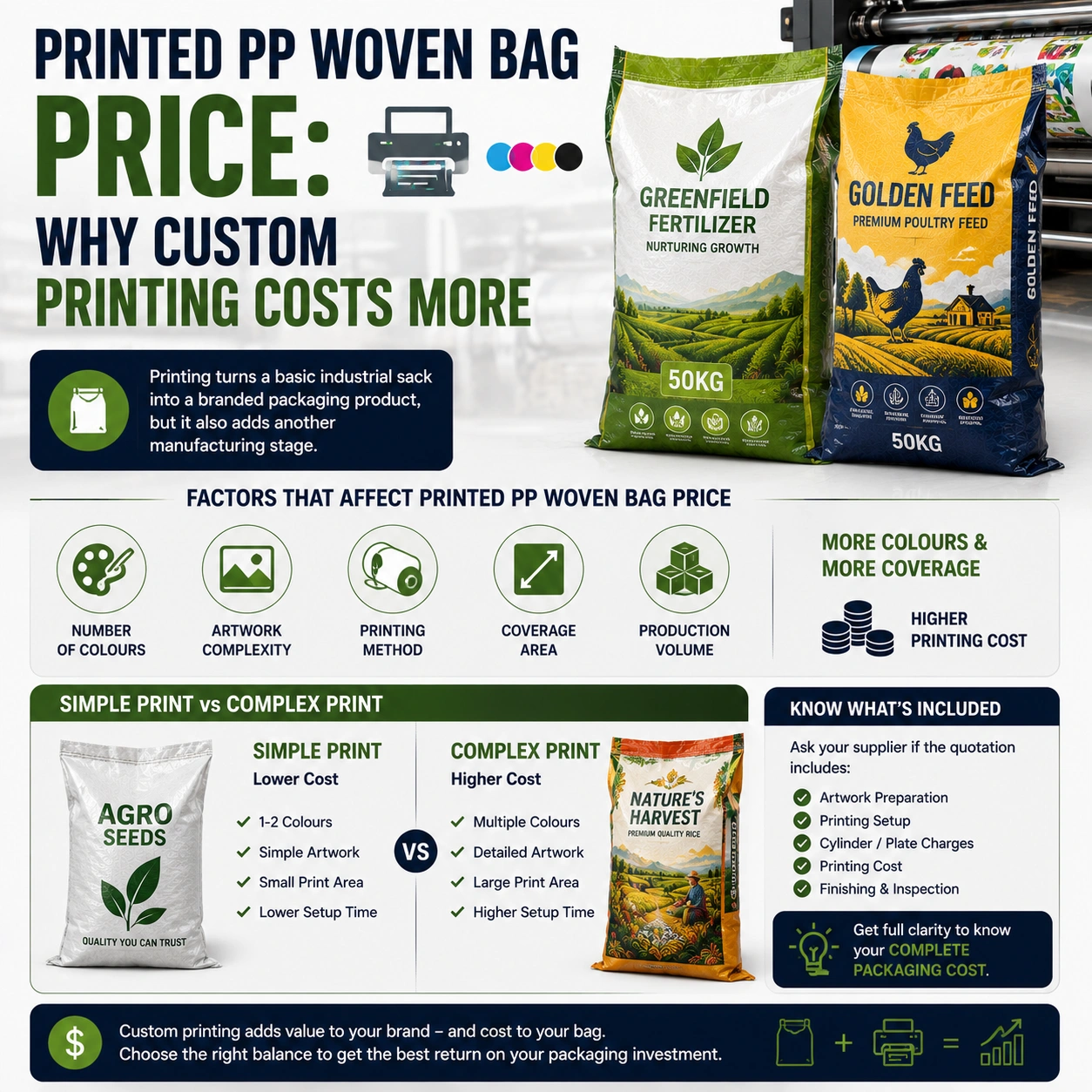
Printing turns a basic industrial sack into a branded packaging product, but it also adds another manufacturing stage. The number of colours, artwork complexity, printing method, coverage area and production volume can influence the printed PP woven bag price.
Simple one-colour identification may require considerably less work than detailed multi-colour branding across a large surface. Artwork preparation and cylinder or printing setup requirements can also affect the economics of smaller production runs.
If branding matters to your business, ask suppliers whether the quotation includes artwork preparation, printing setup and plate-related charges. Otherwise, the initial PP Woven Bag Price may not represent your complete packaging cost.
Laminated PP Woven Bag Price Explained
Lamination adds another layer to woven fabric and can provide useful functional or visual benefits. Depending on the construction, it can improve print quality, surface appearance and resistance to moisture or contamination.
The additional material and manufacturing process can increase the laminated PP woven bag price compared with a standard unlaminated sack. Yet that premium can make financial sense when better product protection reduces losses or when premium branding supports your product positioning.
For moisture-sensitive goods, the right laminated construction may offer more value than simply choosing the cheapest standard sack. Always evaluate the complete application rather than focusing exclusively on the initial purchase price.
Bulk PP Woven Bag Price: Does Quantity Really Matter?
Order volume can have a noticeable effect on unit economics. Larger production runs allow manufacturers to spread setup, artwork, machine preparation and other fixed costs across more bags. As a result, bulk PP woven bag price often becomes more attractive on a per-unit basis.
However, volume alone does not guarantee the lowest overall cost. Storage, cash flow, inventory risk and changing packaging requirements also matter. Ordering 100,000 bags at a lower unit price does not automatically represent a saving if your business only needs 40,000 and must store the remainder for months.
A sensible purchasing strategy balances unit price with actual consumption. If your demand remains predictable, a larger production run may work well. If demand fluctuates, smaller and more frequent orders may provide better inventory control.
PP Woven Sack Price vs Standard PP Woven Bag Price
People often use “PP woven bag” and “PP woven sack” interchangeably, although specifications can vary significantly between products and industries. The important issue remains the actual construction rather than the name printed on the quotation.
A sack designed for cement, fertilizer or animal feed may require different fabric strength, dimensions, closure systems and printing than a bag intended for agricultural produce. Therefore, comparing PP woven sack price without checking specifications can produce misleading results.
Before accepting a quotation, compare material weight, dimensions, construction, printing, lamination, stitching and packaging requirements. That gives you a genuine specification-to-specification comparison.
Understanding PP Bag Manufacturing Cost
PP bag manufacturing cost includes more than raw material. Labour, electricity, machinery, weaving, cutting, stitching, printing, lamination, quality control, packaging and factory overheads all contribute to the final figure.
Production efficiency also matters. A manufacturer with modern equipment and high production capacity may achieve better output efficiency than a smaller operation. However, efficiency should never replace quality control. A low-cost production process means little if inconsistent dimensions or weak seams cause problems after delivery.
This is where supplier evaluation becomes important. Ask about quality checks, production capability and consistency rather than judging the supplier exclusively on price.
Custom PP Woven Bag Price: What Should You Specify?
Custom packaging gives you greater control over the finished product, but every additional specification can affect cost. Before requesting a custom quotation, prepare a clear technical brief.
Include the required bag dimensions, approximate weight or GSM, product weight, fabric construction, printing requirements, lamination, colour, closure type and expected order quantity. The more precise your brief, the easier it becomes for manufacturers to provide an accurate PP Woven Bag Price.
A good supplier should also ask questions rather than simply send a number. If your intended application involves heavy filling, outdoor storage, stacking or long-distance transport, mention those conditions from the beginning.
What About MOQ and Setup Costs?
Minimum order quantity, commonly called MOQ, can strongly influence custom packaging economics. Manufacturers need to allocate production time and prepare equipment, so very small orders may carry higher unit costs.
Custom printing can make this especially noticeable. Setup expenses remain relatively similar whether you produce a small or large batch, which means larger runs generally spread those expenses more efficiently.
If you only need a modest quantity, ask whether the supplier can offer a standard design or existing production specification. That approach may reduce setup costs while still delivering suitable packaging.
A Practical Way to Compare PP Woven Bag Quotations
When you receive three supplier quotations, resist the temptation to highlight the lowest figure immediately. Instead, place each quotation against the same specification.
| Cost factor | Why it matters |
|---|---|
| GSM | Influences material usage and fabric strength |
| Bag size | Changes fabric consumption |
| Printing | Adds artwork and production requirements |
| Lamination | Adds material and processing |
| Closure | Can increase construction complexity |
| Quantity | Affects setup and unit economics |
| Packaging | Changes handling and shipping requirements |
| Delivery | Influences the landed cost |
This method makes the PP Woven Bag Price easier to evaluate because you can see what each supplier actually includes.
How to Reduce Your Overall Packaging Cost
Lowering cost does not always mean demanding the lowest unit price. In many cases, better specification control creates bigger savings.
Start by reviewing whether your current bag uses more material than necessary. If the application does not require very high GSM, a correctly engineered lighter construction may reduce material consumption. You can also review printing coverage, colours, lamination and special finishing.
Order planning can help as well. Predictable demand may allow you to negotiate better bulk pricing, while standardising bag sizes across product lines can simplify purchasing and inventory management.
A manufacturer such as Oberon Polypack can also help buyers evaluate product requirements against practical performance expectations rather than focusing only on the initial quotation.
Quality Should Always Be Part of the Price Discussion
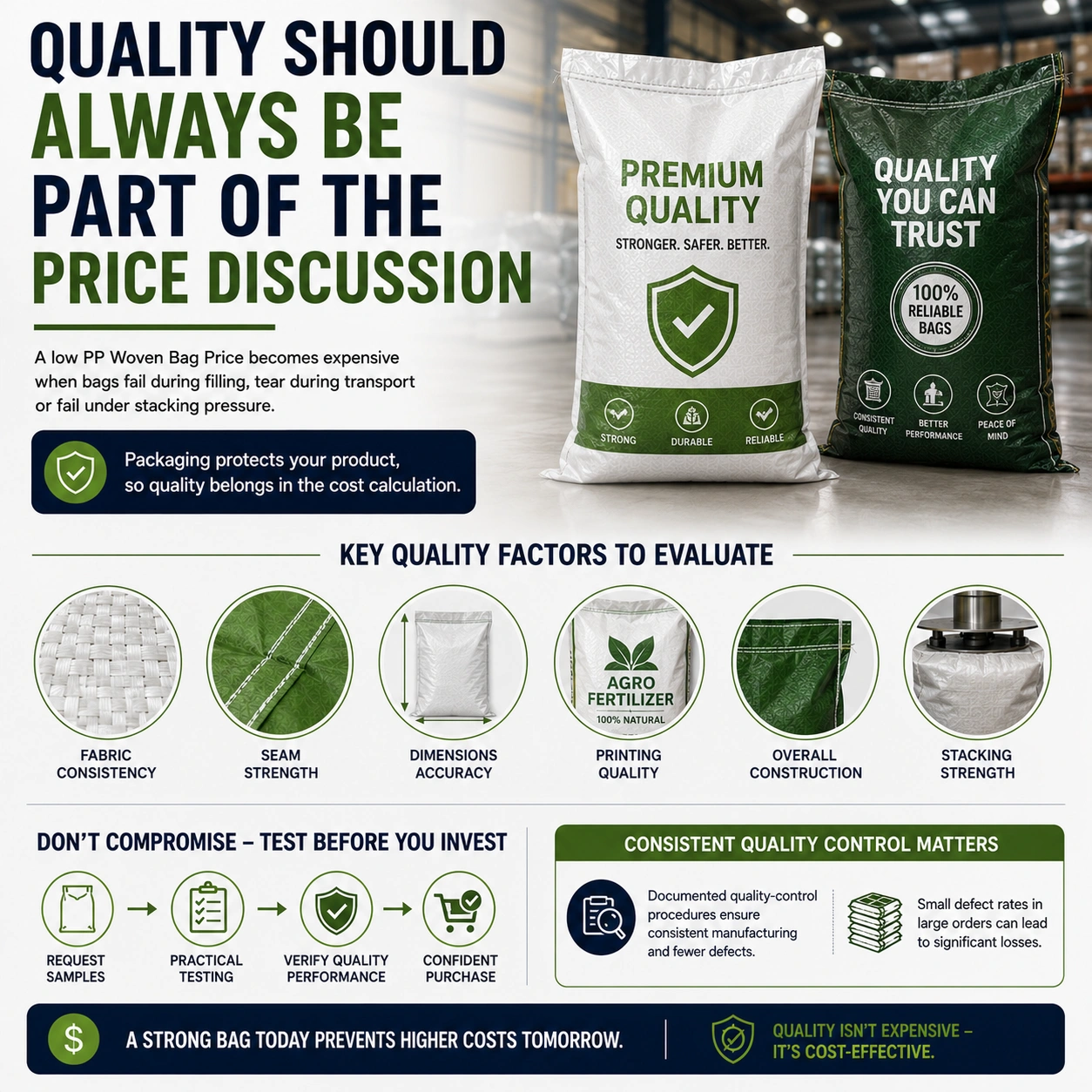
A low PP Woven Bag Price becomes expensive when bags split during filling, tear during transport or fail under stacking pressure. Packaging protects your product, so quality belongs in the cost calculation.
Look at fabric consistency, seam strength, dimensions, printing quality and overall construction. For critical applications, request samples and conduct practical testing before committing to a large order.
I also recommend checking whether the supplier follows documented quality-control procedures. Consistent manufacturing matters particularly when you order large quantities because a small defect rate can become a substantial number of unusable bags.
How Global Shipping Can Change the Final Cost
International buyers should calculate landed cost rather than comparing factory prices alone. Freight, insurance, duties where applicable, port charges, local transport and handling can all affect the final amount paid.
A supplier offering a slightly higher factory PP Woven Bag Price may still provide a better overall deal if they offer efficient packing, reliable production and favourable logistics. Conversely, an exceptionally cheap quotation may lose its advantage once transportation and associated costs enter the calculation.
Always ask whether a quotation represents an ex-factory, FOB, CIF or delivered price. The terminology can significantly change the number you should use for purchasing decisions.
Common Mistakes Buyers Make
One of the biggest mistakes involves comparing quotations based solely on price per bag. Without checking GSM, dimensions, printing and construction, you may compare completely different products.
Another common issue involves ordering excessive quantities simply to obtain a lower unit price. Storage costs and unused inventory can erase the apparent savings.
Finally, avoid treating samples as optional when you plan a significant purchase. A sample gives you an opportunity to inspect construction, dimensions, printing and handling characteristics before you commit to full-scale production.
How to Get a More Accurate PP Woven Bag Price
The easiest way to receive a useful quotation involves giving the manufacturer complete specifications from the start. Tell them what product you will pack, the approximate filling weight, required dimensions, desired GSM, printing requirements, lamination preference, quantity and destination.
If you already have a sample or technical drawing, share it with the supplier. Physical references can remove ambiguity and reduce the chance of receiving a quotation based on assumptions.
You should also request clarification about what the quoted PP Woven Bag Price includes. Ask about packaging, setup charges, taxes, freight and any additional tooling or printing expenses. A transparent quotation helps you calculate the real purchasing cost.
Conclusion
The right PP Woven Bag Price depends on much more than a single number on a quotation. GSM, polypropylene consumption, dimensions, printing, lamination, construction, order quantity, quality control and logistics can all influence the final cost. By comparing identical specifications and considering total landed cost, you can make a much more informed purchasing decision.
If you are planning a new packaging order or want to review your existing specifications, now is a good time to turn those requirements into a clear buying brief. Contact Oberon Polypack to discuss your application, specifications and expected volume, and request a quotation based on the bag you actually need rather than a generic price.
FAQs
1. What is the biggest factor affecting PP Woven Bag Price?
Material consumption usually plays a major role, so GSM, dimensions and construction can have a significant effect. However, printing, lamination, quantity, production requirements and logistics can also influence the final price.
2. Does higher GSM always mean a better PP woven bag?
Not necessarily. Higher GSM generally adds material and can increase strength, but the correct specification depends on the product being packed and the conditions the bag will experience. Over-specifying the bag can increase costs without providing useful benefits.
3. Why does bulk PP woven bag pricing tend to be lower?
Large orders can spread fixed production and setup costs across more units. Manufacturers may also achieve better production efficiency during longer runs. However, buyers should balance lower unit costs against storage requirements and actual demand.
4. Is a laminated PP woven bag worth the additional cost?
It can be worthwhile when the application benefits from improved surface protection, moisture resistance or better print performance. The right choice depends on your product, storage environment, transport conditions and branding requirements.
5. How can I compare PP woven bag suppliers fairly?
Give each supplier the same technical specification and compare GSM, dimensions, construction, printing, lamination, quantity, packaging and delivery terms. Samples and quality checks can then help you confirm that the quoted products actually meet your requirements.