.webp)
Automated filling and packing lines depend on consistent bag dimensions, reliable opening, stable positioning and suitable closure characteristics. Choosing the wrong packaging format can lead to filling interruptions, product leakage, rejected bags and avoidable production delays.
PP woven bags for automated filling must be selected according to the filling machine, product characteristics, required bag capacity, fabric construction and final closure process. A bag that works well during manual packing may not necessarily perform reliably on an automated line.
Quick answer: How do you choose PP woven bags for automated filling lines?
Choose bags that match your machine's approved dimensions, bag-loading and opening mechanism, filling method and closure equipment. Assess fabric construction, GSM, seam strength, surface friction and product compatibility. Then test representative samples under actual production conditions before approving bulk orders. The final specification should be agreed between the packaging supplier and filling-equipment team.
What Are PP Woven Bags for Automated Filling?
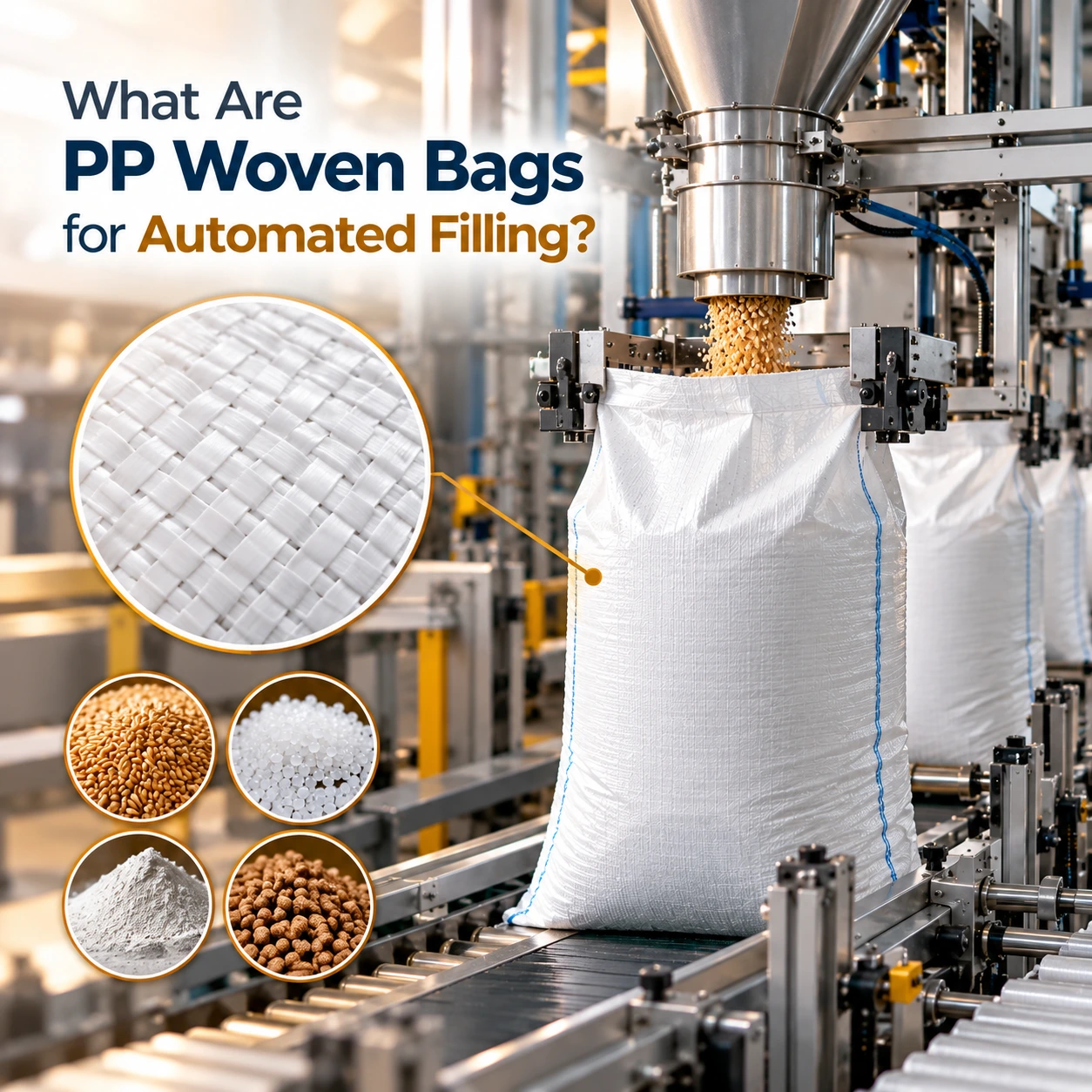
PP woven bags are packaging sacks manufactured from woven polypropylene tapes. The tapes form a fabric structure that can provide strength and flexibility for transporting and storing industrial materials, agricultural products, food grains and other packaged goods.
PP woven bags for automated filling are designed or specified to work with equipment that positions, opens, fills, transfers and closes bags with limited manual intervention. Compatibility depends on the bag construction and the design of the particular machine.
Automated packaging systems may use bag magazines, suction cups, mechanical grippers, bag clamps, weighing systems, filling spouts, conveyors and sewing or sealing equipment. Each component places different demands on the packaging.
For example, an automatic open-mouth bagging machine may require a bag with a predictable mouth shape and sufficient stiffness for reliable opening. A valve-filling system requires a different bag format and filling interface.
Buyers can explore Oberon Polypack's PP woven bags and packaging products when evaluating packaging options for their applications.
Why Does Bag Compatibility Matter in Automated Packaging?
Automated equipment operates through repeatable mechanical movements. Variation in bag dimensions, opening behaviour or surface characteristics can interfere with those movements.
A bag that is too narrow for the filling spout, too long for the handling arrangement or inconsistent in its mouth construction may not position correctly. Similarly, unsuitable friction characteristics can affect bag separation, gripping and conveying.
The resulting symptoms may include:
- Bags failing to open consistently or separating incorrectly from a magazine.
- Bags slipping, skewing or becoming misaligned during positioning.
- Product escaping around the filling interface.
- Unstable filled bags that are difficult to transfer or stack.
- Bags that cannot be closed properly by the installed sewing or sealing system.
These symptoms do not automatically prove that the bag is defective. Machine settings, worn gripping components, filling-spout alignment, product flow and operator adjustments can also contribute to interruptions.
For that reason, PP woven bags for automated filling should be evaluated as part of the complete packaging system rather than as an isolated material purchase.
What Factors Should You Check Before Choosing PP Woven Bags?
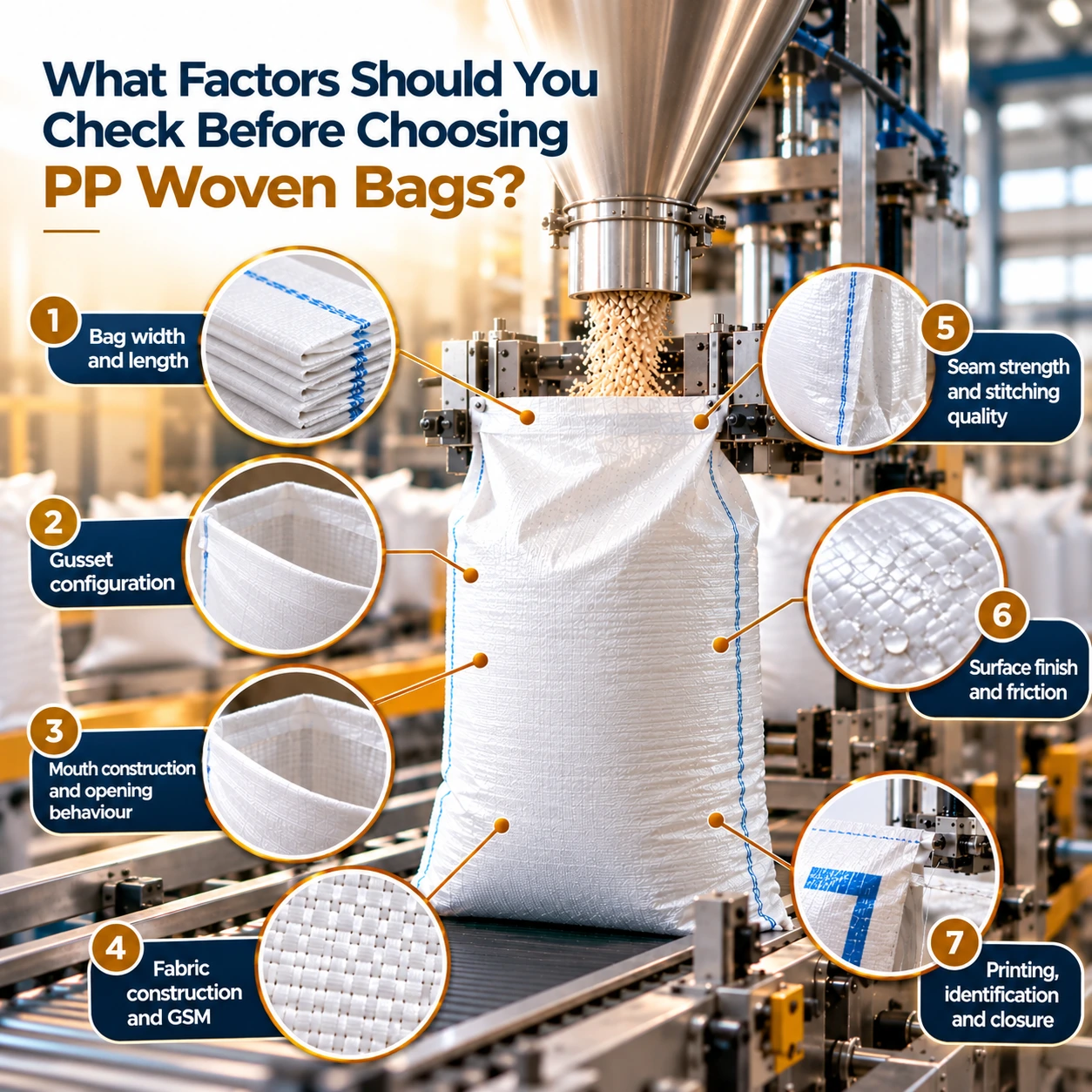
The most reliable selection process begins with the filling machine's requirements and works backwards to the bag specification. Do not select a bag solely because its nominal capacity or material appears suitable.
1. Bag width and length
Bag dimensions determine whether the packaging can be picked up, opened, positioned, filled and transferred correctly.
Width affects the relationship between the bag mouth and the filling spout. Length influences bag handling, the position of the filled product and the space available for closure. Dimensional variation between individual bags can be just as important as the nominal measurements.
Obtain the machine manufacturer's permitted bag dimensions and tolerances. Confirm how the dimensions are measured, including whether the bag is flat, gusseted or otherwise constructed.
2. Gusset configuration
A gusset is a folded section of material that allows the bag to expand or form a different shape when filled. Depending on the design, gussets can influence the bag's profile, opening behaviour, filled shape and stacking characteristics.
However, gussets should not be added simply because they improve the appearance of a filled bag. The design must suit the equipment's gripping, opening and transfer arrangements.
3. Mouth construction and opening behaviour
The bag mouth must work with the machine's bag-opening method. Some systems use suction to separate bag layers, while others use mechanical grippers or a bag clamp.
Consider the mouth finish, lip or cuff configuration where applicable, material stiffness, layer separation and any coatings or lamination that could influence handling.
PP woven bags for automatic packing machines should be tested for consistent opening across multiple samples, not just one carefully selected bag.
4. Fabric construction and GSM
GSM refers to grams per square metre and describes fabric mass per unit area. It is a useful specification, but it does not independently establish bag strength or machine compatibility.
Fabric performance also depends on tape characteristics, weave construction, material quality, coating or lamination, and the way the finished bag is manufactured.
A heavier fabric may affect stiffness, flexibility and the way a bag moves through handling equipment. A lighter fabric may be suitable for one application but insufficient for another.
Specify the required fabric properties and finished-bag performance rather than selecting GSM in isolation.
5. Seam strength and stitching quality
The seams must withstand the forces generated during filling, lifting, conveying, stacking and transportation. A suitable fabric cannot compensate for an inadequate seam.
Inspect stitching consistency, seam placement, loose threads, skipped stitches and the integrity of the bag's bottom construction. Where heat sealing or welding is used, verify the relevant seal construction and acceptance criteria.
The required seam performance depends on the filled weight, product properties, bag design and handling conditions.
6. Surface finish and friction
The surface of a bag affects how it separates from neighbouring bags, engages with gripping components and travels along conveyors.
A finish that works with one machine may behave differently on another. Lamination, coatings, printing coverage and fabric texture can all influence handling.
Discuss surface requirements with the equipment manufacturer and validate them through trials. Avoid assuming that either a smoother or rougher finish will always provide better performance.
7. Printing, identification and closure
Printed graphics, product identification, batch codes and regulatory information should remain legible and correctly positioned after filling and handling. The print layout must not interfere with gripping areas, sensors or closure zones.
Closure compatibility is equally important. Sewing, heat sealing and other closure methods have different material and construction requirements. Confirm the intended closure process before finalising the bag design.
How Do Product Characteristics Affect Bag Selection?
The material inside the bag influences the appropriate construction, filling method and protection requirements.
Powders can generate airborne dust and may require a filling arrangement that controls product escape. Their flow behaviour can change with particle characteristics, moisture content and bulk density. The bag's mouth and filling interface must suit the selected dust-control measures.
Granules and pellets may flow more freely but can still create uneven loading, impact forces and local stress during filling. The bag must accommodate the expected product weight and handling conditions without unacceptable seam or fabric damage.
Bulk density also matters. Two products with the same weight can occupy different volumes, affecting the filled bag's shape and dimensions. Buyers should therefore provide both the target fill weight and relevant product information.
Before specifying PP woven bags for automated filling, document the product type, particle size where relevant, bulk density, moisture sensitivity, dust characteristics and any special protection requirements.
For products that require additional surface protection or improved print presentation, buyers may also evaluate BOPP laminated bags. The suitability of lamination depends on the product and filling system; it should not be assumed to improve every automated application.
Which PP Woven Bag Type Is Suitable for Different Filling Lines?
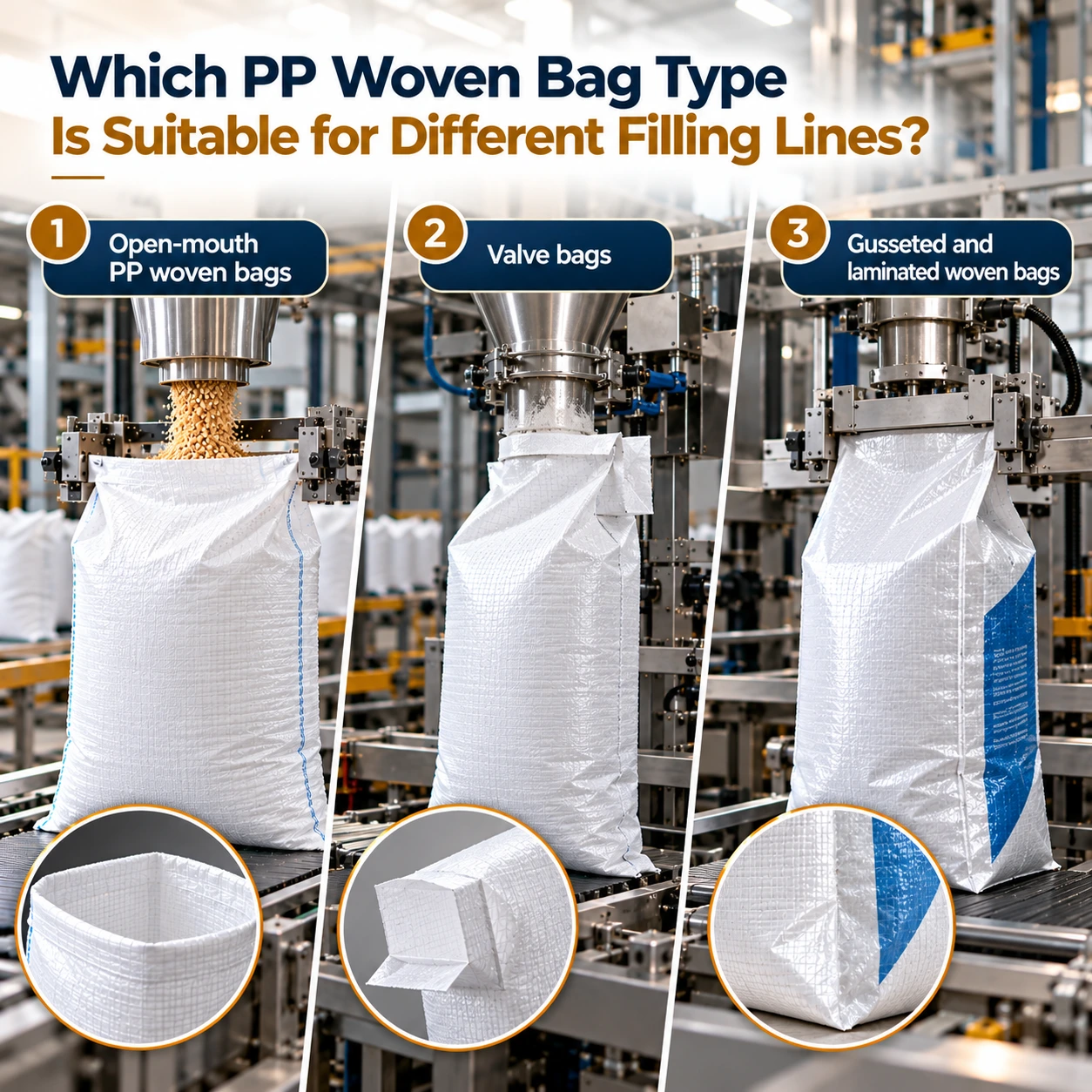
The right format depends on how the machine introduces the product into the bag and how the bag is subsequently closed.
Open-mouth PP woven bags
Open-mouth bags have an opening at the top through which the product is introduced. They can be used with compatible manual, semi-automatic and automatic filling arrangements.
Automatic systems may hold the bag at a clamp or filling spout before releasing it to the closure stage. Buyers should verify the mouth dimensions, opening characteristics, gripping area and required closure allowance.
This format can be appropriate for products such as grains, granules, feed and various industrial materials when the equipment is designed for open-mouth bags.
Valve bags
Valve bags have a designated filling opening or valve through which the product enters. The valve arrangement must match the filling spout and the product's flow characteristics.
These bags are used in certain powder and granular-material applications, including some construction-material packaging systems. Their suitability depends on the valve design, filling method, material properties and closure requirements.
Not every valve bag is suitable for every filling machine, and a conventional open-mouth bag cannot be treated as an interchangeable replacement without checking the equipment design.
Gusseted and laminated woven bags
Gusseted bags may be considered where a particular filled shape, stacking arrangement or machine-handling profile is required. Laminated woven bags may be appropriate where surface protection, moisture resistance or print quality is important.
These features must be assessed alongside the bag-opening and filling mechanism. A feature that benefits storage or presentation may introduce different stiffness or friction characteristics during automated handling.
| Bag format or feature | Potential application | Main compatibility checks |
|---|---|---|
| Open-mouth woven bag | Compatible open-mouth filling lines | Mouth opening, clamp fit, dimensions and closure |
| Valve woven bag | Filling systems designed for valve bags | Valve geometry, spout fit, flow and sealing |
| Gusseted bag | Applications requiring a particular filled profile | Gusset dimensions, opening and transfer stability |
| Laminated woven bag | Applications requiring additional surface protection or improved printing | Stiffness, friction, layer separation and closure |
| Non-laminated woven bag | Applications suited to an unlaminated woven surface | Fabric strength, product protection and handling behaviour |
These are general selection guidelines, not a guarantee of compatibility. Confirm the final bag format against the actual equipment specification.
PP Woven Bag Selection Checklist for Automated Filling Lines
Before requesting quotations, prepare a specification that defines the machine requirements, product requirements and finished-bag acceptance criteria.
| Selection factor | What to verify | Why it matters |
|---|---|---|
| Dimensions | Width, length, gussets and agreed tolerances | Supports consistent positioning and handling |
| Opening | Mouth construction and opening behaviour | Helps the machine pick up and open each bag |
| Fabric | GSM, weave, tape properties and construction | Supports the required strength and handling characteristics |
| Seams | Stitching, seam position and required strength | Helps reduce seam failure and leakage |
| Surface finish | Texture, coating, lamination and friction | Influences gripping, separation and conveying |
| Product compatibility | Weight, bulk density, particle size and protection needs | Matches the bag to the contents |
| Filling interface | Spout, clamp, valve or other connection | Helps ensure reliable filling |
| Closure | Sewing, sealing or other specified method | Supports consistent final closure |
| Identification | Printing, batch information and label placement | Supports traceability and product identification |
| Quality acceptance | Inspection method, tolerances and trial criteria | Establishes a consistent basis for approval |
Practical checks before approving the specification
Obtain the filling machine's manual or approved bag specification, including dimensional tolerances.
Provide the supplier with the product type, target fill weight, required bag format and closure method.
Agree on fabric, seam and finished-bag requirements before production.
Request representative samples and conduct trials using the intended machine.
Record the acceptance criteria and resolve any issues before authorising a bulk order.
The aim is to turn a general packaging requirement into a measurable specification that both the supplier and the production team can follow.
What Problems Can the Wrong Bags Cause?
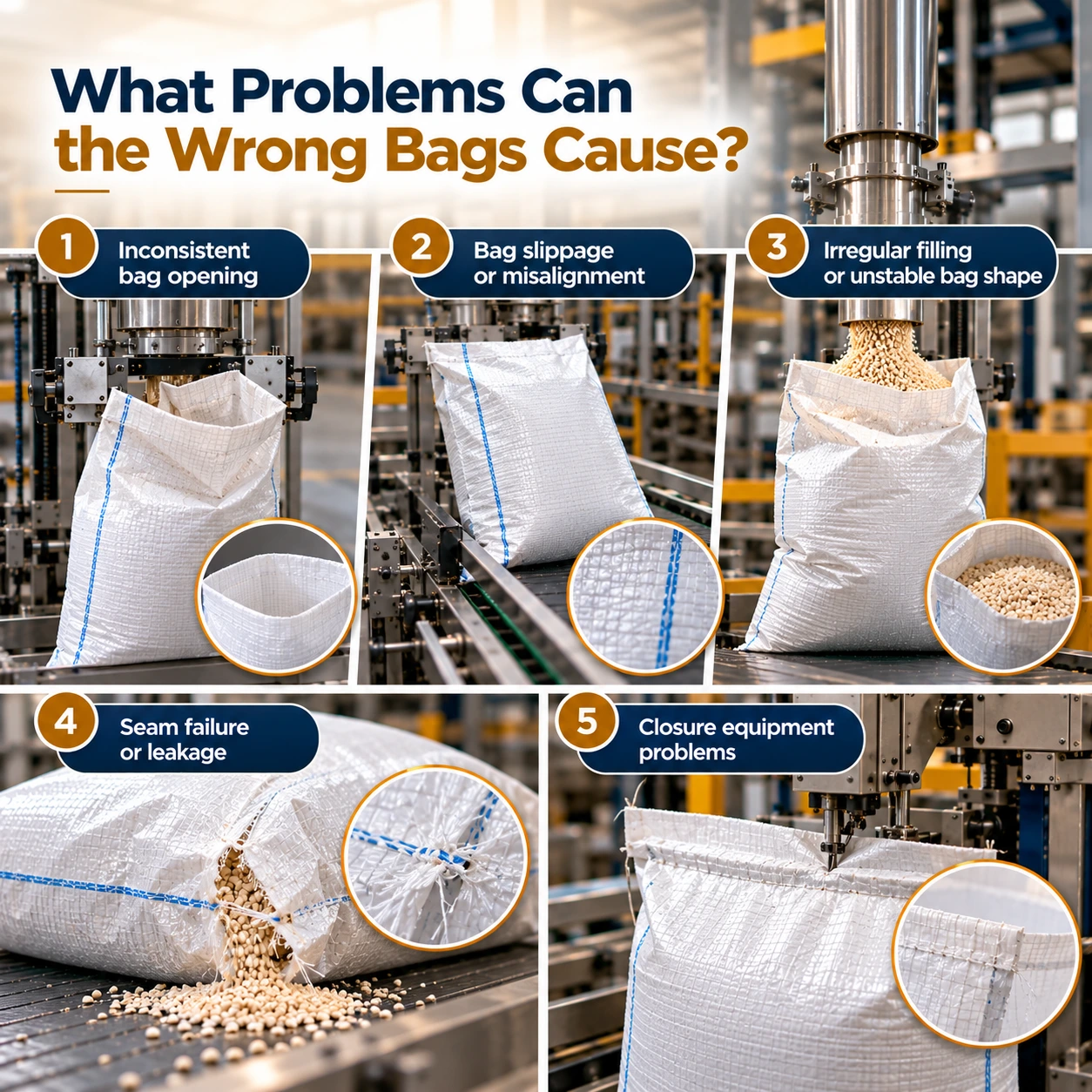
Bag-related problems should be investigated systematically because similar symptoms can have different causes.
Inconsistent bag opening: Check mouth construction, dimensional variation, bag separation, suction or gripping performance and machine settings.
Bag slippage or misalignment: Review surface friction, gripping pressure, bag positioning, conveyor conditions and the consistency of the finished dimensions.
Irregular filling or unstable bag shape: Check product flow, filling-spout alignment, target weight, bag dimensions and how the product settles during filling.
Seam failure or leakage: Inspect fabric condition, seam construction, stitching or sealing quality, and stresses introduced during filling and handling.
Closure equipment problems: Confirm that the closure allowance, material construction, mouth finish and bag dimensions match the sewing or sealing equipment.
These checks help separate packaging-related causes from machine-related causes. Any corrective action should follow the results of inspection and testing rather than an assumption that the bag is solely responsible.
How Should You Test PP Woven Bags Before Bulk Ordering?
Sample testing is essential because drawings and material specifications cannot fully predict how bags will behave on a particular production line.
Begin with a documented sample specification. Check the dimensions, construction, fabric properties, mouth finish, seams and closure allowance against the agreed requirements. Where appropriate, request test reports for relevant properties.
Next, conduct trials under representative production conditions. Use the intended filling equipment, product, operating settings and closure process. Observe bag pickup, opening, positioning, filling, transfer and closure. Include enough samples to reveal variation rather than relying on a single successful run.
Inspect the filled bags for leakage, seam damage, shape consistency and closure quality. Conduct handling or stacking checks appropriate to the actual distribution process.
Agree on acceptance criteria before testing. These may cover dimensional tolerances, required strength, visual defects, filling compatibility and closure performance. Record the trial conditions and results so that the approved sample and production specification remain traceable.
Where changes are made to fabric, dimensions, lamination, seams or bag design, reassess whether additional trials are needed. A change that appears minor to a supplier may affect the behaviour of the complete packaging system.
For relevant food-grain applications, buyers may consult ISO 23560:2015, which specifies general characteristics, requirements and test methods for woven polypropylene sacks with capacities of 25 kg or 50 kg intended for foodstuffs such as cereals, sugar and pulses. Its scope is specific; it should not be treated as a universal standard for every product or automated filling application.
How to Work With a PP Woven Bags Manufacturer
A detailed enquiry helps a supplier assess the required construction and identify questions that need to be resolved before production.
Share the following information in your request for quotation:
- Product name, physical characteristics and target fill weight.
- Filling machine manufacturer and model, where available.
- Required bag format, dimensions and permitted tolerances.
- Fabric construction, GSM or other agreed material requirements.
- Required seam design, closure method and surface finish.
- Printing artwork, identification requirements and any applicable product standards.
- Order quantity, delivery destination, packaging requirements and expected schedule.
Ask the supplier to confirm which specifications can be met, which details require technical approval and whether sample bags are available for line trials. Provide the machine manufacturer's bag requirements whenever possible.
A supplier should not confirm machine compatibility based only on a nominal bag size or product weight. Final approval should reflect the actual equipment, product and agreed acceptance criteria.
Oberon Polypack supplies PP woven bags, woven polypropylene fabric and BOPP laminated bags for industrial and commercial packaging applications. Buyers can review the product range and discuss their requirements directly with the company through its official enquiry page.
Conclusion: Choose Bags Around the Complete Packaging Process
Selecting PP woven bags for automated filling requires more than matching a bag to a target weight. Dimensions, mouth construction, fabric properties, seams, surface finish, product characteristics and closure requirements all influence whether the bag will work reliably with the intended equipment.
The most dependable approach is to obtain the machine specification, document the product and packaging requirements, agree on measurable acceptance criteria and test representative samples before placing a bulk order.
For businesses evaluating PP woven bags for automated filling, Oberon Polypack can be contacted to discuss the required bag format, dimensions, material construction and order specifications. Share your equipment details and product requirements to begin a practical packaging assessment.
Contact Oberon Polypack to discuss your packaging requirements.
Frequently Asked Questions
1. Can standard PP woven bags be used on automated filling lines?
Sometimes. Standard PP woven bags may work if their dimensions, mouth construction, surface characteristics, strength and closure requirements match the machine. Testing representative bags on the intended line is the most reliable way to confirm suitability.
2. How do I determine the correct bag dimensions for my filling machine?
Start with the machine manufacturer's approved bag dimensions and tolerances. Consider the filling-spout size, gripping arrangement, mouth opening, filled-bag shape and closure allowance. Confirm the dimensions with physical samples before approving production.
3. Does GSM determine whether a bag is suitable for automated filling?
No. GSM measures fabric mass per unit area, but it does not independently establish strength, opening behaviour or machine compatibility. Weave construction, tape properties, seams, dimensions and surface finish must also be considered.
4. Which is better for automated filling: open-mouth bags or valve bags?
Neither is universally better. Open-mouth bags suit equipment designed to clamp and fill an open bag, while valve bags require a compatible valve-filling arrangement. The product, filling method and closure process determine the appropriate format.
5. How can bag slippage be reduced during automated packaging?
Inspect the bag's surface characteristics, dimensional consistency, gripping areas and interaction with the conveyor. Also review clamp settings, machine alignment and component condition. Trial any bag or machine adjustments under representative operating conditions.
6. Why should sample bags be tested before a bulk order?
Samples reveal how the bags behave during pickup, opening, filling, conveying and closure. Trials can identify compatibility problems that may not be apparent from drawings or specifications alone, helping buyers resolve issues before committing to a large order.
7. What specifications should I send to a PP woven bags manufacturer?
Provide the product type, target fill weight, bag dimensions, required format, filling machine details, fabric and seam requirements, closure method, printing needs, order quantity and destination. Include the machine manufacturer's approved bag specification if available.