Fertilizer may look harmless sitting in a warehouse, but the packaging carrying it has a demanding job. Bags can face heavy filling weights, stacking pressure, rough handling, humidity, dust and long-distance transportation before the product reaches its final destination. Choosing the right sack is therefore about much more than finding something that holds the required number of kilograms.
PP Woven Bags for Fertilizer Packaging are widely used because woven polypropylene combines strength, relatively low weight and flexible manufacturing options. Oberon Polypack lists fertilizers among the heavy and bulk materials its PP woven bags are designed to package, with options for different sizes, GSM, denier, mesh, lamination and moisture protection.
What Are PP Woven Bags for Fertilizer Packaging?
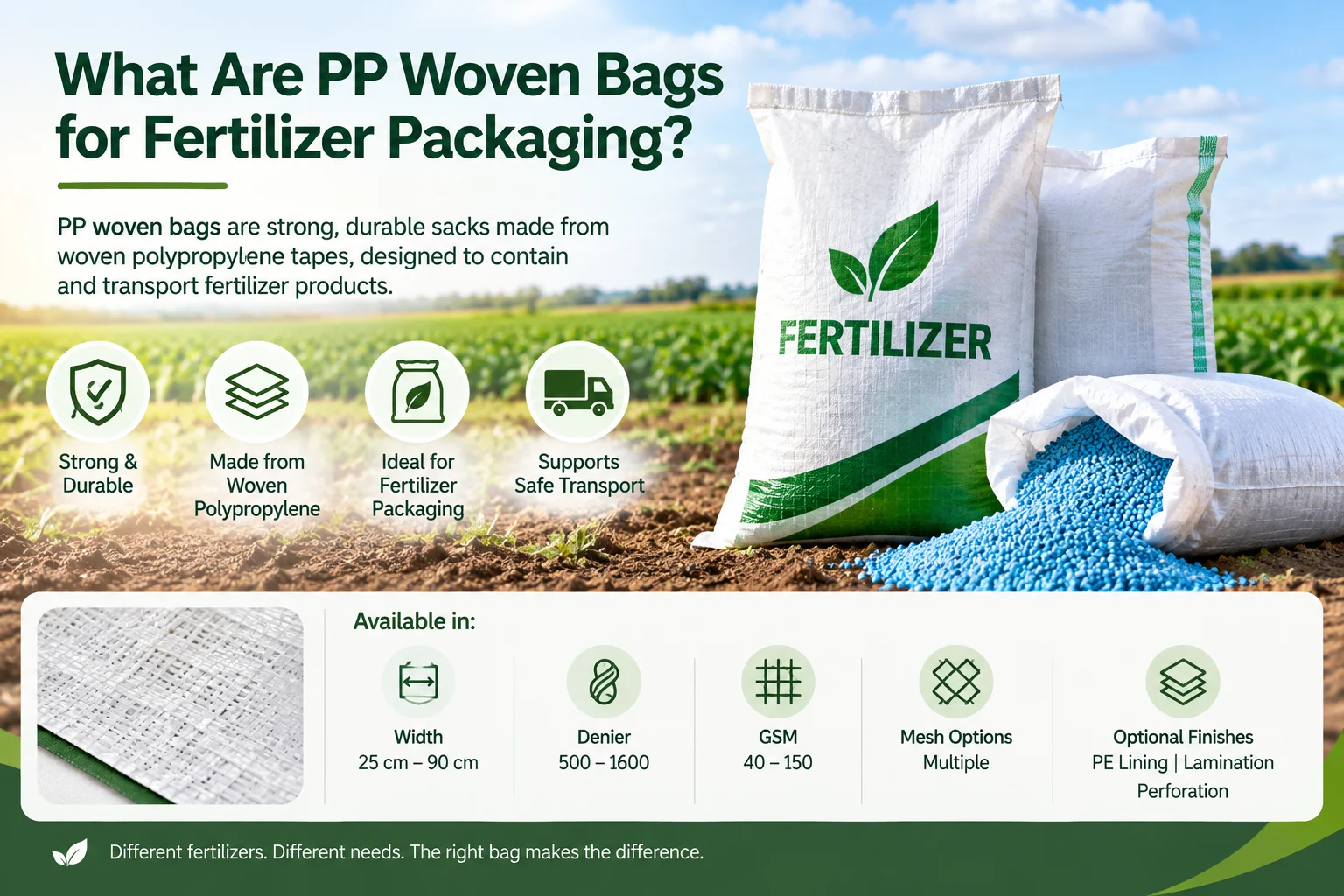
PP Woven Bags for Fertilizer Packaging are sacks manufactured from woven polypropylene tapes and designed to contain and transport fertilizer products. The tapes are woven together to create a fabric structure that provides the mechanical properties needed for bulk packaging.
The bags can be produced in different dimensions, fabric weights, weave constructions and finishes depending on the fertilizer and the supply chain. For example, a bag intended for granular fertilizer may have different requirements from one used for a finer powder.
The finished construction matters just as much as the polymer itself. Fabric quality, stitching, bag dimensions, lamination and optional inner liners can all influence how the package performs during filling, storage and transportation.
Oberon Polypack currently lists PP woven bags in widths from 25 cm to 90 cm, with 500–1600 denier, 40–150 GSM, multiple mesh options and optional PE lining, lamination and perforation.
Why PP Woven Fertilizer Bags Are Widely Used
Fertilizer packaging has to balance several requirements at once. The bag needs to carry the product without excessive stretching or tearing, remain practical to handle and protect the contents from conditions encountered during storage and transportation.
PP woven fertilizer bags offer a useful combination of strength and flexibility. The woven structure helps the fabric withstand handling, while polypropylene provides a lightweight material base suitable for bulk packaging.
For fertilizer manufacturers and distributors, consistency is also important. A bag specification that works during one production run should continue to perform consistently across larger orders.
Oberon's published product information identifies agriculture and fertilizers among the applications for its PP woven bags and highlights tensile strength, load-bearing capacity and options for moisture and dust resistance.
8 Key Features to Consider Before Buying Fertilizer Bags
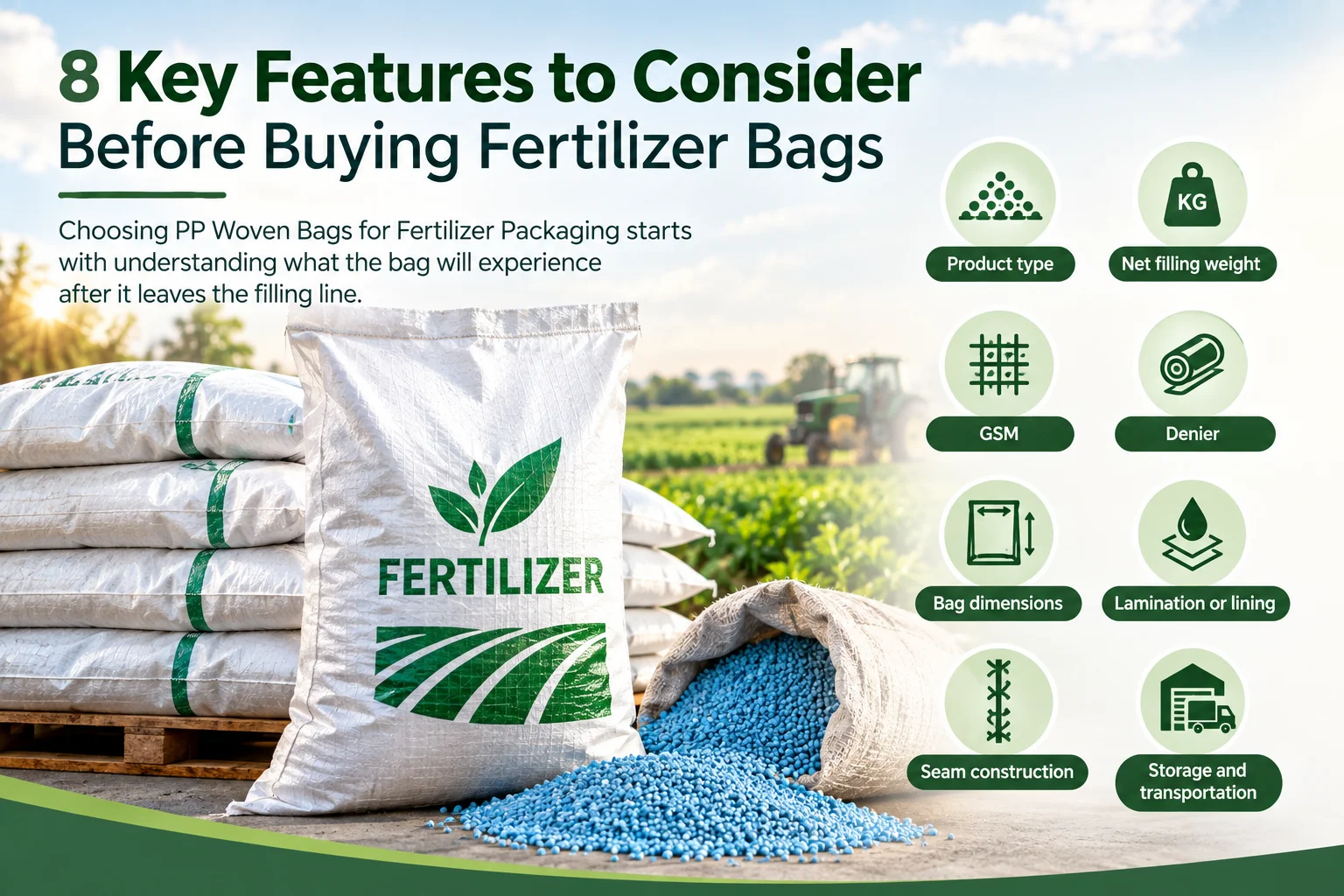
Choosing PP Woven Bags for Fertilizer Packaging starts with understanding what the bag will experience after it leaves the filling line.
- Product type: Identify whether the fertilizer is granular, powdered, blended or another formulation.
- Net filling weight: Define the exact weight required per bag.
- GSM: Select an appropriate fabric weight based on the complete packaging requirement.
- Denier: Consider the polypropylene tape specification and its relationship to fabric construction.
- Bag dimensions: Make sure the size suits both product volume and filling equipment.
- Lamination or lining: Consider additional protection when moisture, dust or contamination is a concern.
- **Seam construction: **The finished bag needs stitching appropriate for the expected load and handling.
- Storage and transportation: Account for stacking, warehouse conditions, outdoor exposure and shipping distance.
A good specification sheet brings these details together instead of treating the bag as a generic commodity.
Fertilizer Bag Specifications: Start With the Product
One of the biggest mistakes buyers make is choosing fertilizer bag specifications before defining the product itself.
A fertilizer's density, particle size and physical form can affect how much space the product occupies and how it behaves during filling. Two products with the same net weight may not require identical packaging if their physical characteristics are different.
The filling process matters too. Automated filling lines may impose different requirements from manual filling, particularly around bag dimensions, mouth construction and production consistency.
Before requesting quotations, provide the supplier with the product type, target weight, approximate bulk density, required bag dimensions and intended handling conditions.
That information gives the manufacturer a much stronger basis for recommending the bag construction.
GSM and Strength in PP Woven Fertilizer Sacks
GSM is one of the most frequently discussed specifications when buying PP woven fertilizer sacks. It describes the weight of the woven fabric per square metre.
However, higher GSM should not automatically be interpreted as "stronger bag." Fabric performance is influenced by several variables, including tape denier, weave density, raw-material quality, manufacturing consistency and finished-bag construction.
Oberon Polypack currently lists PP woven bag fabric from 40 to 150 GSM and denier from 500 to 1600, allowing specifications to be matched to different applications.
For procurement teams, the practical approach is to evaluate GSM alongside tensile performance, dimensions, stitching and the actual weight being packed.
How Denier Affects Fertilizer Bag Strength
Denier describes the thickness of the polypropylene tape used in the woven fabric. It is an important part of the material specification, but it should not be used as a standalone indicator of finished-bag strength.
A suitable fertilizer bag strength specification depends on the relationship between denier, weave, GSM and manufacturing quality. The finished sack also introduces seams and other structural points that need to withstand the expected load.
This is particularly important when fertilizer bags are filled to higher weights or moved repeatedly through warehouses and distribution centres.
Rather than asking a supplier for "the highest denier available," buyers should explain the application and ask for a construction designed around the required load and handling conditions.
Moisture Protection for Fertilizer Packaging
Moisture can be an important consideration in fertilizer storage. Depending on the fertilizer formulation and storage environment, exposure to humidity can affect the product and its handling characteristics.
This is where fertilizer packaging solutions may include lamination or an internal PE liner. Oberon Polypack lists both PE lining and laminated/coated options for its PP woven bags, with its product information describing these features as options for moisture and environmental protection.
The right choice depends on the product and storage conditions. A buyer should consider whether bags will remain indoors, move through humid environments or spend time in less controlled storage areas.
It is also worth remembering that no packaging construction should be assumed to provide unlimited moisture protection. The bag design needs to be evaluated against the actual environment.
Laminated PP Fertilizer Bags: When Are They Useful?
Laminated PP fertilizer bags have an additional polymer layer applied to the woven fabric. This can alter the bag's surface characteristics and provide an additional barrier against external moisture and dust.
For fertilizer applications, lamination can be useful when the packaging needs greater protection than unlaminated woven fabric can provide. It can also create a smoother surface for certain printing and branding requirements.
However, lamination is not automatically required for every fertilizer product. If the application is primarily focused on ventilation, handling or cost efficiency, an unlaminated construction may be more appropriate.
The decision should therefore be made around the product and supply-chain conditions rather than treating lamination as a universal upgrade.
PP Woven Bags for Granular Fertilizer
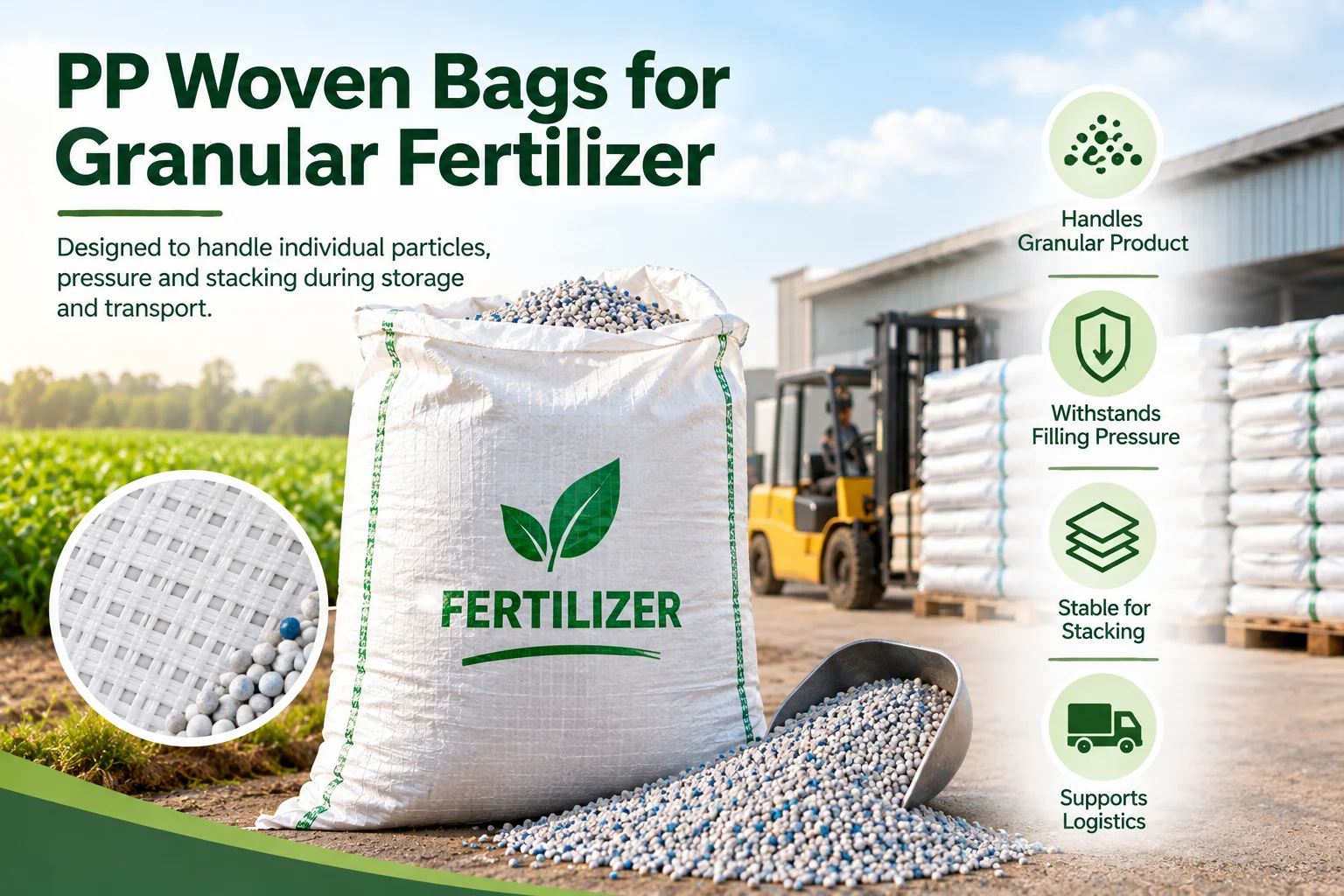
PP woven bags for granular fertilizer need to cope with individual particles moving and settling inside the package. During filling, the product can place pressure on the fabric and seams. During stacking, the bags also experience compression from the layers above.
Bag dimensions should therefore provide enough room for the required filling weight without creating an awkward or unstable package.
The filling system should also be considered. Automated equipment may require specific bag dimensions, mouth configurations or stitching arrangements.
A well-designed fertilizer sack is essentially part of the filling and logistics system. It should not be specified separately from the way the fertilizer is packed and transported.
What About Powdered Fertilizer?
Powdered materials can introduce different packaging considerations because fine particles can migrate through small openings and create dust during handling.
For these applications, polypropylene fertilizer bags may be combined with liners or other construction features depending on the product and required containment.
The appropriate solution depends on particle size, filling method, storage environment and the desired level of dust and moisture protection.
If the fertilizer is particularly fine or reactive, buyers should give the manufacturer detailed product information rather than simply ordering a standard woven sack.
Fertilizer Bag Strength and Load Requirements
A fertilizer bag is subjected to more than its static filling weight.
During filling, the product pushes outward against the fabric. When the bag is lifted, the load is transferred through the fabric and seams. During stacking, the lower bags experience additional compression. Transportation adds vibration and movement to the equation.
This is why fertilizer bag strength needs to be considered as a complete packaging characteristic.
Oberon Polypack describes its PP woven bags as having high load-bearing and tear strength and identifies fertilizers among the heavy materials for which its bags are suitable.
For large orders, buyers should provide the intended filling weight, stacking arrangement, handling method and transport conditions so the supplier can recommend an appropriate construction.
How Bag Dimensions Affect Fertilizer Packaging
A bag that is technically strong can still be poorly suited to the application if its dimensions are wrong.
Bag width and length influence filling efficiency, product distribution and stacking stability. The dimensions also need to work with the machinery used to fill and close the sacks.
For fertilizer packaging bags, consistency between bag dimensions and filling equipment can save time on the production floor. It can also make palletising and warehouse handling more predictable.
Before approving a bulk order, confirm the finished bag dimensions against the actual filling line and product volume.
Bulk Fertilizer Bags and Storage Conditions
Bulk fertilizer bags may spend weeks or months moving through warehouses, distribution centres and agricultural supply chains. During that time, the packaging can be exposed to stacking pressure, handling and changes in environmental conditions.
For storage involving sunlight, UV-stabilised material may be worth discussing with the manufacturer. Oberon's export information lists optional UV stabilisation for woven packaging intended for storage or transport involving sunlight and outdoor conditions.
Storage configuration matters too. Bags should be stacked according to the product, packaging design and warehouse safety requirements rather than assuming that every sack can be stacked indefinitely.
PP Woven Fertilizer Bags vs Laminated Options
| Feature | Unlaminated PP woven bag | Laminated PP woven bag |
|---|---|---|
| Woven structure | Yes | Yes |
| External coating | No | Yes |
| Moisture barrier | More limited | Enhanced |
| Dust protection | Depends on construction | Generally improved |
| Surface finish | Woven texture | Smoother coated surface |
| Printing potential | Suitable for selected applications | Can provide a smoother print surface |
| Typical consideration | Cost and breathability | Additional protection |
| Best selection basis | Product and environment | Product and moisture/dust requirements |
Neither construction is automatically better for every fertilizer. The correct option depends on how the fertilizer will be filled, stored and transported.
Fertilizer Packaging Requirements for International Supply Chains
When fertilizer is sold internationally, packaging may need to deal with longer transportation routes and more varied environmental conditions.
The buyer should consider container loading, palletising, warehouse storage, handling equipment, exposure to humidity and possible outdoor storage.
Fertilizer packaging requirements should therefore be discussed before production rather than after the bags are manufactured.
For export orders, also clarify dimensions, printing, labelling, documentation and quality expectations in the purchase specification.
Oberon Polypack states that it serves more than 60 export countries and provides customised woven packaging solutions for agricultural and industrial applications.
How to Choose a PP Woven Bag Supplier for Fertilizer
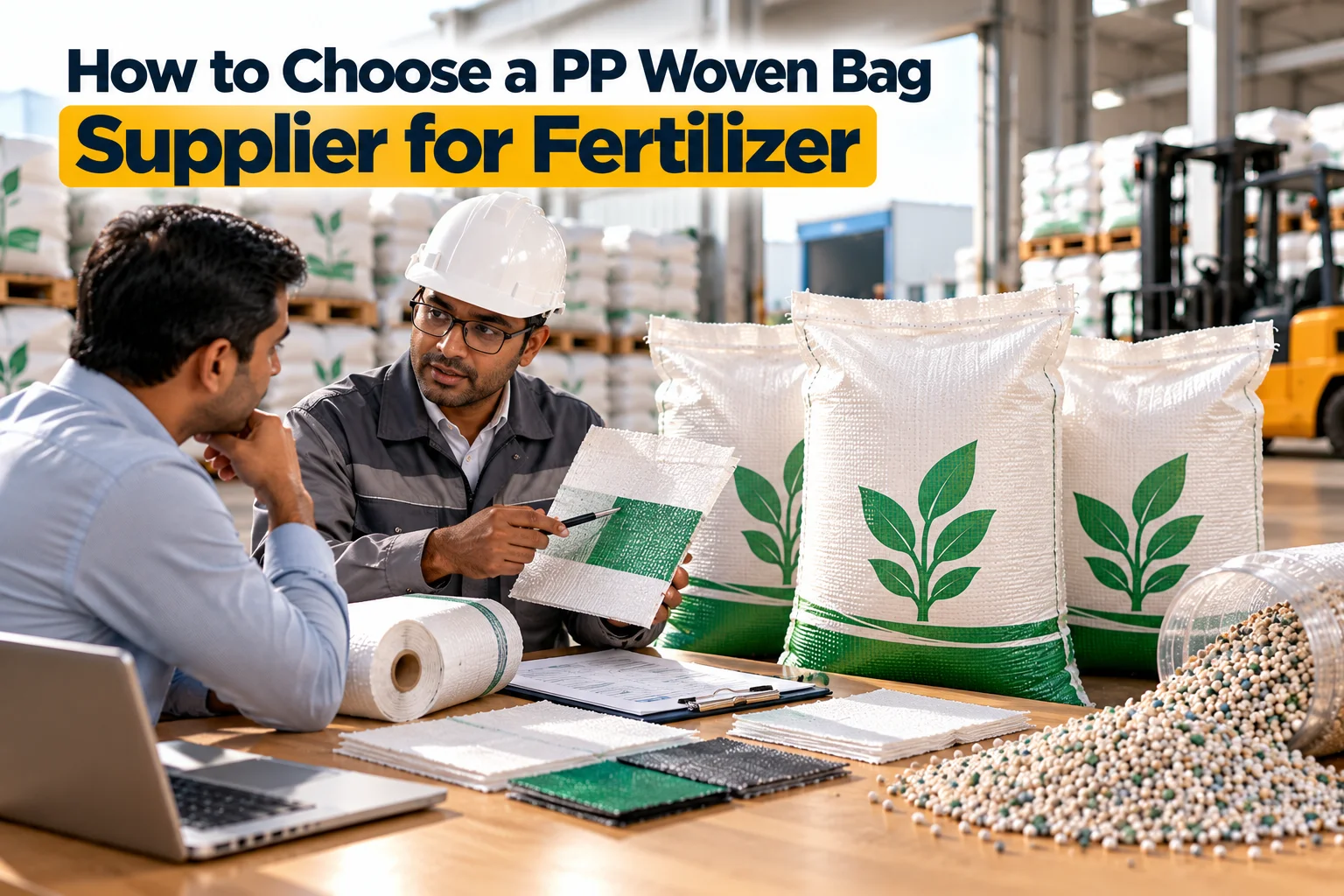
The right supplier should be able to talk about your fertilizer rather than simply quote a standard sack.
Ask about GSM, denier, weave, dimensions, stitching, lamination, PE lining and optional UV stabilisation. Explain the filling weight and how the bags will be handled after production.
It is also useful to ask about manufacturing consistency and quality control. Large fertilizer orders can involve thousands of bags, so small variations repeated across a production run can become expensive.
Oberon Polypack describes its PP woven bags as customisable in size, colour, finish and other specifications and states that it provides technical support for selecting packaging according to business requirements.
Common Mistakes When Buying Fertilizer Packaging Bags
One common mistake is choosing the lowest-cost bag without comparing the complete specification. A cheaper bag may not provide the construction needed for the required filling weight or storage conditions.
Another is assuming that the highest GSM automatically provides the best performance. GSM is useful, but it is only one part of the finished bag specification.
Buyers can also overlook moisture requirements. If fertilizer will be stored in humid environments, the difference between an unlaminated bag and a bag with an appropriate liner or coating may become important.
Finally, changing the product weight after approving a sample can create problems. If the filling weight, product density or handling conditions change, the packaging specification should be reviewed before production continues.
Fertilizer Bag Buyer Checklist
Before placing an order for PP Woven Bags for Fertilizer Packaging, confirm:
| Requirement | Buyer should specify |
|---|---|
| Fertilizer type | Granular, powder, blended or other |
| Net weight | Exact filling weight per bag |
| Product density | Approximate bulk density |
| Bag dimensions | Width and length |
| Fabric | GSM and denier |
| Weave | Required construction |
| Closure | Stitching/top configuration |
| Moisture protection | Unlaminated, laminated or PE-lined |
| UV exposure | Indoor, outdoor or mixed storage |
| Printing | Number of colours and artwork requirements |
| Quantity | Trial or bulk order |
| Handling | Manual or mechanical |
| Storage | Warehouse, palletised or outdoor |
| Transport | Domestic or international |
This level of detail gives both buyer and manufacturer a much clearer starting point.
Conclusion
Selecting PP Woven Bags for Fertilizer Packaging requires more than choosing a bag that fits the required amount of fertilizer. GSM, denier, weave construction, dimensions, seams, lamination, liners, UV requirements and handling conditions all contribute to the finished packaging performance. The right bag should protect the product while remaining practical to fill, stack, store and transport.
If you are sourcing PP Woven Bags for Fertilizer Packaging for agricultural distribution, fertilizer manufacturing or international bulk supply, define your product and operating conditions before requesting a quotation. contact the Oberon Polypack team to discuss customised fertilizer packaging requirements.
FAQs
1. What are PP woven bags for fertilizer packaging used for?
PP Woven Bags for Fertilizer Packaging are used to contain and transport fertilizers in granular, powdered and other bulk forms. They provide a woven polypropylene structure that can be customised for different weights, dimensions, strength and moisture-protection requirements.
2. Are PP woven bags suitable for granular fertilizer?
Yes. PP woven bags for granular fertilizer are commonly used where the packaging needs to handle bulk product weight and repeated handling. The appropriate fabric and bag construction should be selected according to the fertilizer's weight, density and handling conditions.
3. Do fertilizer bags need lamination?
Not always. Lamination can provide additional moisture and dust protection, but the requirement depends on the fertilizer, storage environment and transportation conditions. Some applications may be adequately served by unlaminated woven bags.
4. What GSM should fertilizer packaging bags have?
There is no universal GSM suitable for every fertilizer. The appropriate GSM depends on the required load, bag dimensions, fabric construction, handling and other specifications. GSM should be selected as part of the complete bag design rather than in isolation.
5. Are polypropylene fertilizer bags moisture resistant?
Polypropylene itself has useful moisture-resistance characteristics, but the finished bag's protection depends on its construction. Lamination or an internal PE liner can provide additional protection where humidity or external moisture is a concern. Oberon lists both options in its PP woven bag specifications.
6. How do I choose the right fertilizer packaging supplier?
Start by giving the supplier complete information about the fertilizer, filling weight, dimensions, storage conditions and handling process. Then compare technical capabilities, customisation, manufacturing consistency, quality control and available moisture-protection options. A supplier that can engineer the bag around the application is generally more useful than one offering only standard sizes.