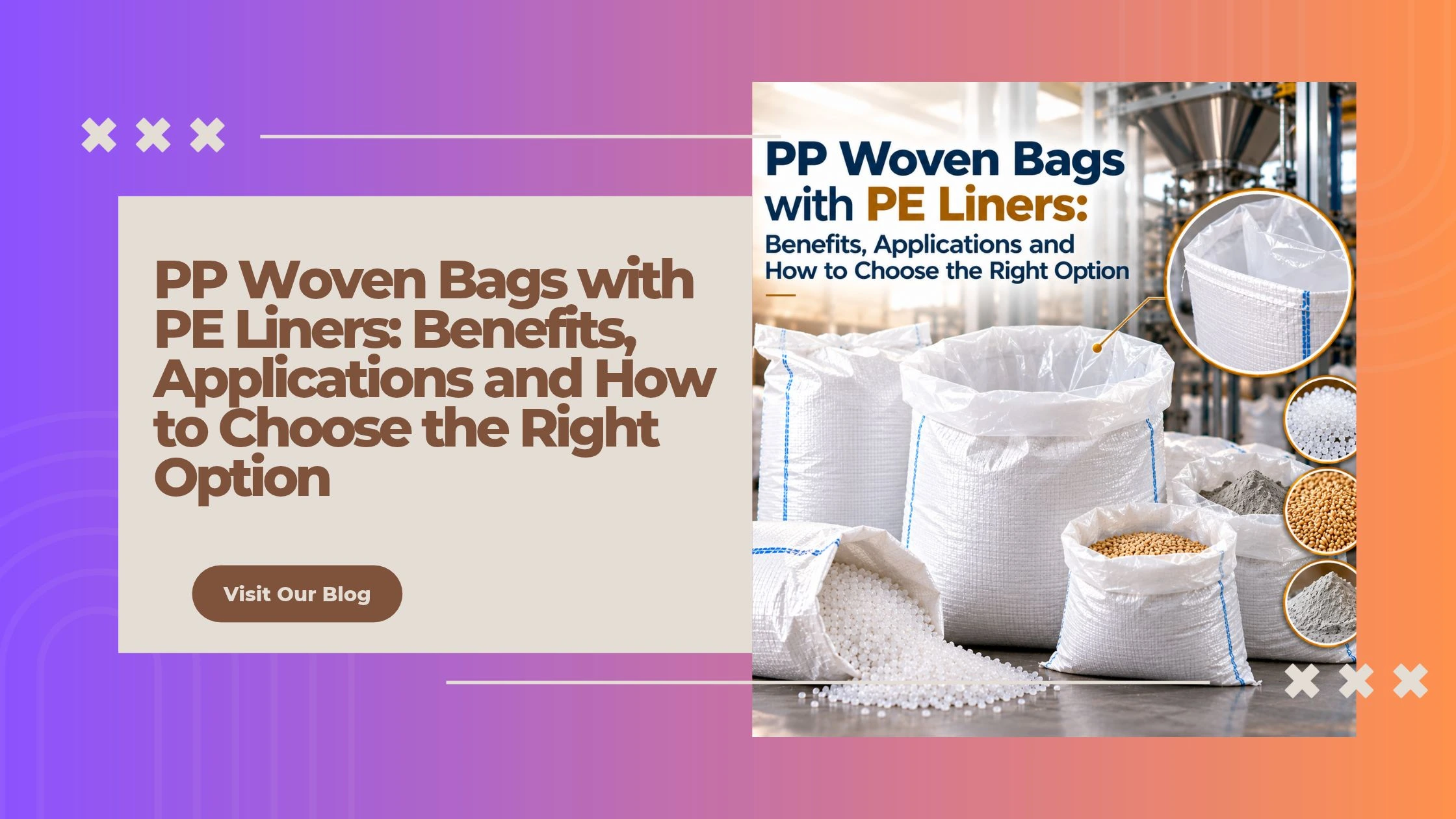
Packaging materials must protect products during filling, storage and transportation without adding unnecessary cost or complexity. For many industrial and agricultural applications, a woven polypropylene bag combined with a polyethylene inner liner can offer a practical balance of outer-bag strength and additional product protection.
PP woven bags with PE liner are worth considering when businesses need better control over moisture exposure, fine-particle containment or direct contact between the product and the woven outer surface. However, the right construction depends on the product, liner material, closure method and expected storage conditions.
Quick answer: PP woven bags with PE liner combine a woven polypropylene outer sack with a polyethylene inner layer. The outer bag provides structural support, while the liner can help limit moisture ingress and product leakage when appropriately designed and closed. Buyers should evaluate liner thickness, dimensions, compatibility and sealing requirements before approving samples for bulk production.
What Are PP Woven Bags with PE Liners?
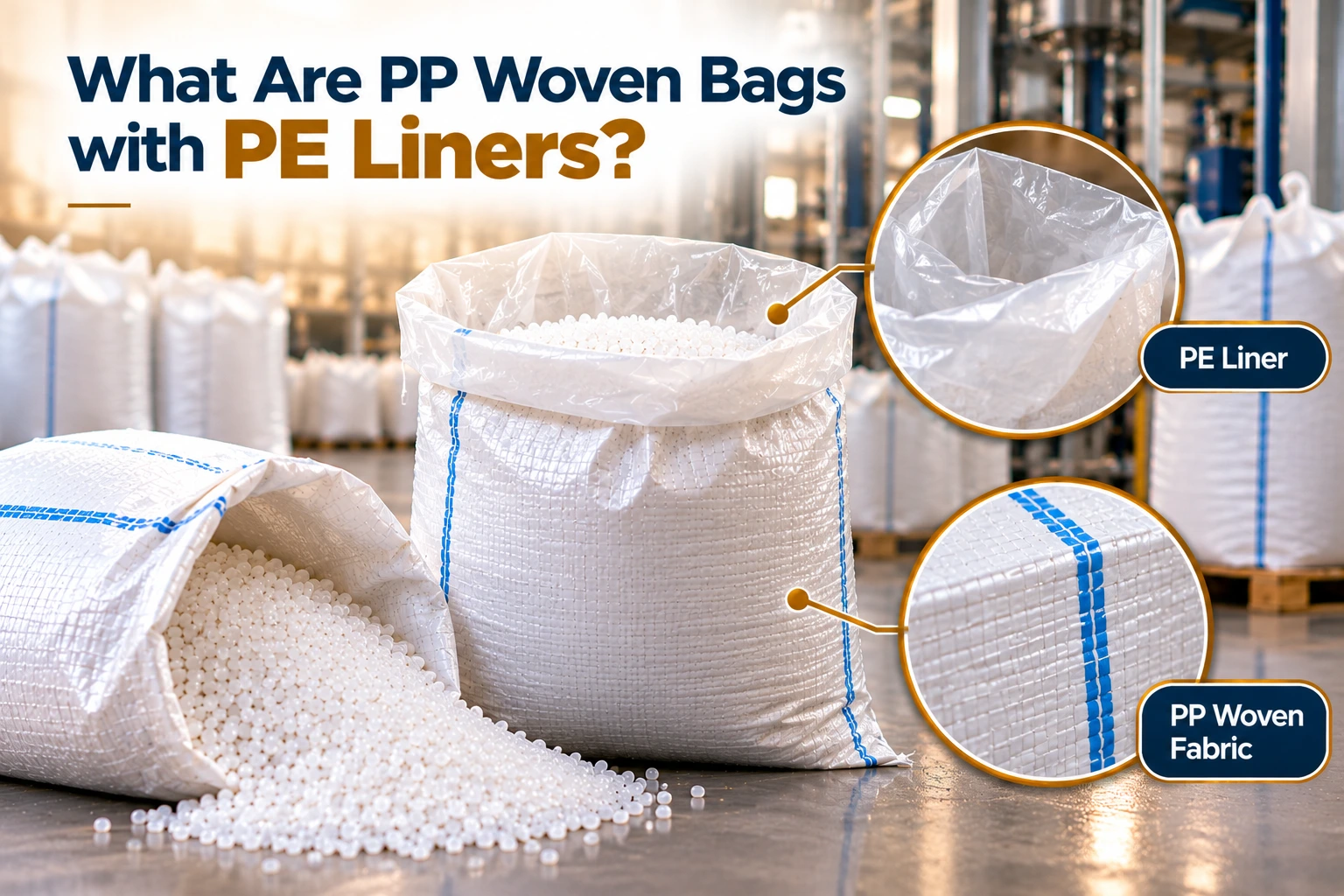
PP woven bags with PE liner are packaging sacks constructed from woven polypropylene (PP) fabric and a separate polyethylene (PE) inner liner. The two components perform different functions and should be assessed as one packaging system.
The outer PP fabric consists of interwoven polypropylene tapes. Its structure provides strength for handling, stacking and transporting packaged goods. The exact load-bearing performance depends on fabric construction, bag dimensions, seams and the finished design.
The PE liner is a flexible plastic film placed inside the woven bag. Depending on its material properties and construction, it can help reduce moisture exposure, retain fine particles and separate the contents from the woven surface.
A liner may be inserted separately, attached at selected points or configured to suit a particular filling process. The appropriate arrangement depends on the product and packaging equipment.
For example, an agricultural supplier packaging moisture-sensitive powder may need a different liner specification from a manufacturer packing dry granules for short-distance transportation.
The important distinction is that the outer bag provides mechanical support, while the inner liner contributes a separate layer of product containment and protection. Neither component should be selected without considering the other.
What Are the Benefits of PP Woven Bags with PE Liners?
PP woven bags with PE liner can provide several practical benefits when their construction matches the application.
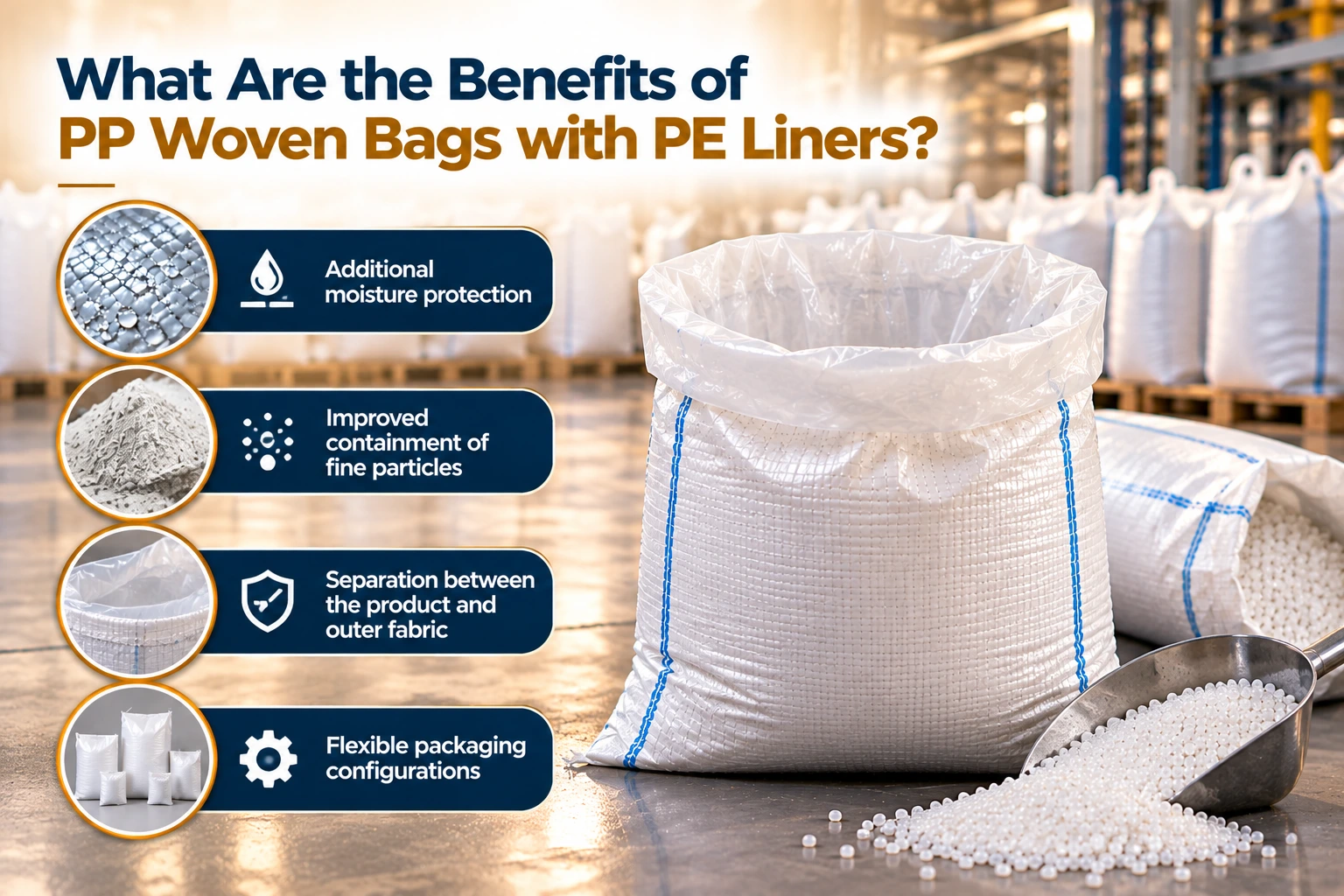
Additional moisture protection
A PE liner can reduce direct exposure to ambient moisture compared with an unlined woven sack. This can be useful for dry powders, granules and agricultural materials that may be affected by humidity.
However, the level of protection depends on the polyethylene grade, film thickness, film integrity, closure quality and environmental conditions. Moisture can still enter through damaged film, incomplete closures or handling-related punctures.
A liner should therefore be treated as one part of a moisture-control strategy, not as an automatic guarantee against water or humidity.
Improved containment of fine particles
Some powders can escape through openings or weaknesses in an unlined bag's fabric and seams. A properly fitted liner can provide an additional containment layer.
Its effectiveness depends on film integrity, liner dimensions and the closure arrangement. Fine particles can still escape if the liner tears, becomes displaced or is not closed correctly.
Separation between the product and outer fabric
The liner creates an additional surface between the contents and the woven PP fabric. This can be useful where direct contact with the outer fabric is undesirable.
For sensitive products, buyers should also assess manufacturing cleanliness, liner handling, storage conditions and the suitability of all materials that may contact the product.
Flexible packaging configurations
PP woven bags with PE liner can be specified for different bag sizes, capacities, filling methods and closure arrangements. This flexibility helps procurement teams match packaging to operational needs rather than selecting a standard construction without reviewing the application.
The liner may also be designed to suit particular opening or filling arrangements, subject to supplier capability and sample validation.
PP Woven Bags with PE Liners vs Unlined PP Woven Bags
Neither construction is universally better. The correct choice depends on the product's protection requirements, operating conditions and total packaging cost.
| Comparison factor | PP woven bags with PE liners | Unlined PP woven bags |
|---|---|---|
| Moisture protection | Can provide additional protection depending on film and closure | Woven construction alone generally provides limited moisture-barrier protection |
| Fine-particle containment | Additional containment layer when the liner remains intact | Depends on fabric, seams and bag construction |
| Product contact | Separates contents from the woven surface | Contents may contact the inner woven surface |
| Packaging materials | Includes an additional PE film layer | Typically uses less material |
| Filling and closure | Requires liner positioning and closure compatibility | Usually involves fewer liner-related handling steps |
| Material compatibility | Requires assessment of both the liner and outer bag | Requires assessment of the woven material and other components |
| Typical selection basis | Additional containment or moisture control is required | The product's requirements can be met without a separate liner |
When comparing quotations, consider the complete cost of packaging and handling. A lower-priced unlined bag may not meet the required protection level, while an unnecessary liner may add material and handling costs without providing a meaningful benefit.
Which Products Can Be Packed in PP Woven Bags with PE Liners?
PP woven bags with PE liner may be suitable for several industrial and agricultural applications, provided the materials and construction meet the product's requirements.
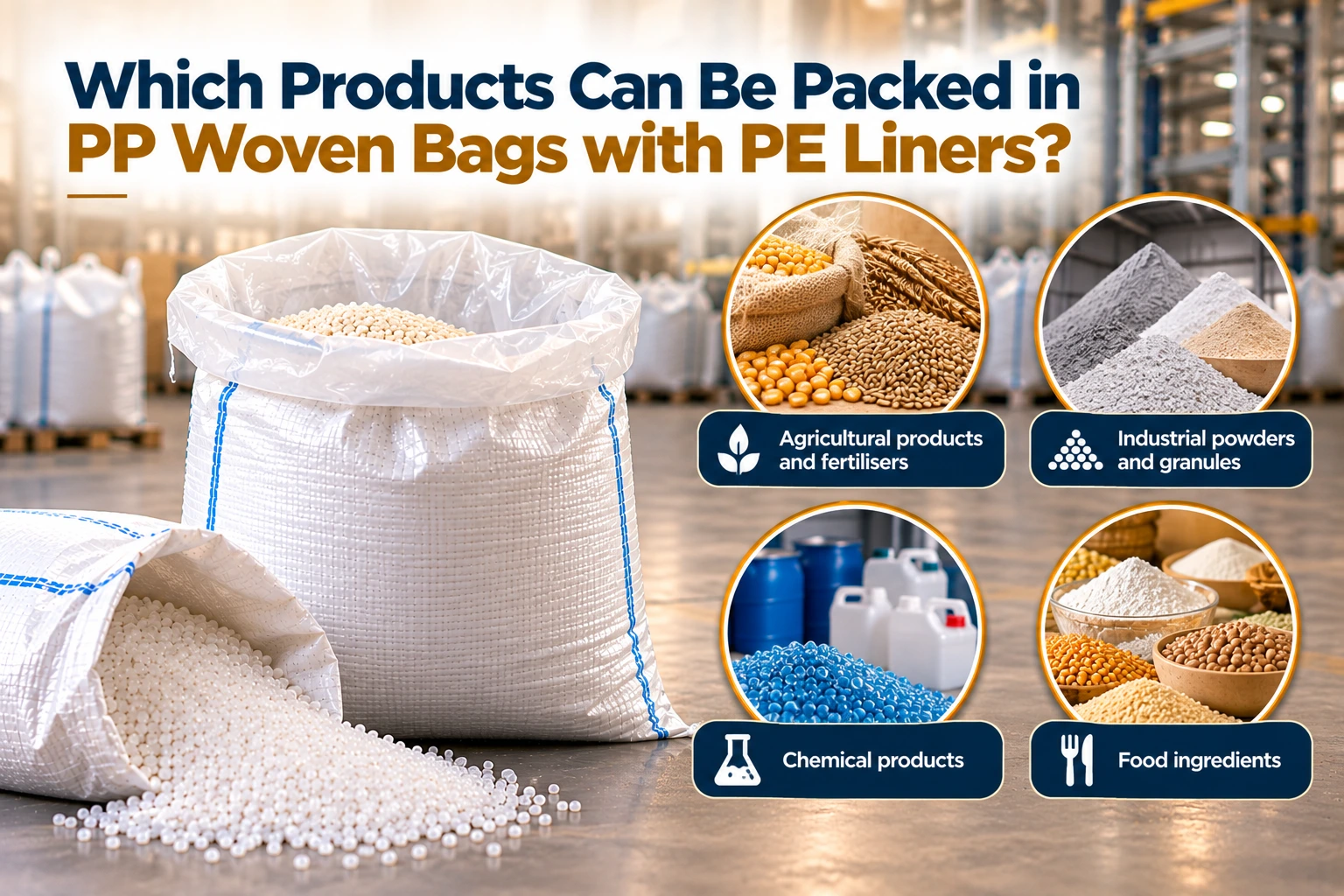
Agricultural products and fertilisers
Grains, seeds, fertiliser materials and certain agricultural products may benefit from a liner when moisture exposure or fine-particle containment is a concern.
The required construction depends on the material's sensitivity, storage duration, transport environment and applicable product standards. Products that require ventilation or controlled moisture exchange may need a different packaging approach.
Industrial powders and granules
Mineral powders, dry compounds and selected industrial granules may use PE-lined woven bags to improve containment and reduce direct contact with the woven outer surface.
The product's particle size, density, temperature at filling and chemical properties should be considered. A liner that is suitable for one powder may not be suitable for another material.
Chemical products
PE liner bags for industrial packaging can be considered for selected chemical products, but compatibility must be established for the specific chemical and operating conditions.
The chemical concentration, temperature, contact duration and stress conditions can influence material suitability. Hazardous products may also be subject to packaging, transport and regulatory requirements that cannot be satisfied simply by adding a standard PE liner.
Obtain the relevant material compatibility information and validate the complete packaging arrangement before use.
Food ingredients
Food ingredients may be packaged in lined woven sacks when the entire packaging system meets the applicable food-contact requirements.
A liner being made from polyethylene does not, by itself, prove that it is suitable for every food product. In India, buyers should consult the applicable FSSAI Packaging Regulations; for US markets, the FDA's food-contact guidance explains the importance of authorisation for applicable food-contact substances.
The intended food, material formulation, manufacturing conditions and destination-market requirements must be checked before approval.
How to Choose the Right PE Liner for PP Woven Bags
Selecting a liner requires more than choosing a film thickness. Buyers should assess the product, bag dimensions, filling process and required protection level together.
1. Match the liner material to the product
Polyethylene is available in different grades and formulations, with varying flexibility, mechanical performance and other properties. The appropriate choice depends on the application.
Review the packaged material's chemical properties, temperature, contact duration and handling conditions. Where compatibility is uncertain, request technical documentation and conduct appropriate testing.
Do not assume that all polyethylene films behave identically or that a PE liner is suitable for every chemical.
2. Select an appropriate liner thickness
PP woven bag liner thickness influences film mass and can affect mechanical performance, flexibility and handling. However, thickness alone does not determine whether a liner will resist puncture, tearing or abrasion.
The required specification depends on the product, bag capacity, filling arrangement and expected handling stresses. A film that performs adequately with a smooth, free-flowing product may not perform the same way with sharp-edged particles.
Agree on a suitable thickness and relevant performance criteria with the supplier. Avoid choosing a universal thickness based solely on the nominal weight of the packaged product.
3. Confirm liner and bag dimensions
The liner should fit the outer bag and filling process. An undersized liner may be stretched excessively or fail to cover the intended area. An oversized liner may fold, become trapped or interfere with filling and closure.
Check the liner's width, length, fit and positioning within the finished bag. Where necessary, confirm whether the liner should be loose, attached or arranged in a particular way.
4. Review the filling and closure method
The liner must remain correctly positioned while the bag is filled. Consider whether the filling process uses manual loading, an open-mouth filling machine, a valve arrangement or another system.
The closure process also matters. Sewing, heat sealing and other closure methods have different requirements. If the liner is intended to be heat sealed, the film material and sealing process must be compatible with the equipment and product.
A well-selected liner can still fail to protect the contents if the closure is incomplete or damaged.
5. Consider storage and transportation conditions
Assess exposure to humidity, rain, temperature changes, stacking pressure, vibration and handling impacts. The expected distribution route and storage duration can affect the required packaging performance.
Where moisture control is important, identify the required protection level and determine whether the proposed liner and closure can achieve it under representative conditions.
Technical guidance on moisture-barrier packaging, including water vapour transmission rate (WVTR), is available from the Canadian Conservation Institute. Although that resource addresses artwork transport, its discussion illustrates why barrier performance should be evaluated using material properties and test conditions rather than a general claim that a film is moisture-proof.
PE Liner Thickness, Fit and Bag Specifications Explained
The specification for PP woven bags with PE liner should describe the required finished packaging, not simply state that an inner liner is needed.
A useful specification identifies the liner material, thickness, dimensions, positioning, closure method and intended application. Where performance is critical, it should also define the relevant test methods and acceptance criteria.
For example, a liner that is too loose may fold into the filling area, while a liner that is too tight may experience excessive stress during filling. Poor positioning can also create folds or trapped material near the closure.
Punctures may result from sharp product particles, rough handling, contact with equipment or defects in the film. The cause should be investigated before changing the thickness, material or bag design.
The following checklist helps buyers prepare a clear specification:
- Product name, characteristics and target fill weight.
- Finished bag width, length, capacity and dimensional tolerances.
- Required PE grade, film thickness and liner dimensions.
- Required moisture, dust or contamination protection.
- Filling method, liner positioning and closure process.
- Storage duration, environmental exposure and transport conditions.
- Required material documentation, test methods and applicable regulatory requirements.
- Sample approval procedure and finished-packaging acceptance criteria.
These details help the packaging supplier recommend a suitable construction and identify any requirements that need additional validation.
What Common Problems Can Occur with PE-Lined PP Woven Bags?
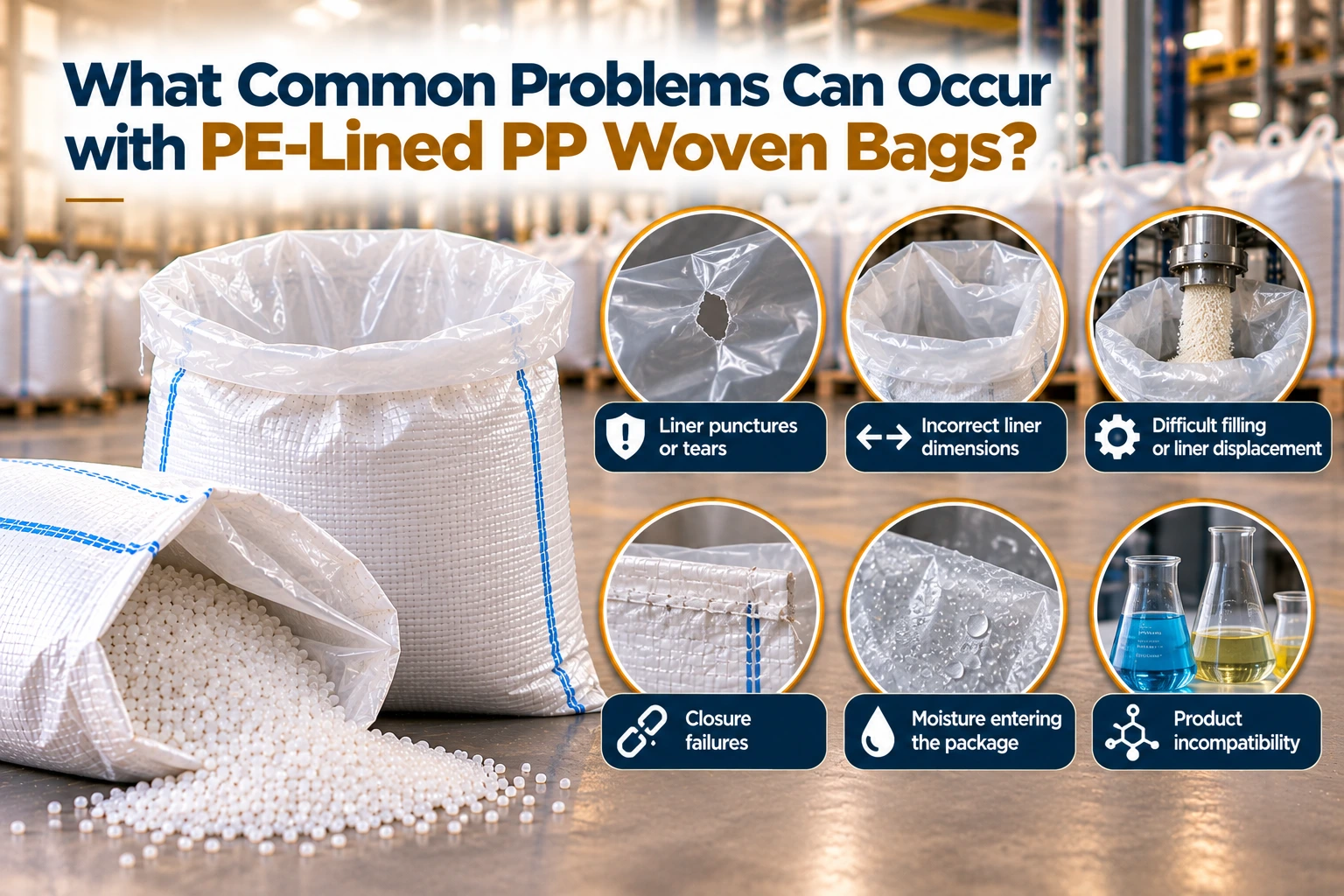
Problems should be investigated systematically because several causes can produce similar symptoms.
Liner punctures or tears: Check film condition, product characteristics, contact with equipment, handling practices and the integrity of the liner during filling.
Incorrect liner dimensions: Review the liner's width and length against the finished bag and filling process. Confirm that the liner is positioned correctly and does not create excessive folds or tension.
Difficult filling or liner displacement: Examine the filling arrangement, liner opening, attachment method and machine settings. The problem may arise from the liner design or the equipment rather than the film itself.
Closure failures: Inspect the closure method, liner positioning, contamination around the sealing area and compatibility between the film and closure equipment.
Moisture entering the package: Check for damaged film, incomplete closures, punctures and exposure during storage or transport. The outer woven bag and inner liner should be examined together.
Product incompatibility: Review the PE grade, product chemistry, contact conditions and any changes in product quality. Seek technical advice if the material's suitability is uncertain.
These checks are starting points, not confirmed diagnoses. Use inspection and representative testing to identify the actual cause.
How to Test PP Woven Bags with PE Liners Before Bulk Ordering
Before placing a large order, request representative samples that match the proposed production specification.
First, inspect the outer bag and liner for dimensional consistency, visible damage, incorrect positioning and defects that could affect filling or closure. Confirm that the supplied material documentation matches the agreed requirements.
Next, conduct filling trials using the intended product and equipment. Observe liner movement, bag stability, filling behaviour and closure quality. Inspect the finished packages for punctures, tears, leakage and other relevant defects.
Where moisture protection is important, agree on a suitable test method and acceptance criteria. A simple visual inspection cannot establish a quantified moisture-barrier performance level. Test conditions should reflect the expected application as closely as practical.
Storage and transport testing may also be necessary when packages will face prolonged storage, temperature variation, vibration or stacking loads.
Document the approved sample, material specification, inspection criteria and trial results. If the liner material, dimensions, thickness or closure design changes later, determine whether additional approval is required.
What Should Buyers Ask a PP Woven Bag Manufacturer?
When contacting a PP woven bag manufacturer, provide enough information to assess the complete packaging requirement.
Ask the supplier to confirm:
- Whether the proposed outer bag and PE liner construction is suitable for the stated application.
- Which liner material, thickness and dimensions are proposed, and why.
- How the liner will be positioned and closed during the filling process.
- What technical documentation or product compatibility information is available.
- Which sample tests and acceptance criteria should be agreed before bulk production.
- Whether the finished packaging can meet the applicable destination-market and product requirements.
Also provide the product type, target fill weight, bag size, order quantity, printing needs, filling method and expected storage and transport conditions.
Oberon Polypack's official website provides information about its woven packaging products. Buyers can review the company's PP woven and BOPP packaging range and contact the team through the official website to discuss their specific requirements. Confirm availability and the proposed liner construction directly with the supplier.
Conclusion: Choosing the Right PP Woven Bag with a PE Liner
The right packaging solution depends on how the outer woven bag, inner liner, packaged product and closure process work together. A PE liner can provide additional containment and help reduce moisture exposure, but its performance depends on material properties, thickness, dimensions, integrity and closure quality.
Before ordering, define the product protection requirements, confirm material compatibility, agree on the finished-bag specification and test representative samples. This approach helps buyers select packaging based on practical requirements rather than assumptions about what a standard liner can achieve.
Oberon Polypack can be approached to discuss PP woven packaging requirements, proposed liner specifications and suitable options for evaluation. Share your product details, bag dimensions and protection needs to begin the discussion.
Visit Oberon Polypack to discuss your packaging requirements.
Frequently Asked Questions
1. What is the purpose of a PE liner in a PP woven bag?
A PE liner adds an inner film layer that can help reduce moisture exposure, contain fine particles and separate the product from the woven outer surface. Its effectiveness depends on the material, fit, integrity and closure.
2. Are PP woven bags with PE liners waterproof?
Not automatically. A PE liner can reduce moisture ingress, but punctures, incomplete closures and damaged film can allow water or moisture to enter. Waterproof performance must be established for the complete packaging construction and intended conditions.
3. How do I choose the right PE liner thickness?
Consider the product, filling method, bag dimensions, expected handling stresses and required protection level. Thickness should be selected alongside mechanical performance and compatibility requirements, then validated through representative testing.
4. Can PP woven bags with PE liners be used for food packaging?
Yes, where the complete packaging system meets the applicable food-contact requirements for the intended product and destination market. A polyethylene liner alone does not establish food-contact compliance.
5. Are PE-lined PP woven bags suitable for chemical products?
They may be suitable for selected chemicals, but compatibility depends on the chemical, concentration, temperature, contact duration and packaging design. Confirm suitability with technical documentation and appropriate testing before use.
6. What is the difference between a PE liner and BOPP lamination?
A PE liner is a separate film layer placed inside a woven bag. BOPP lamination involves bonding biaxially oriented polypropylene film to the woven fabric. The constructions differ in material arrangement, appearance, handling and performance; neither should be assumed to provide a particular barrier level without verification.
7. Can PE liners be customised for automatic filling machines?
Liner dimensions and configurations can be specified to suit a particular filling process, subject to supplier capability. Buyers should confirm liner opening, positioning, attachment and closure requirements with the equipment manufacturer and test samples on the intended line.