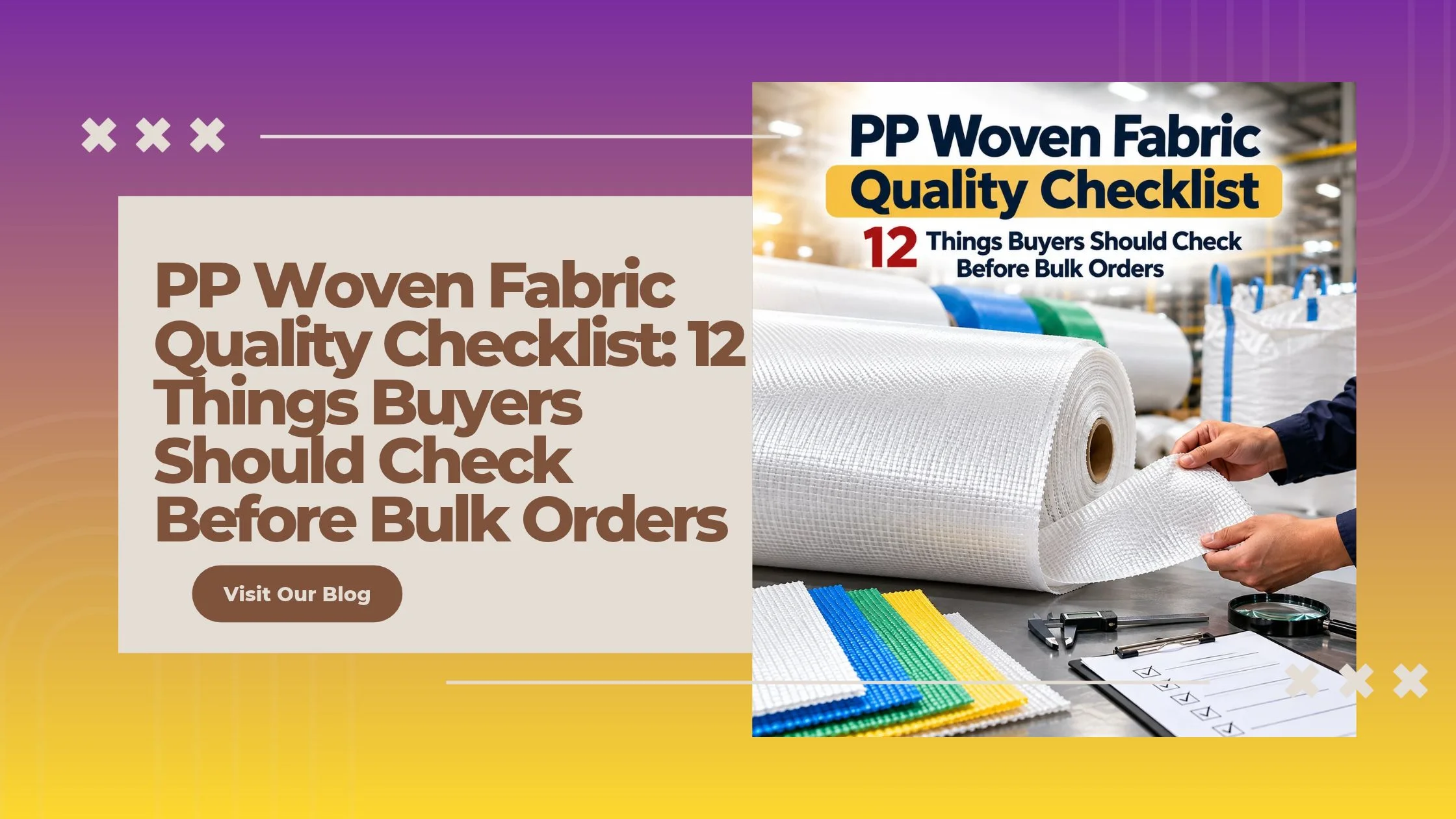
Ordering PP woven fabric in bulk is not the time to discover that the GSM varies between rolls, the width does not match your cutting setup, or the weave develops weak areas during conversion. A sample can look perfectly acceptable while a large production batch tells a very different story.
That is why PP woven fabric quality should be evaluated through a defined inspection process rather than by appearance or price alone. Buyers need to check measurable specifications, manufacturing consistency, roll condition and application requirements before approving a large order. If you are already comparing material dimensions, GSM and roll requirements, Oberon Polypack's PP woven fabric rolls, GSM, width and size guide provides a useful background.
What Does PP Woven Fabric Quality Actually Mean?
PP woven fabric quality is the ability of the material to consistently meet agreed technical and functional requirements. Those requirements can include GSM, width, denier, tensile strength, weave consistency, appearance, roll length, lamination and environmental performance.
The important word is consistently. One excellent sample does not necessarily prove that an entire bulk shipment will perform the same way. For procurement teams, quality means that the agreed specifications remain within acceptable tolerances across production batches and rolls.
This is particularly important because PP woven fabric is converted into products such as sacks, bags, sheets and protective packaging. The fabric has to work not only as a material but also within the buyer's actual cutting, printing, stitching, lamination or filling process.
12 Things to Check for PP Woven Fabric Quality Before Bulk Orders
.webp)
1. Check PP Woven Fabric GSM
2. Verify PP Woven Fabric Width
3. Test PP Woven Fabric Strength
4. Inspect Weave Consistency
5. Identify PP Woven Fabric Defects
6. Check Tape Construction and Denier
7. Inspect PP Woven Fabric Roll Quality
8. Check Surface Appearance and Colour
9. Verify Lamination, Coating or Liner Requirements
10. Consider UV and Environmental Exposure
11. Review PP Woven Fabric Testing and Quality Records
12. Evaluate the PP Woven Fabric Supplier
A reliable PP woven fabric quality checklist should cover measurable properties as well as visual and manufacturing conditions. Before approving bulk production, buyers should work through these 12 checks.
1. Check PP Woven Fabric GSM
GSM, or grams per square metre, measures the weight of the fabric over a defined area. It is an important PP woven fabric specification because it provides a reference for material construction and consumption.
However, higher GSM does not automatically mean better quality. Overall performance also depends on tape characteristics, denier, weave density, tensile properties and manufacturing consistency. Oberon Polypack's current PP woven fabric specifications, for example, list GSM options from 40 to 150 GSM, alongside defined width and denier ranges.
For bulk purchasing, compare the measured GSM with the agreed specification and tolerance. If GSM matters to your production cost or finished-product performance, do not rely solely on how heavy the fabric feels.
2. Verify PP Woven Fabric Width
PP woven fabric width directly affects cutting efficiency and material utilisation. A small mismatch can create unnecessary waste when the fabric is converted into bags, sheets or other products.
Before ordering, confirm exactly how the supplier measures width and whether the quoted figure represents flat width, finished width or another agreed measurement. Your purchase specification should also identify the permitted tolerance.
For automated production, width consistency becomes even more important because variations can affect machine settings and cutting patterns.
3. Test PP Woven Fabric Strength
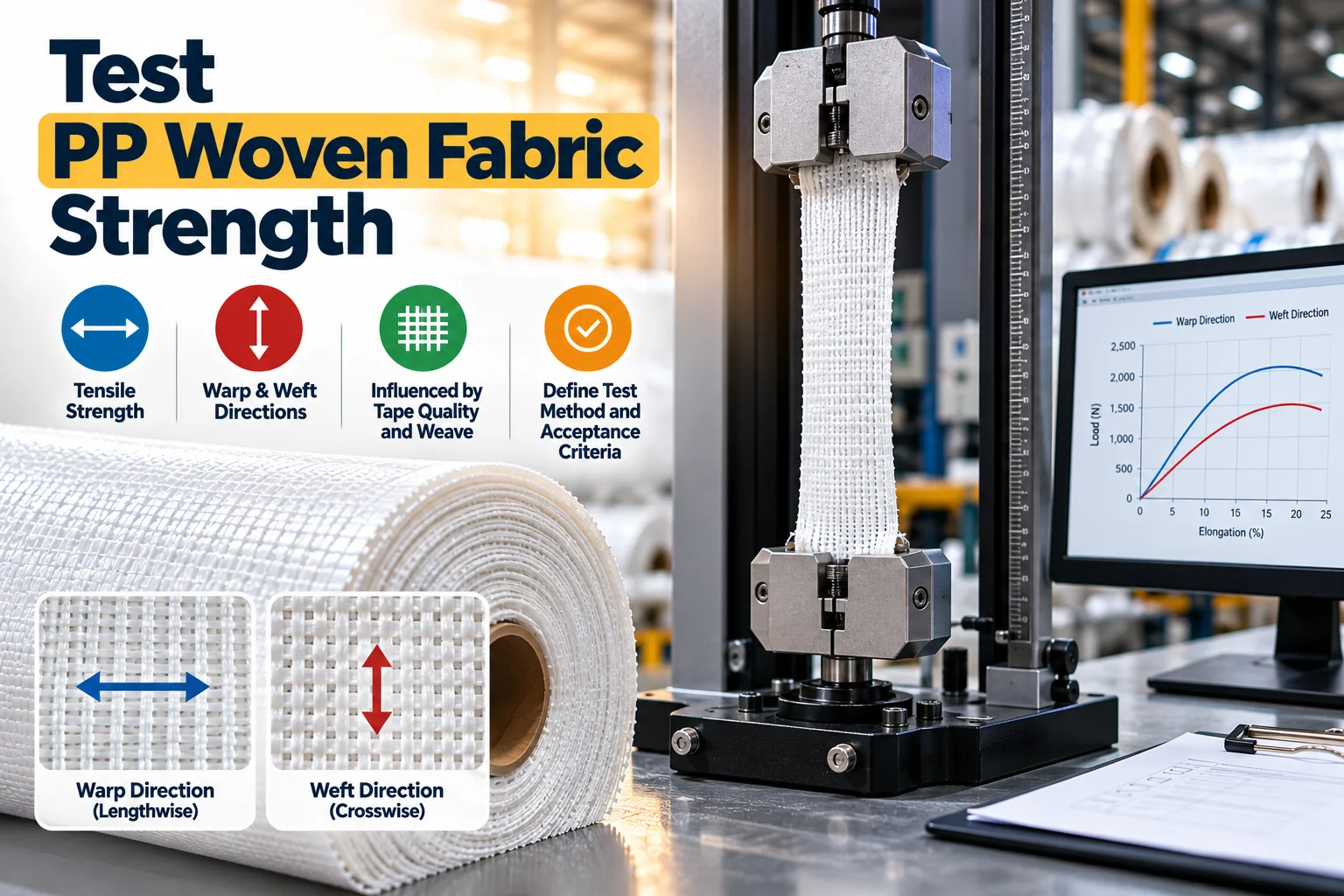
PP woven fabric strength is critical when the finished product must carry, protect or support a defined load. Tensile strength should generally be considered in both warp and weft directions because the woven structure contains tapes running in both directions.
Do not assume that two fabrics with identical GSM will have identical strength. Tape quality, denier, weave density and manufacturing control can all influence mechanical performance.
For demanding applications, define the required test method and acceptance criteria before production begins. This gives both buyer and supplier a common technical benchmark.
4. Inspect Weave Consistency
During PP woven fabric inspection, examine the weave across the complete usable width rather than checking only one convenient section.
Look for uneven tape spacing, broken or loose tapes, holes, irregular weaving and obvious changes in density. A consistent weave helps provide predictable performance and can also support smoother downstream processing.
This is especially important for material that will be printed or laminated, where surface irregularities can become more noticeable.
5. Identify PP Woven Fabric Defects
PP woven fabric defects can range from minor visual imperfections to issues that compromise the material's intended use. Common concerns include holes, broken tapes, contamination, uneven weaving, damaged edges, inconsistent colour and surface irregularities.
The key is to establish acceptance criteria before the bulk order is produced. A defect that is acceptable for one application may be unacceptable for another.
A written defect classification also makes supplier discussions much easier because both sides know what constitutes a minor, major or unacceptable issue.
6. Check Tape Construction and Denier
The woven structure starts with polypropylene tapes, so tape consistency deserves attention. Denier describes the linear density of the tape and is an important part of PP woven fabric specifications.
Variations in tape dimensions can influence the finished fabric's appearance and mechanical performance. Buyers should therefore ask how tape width, thickness and denier are controlled during production.
This is one reason manufacturing quality matters just as much as final inspection. Good final inspection can identify a problem, but controlled extrusion and tape production can help prevent the problem in the first place.
7. Inspect PP Woven Fabric Roll Quality
A technically compliant fabric can still cause production problems if the rolls are poorly wound or packaged.
Check the roll's winding condition, edges, core, length and general cleanliness. Look for telescoping, loose winding, crushed edges or other conditions that could interfere with unwinding.
Roll length should also be agreed before ordering. Longer rolls can reduce changeovers, but the ideal length depends on machinery, storage and handling capacity.
8. Check Surface Appearance and Colour
For products where the fabric remains visible or receives printing, inspect surface uniformity and colour consistency across multiple rolls.
Look for stains, contamination, shade variation and unusual surface marks. If a particular colour is required, an approved reference sample can help establish an objective comparison point.
Do not judge colour from a photograph alone when exact colour matching matters. Lighting, screens and photography can all affect perceived colour.
9. Verify Lamination, Coating or Liner Requirements
Some PP woven applications require lamination, coating or an internal PE liner for additional protection or functional performance. These requirements should be clearly stated in the purchase specification.
Inspect laminated fabric for consistent coverage, bonding and surface condition. Where applicable, check for bubbles, wrinkles, peeling or poor adhesion.
The specification should also make clear whether the quoted GSM refers to the base woven fabric or the finished construction. Otherwise, two suppliers may appear to offer equivalent material when they are actually quoting different constructions.
10. Consider UV and Environmental Exposure
If the finished product will be exposed to sunlight, outdoor storage or demanding environmental conditions, ask whether UV stabilisation is required.
PP woven fabric durability depends partly on how well the material is matched to its operating environment. Moisture, temperature, abrasion, chemicals and sunlight can all affect the requirements.
Do not specify environmental protection simply because it sounds like an upgrade. Match the requirement to the actual use case, expected exposure and storage conditions.
11. Review PP Woven Fabric Testing and Quality Records
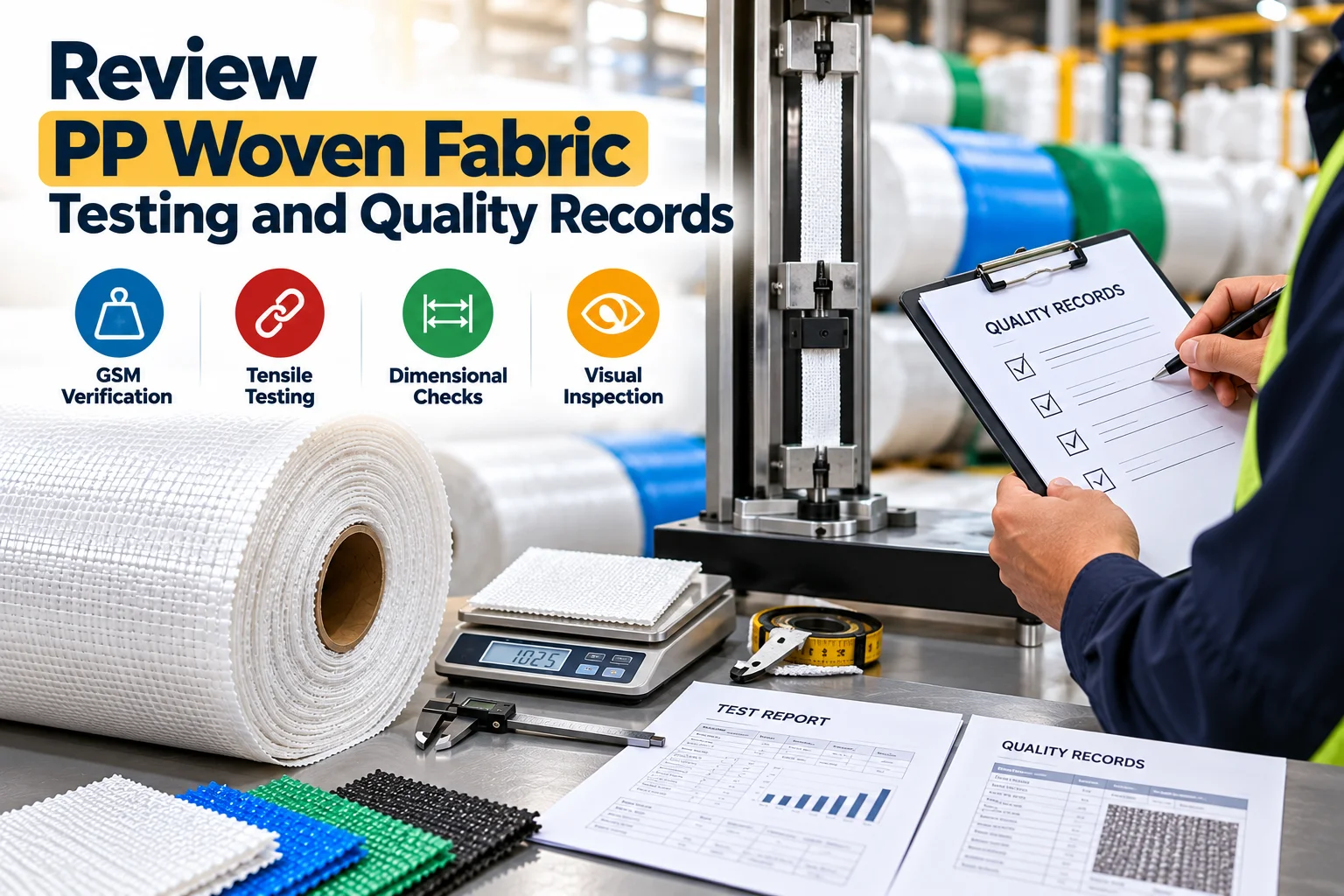
A supplier's testing system can provide valuable insight into its manufacturing controls. Depending on the application, PP woven fabric testing may include GSM verification, tensile testing, dimensional checks and visual inspection.
Ask what is tested, how frequently testing occurs and how non-conforming material is handled. For technically sensitive orders, relevant test reports can provide additional evidence that the supplied material meets the agreed requirements.
Quality control should ideally operate throughout manufacturing rather than only at the final stage. Oberon's published manufacturing information describes inspection for GSM, weave uniformity and broken or loose tapes as part of its fabric production process.
12. Evaluate the PP Woven Fabric Supplier
Finally, assess the supplier's ability to reproduce the required quality at your actual order volume.
Consider manufacturing capacity, production controls, technical support, customisation capability, testing processes, packaging and supply consistency. A supplier that can provide one good sample but struggles to maintain specifications across repeat orders creates a different purchasing risk from a supplier with established quality controls.
For recurring PP woven fabric bulk orders, ask how specifications are documented, how batches are inspected and how deviations are communicated. Those answers can tell you a great deal about the supplier's approach to manufacturing quality.
PP Woven Fabric Quality Parameters Buyers Should Verify
The easiest way to turn quality expectations into an actionable purchasing specification is to put the important parameters in one place.
| Quality parameter | What buyers should check | Why it matters | Typical verification |
|---|---|---|---|
| GSM | Actual fabric weight and tolerance | Affects material consumption and construction | GSM measurement |
| Width | Usable width and tolerance | Influences cutting and conversion efficiency | Dimensional measurement |
| Denier | Tape linear density | Influences tape construction and performance | Tape/specification check |
| Tensile strength | Warp and weft performance | Indicates resistance to pulling forces | Tensile testing |
| Weave | Uniformity and density | Helps maintain consistent structure | Visual inspection/testing |
| Roll length | Actual length and tolerance | Affects production planning | Roll measurement |
| Surface | Cleanliness, colour and uniformity | Important for appearance and conversion | Visual inspection |
| Lamination | Coverage and adhesion where applicable | Supports required barrier/surface performance | Visual inspection/testing |
| Edges | Straightness and damage | Can affect conversion and handling | Roll inspection |
| Packaging | Protection during transport | Helps prevent shipment damage | Pre-shipment inspection |
The exact acceptance limits should come from your product specification and intended application rather than from a generic table. Different buyers may require different combinations of strength, weight, width and finishing.
How to Conduct a PP Woven Fabric Inspection
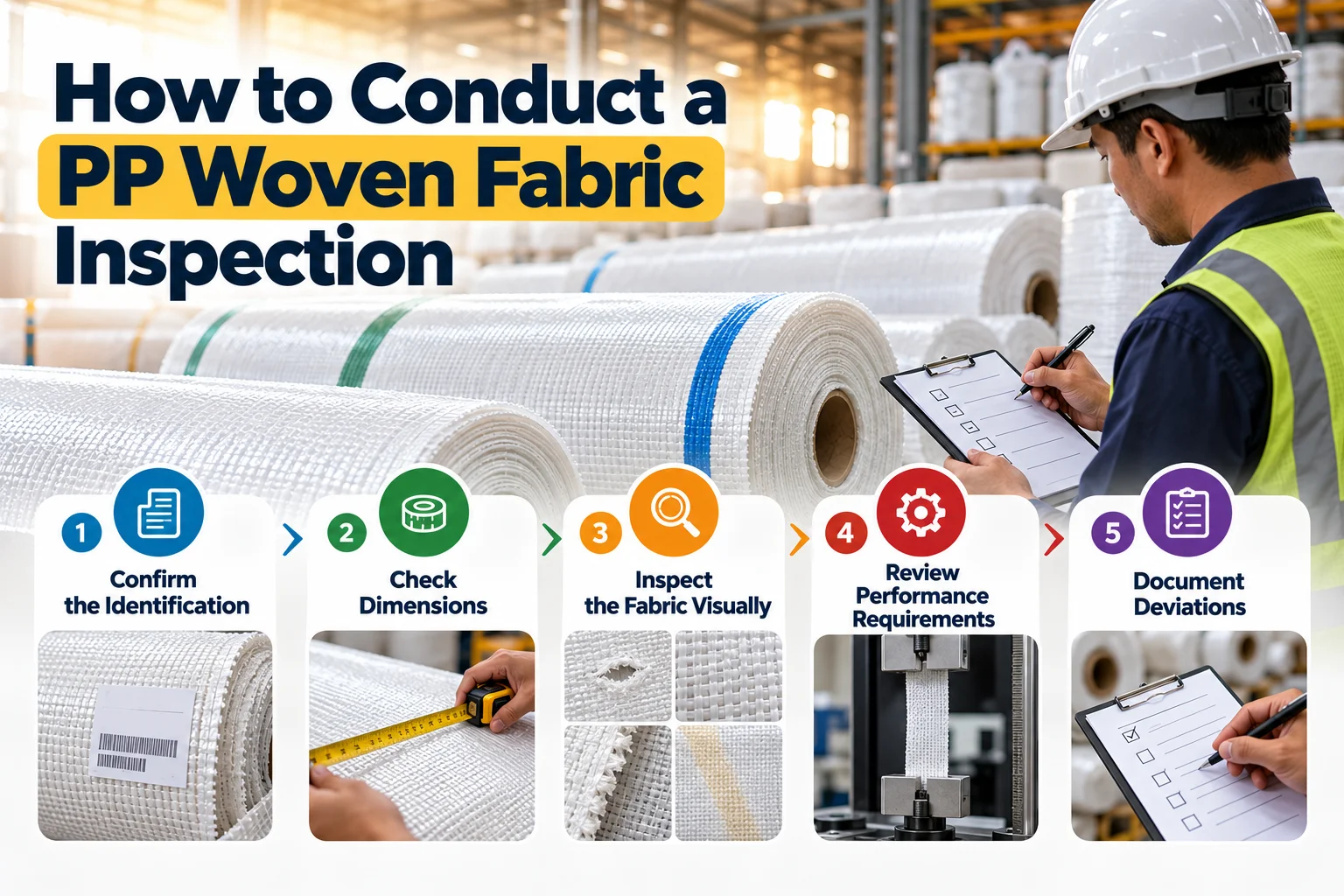
A practical inspection should begin with the approved specification rather than the delivered material. Compare the purchase order, technical specification and approved sample before examining the rolls.
For a straightforward inspection, focus on these essential checks:
- Confirm the identification: Match the production batch, roll numbers, specification and quantity against the purchase documentation.
- Check dimensions: Measure representative samples for GSM, width and other agreed dimensional requirements.
- Inspect the fabric visually: Look for holes, broken tapes, weaving irregularities, contamination, damaged edges and colour variation.
- Review performance requirements: Where specified, verify tensile strength or other application-specific properties through appropriate testing.
- Document deviations: Record the roll number, measured result, defect and acceptance status rather than relying on verbal observations.
Sampling should be agreed in advance, particularly for large orders. The objective is to obtain a representative view of production quality rather than simply finding the best-looking roll.
PP Woven Fabric Quality vs Price: What Buyers Should Compare
The lowest quotation is not necessarily the lowest overall procurement cost. A cheaper material can become expensive if inconsistent GSM increases waste, incorrect width affects cutting efficiency or weak fabric causes finished-product failures.
Instead, compare the complete specification and expected performance. A useful supplier comparison should consider technical compliance, consistency, testing, production capacity, delivery reliability and suitability for your machinery.
For example, Oberon Polypack states that its PP woven fabric is available in custom widths, GSM options, colours and finishes, with tubular and flat forms and optional lamination. Those capabilities can matter when the buyer's application requires a specific construction rather than a generic fabric.
Common PP Woven Fabric Buying Mistakes
The biggest mistake is treating GSM as the complete definition of quality. GSM is important, but it does not independently describe tensile performance, weave consistency or suitability for a particular application.
Another mistake is approving a single sample and assuming the entire production run will match it. Bulk manufacturing requires controls that maintain the approved specification across rolls and batches.
A third mistake is leaving tolerances vague. A specification that says "good quality fabric" gives both parties room for different interpretations. Specific measurable requirements are much easier to inspect and enforce.
How Manufacturing Quality Affects PP Woven Fabric Durability
PP woven fabric durability is influenced by the combined effect of raw material, tape production, stretching, weaving and finishing. A consistent manufacturing process helps ensure that the finished material performs predictably.
During production, control over tape dimensions, weaving density, fabric tension and finishing can affect the final result. This is why buyers should look beyond a final product photograph and ask how quality is controlled throughout manufacturing.
Oberon describes PP woven fabric as being produced from polypropylene tapes woven in warp and weft directions, with customisation available across width, GSM, colour and finish. Understanding this construction helps buyers ask more useful questions about the specification they actually need.
Conclusion
Reliable PP woven fabric quality comes from consistency across multiple parameters, not from one specification alone. Buyers should evaluate GSM, width, denier, tensile strength, weave, defects, roll condition, finishing, environmental requirements and manufacturing controls before approving PP woven fabric bulk orders. A written specification, representative sampling and defined acceptance criteria can make the purchasing process much more predictable.
If you are sourcing PP woven fabric for packaging, agricultural, industrial or other applications, start with the exact technical requirements your production process needs. You can explore Oberon Polypack's PP woven fabric range and contact the team to discuss customised fabric requirements, specifications and bulk supply options.
FAQs
1. What is PP woven fabric quality?
PP woven fabric quality refers to how consistently the fabric meets agreed requirements for properties such as GSM, width, denier, tensile strength, weave, appearance, roll condition and finishing. The correct quality level depends on the fabric's intended application.
2. How is PP woven fabric inspected?
PP woven fabric inspection normally combines visual checks, dimensional measurements and, where required, performance testing. Buyers may evaluate GSM, width, weave consistency, tensile strength, roll condition, colour and visible defects against an agreed specification.
3. Does higher GSM mean better PP woven fabric?
No. Higher GSM means more weight per square metre, but it does not automatically mean better overall quality. Fabric performance also depends on tape construction, denier, weave density, tensile properties and manufacturing consistency.
4. What PP woven fabric defects should buyers look for?
Common defects include holes, broken or loose tapes, uneven weaving, damaged edges, contamination, surface irregularities and colour variation. The acceptable level depends on the application and should be defined before bulk production.
5. What should I ask a PP woven fabric supplier before placing a bulk order?
Ask about GSM, width and tolerances, denier, tensile strength, weave construction, roll length, lamination, packaging, testing procedures, production capacity and quality-control systems. Request a representative sample when the application requires close specification control.
6. How can I verify PP woven fabric quality before receiving a large shipment?
Start with a written specification and an approved reference sample. Then inspect representative production rolls and measure the critical properties. For important applications, combine visual inspection with appropriate laboratory or performance testing before accepting the shipment.