Choosing a PP woven bag manufacturer requires more than comparing quotations. Buyers must assess manufacturing capabilities, material specifications, product quality, sample performance, delivery commitments and commercial terms before placing a large order. A supplier that understands the application and documents its commitments clearly can make procurement easier to manage.
PP woven bag manufacturer evaluation is the process of checking whether a potential supplier can meet the buyer's technical, quality, quantity, documentation and delivery requirements. Before committing to bulk production, buyers should verify the required bag construction, inspect representative samples, agree on acceptance criteria and confirm all important terms in writing.
This guide explains how to assess suppliers systematically, compare quotations fairly and reduce avoidable purchasing risks when sourcing PP woven bags in India or internationally.
Why Is Choosing the Right PP Woven Bag Manufacturer Important?
A PP woven bag is not simply a standard packaging item. Its suitability depends on the product being packed, the required bag dimensions, the fabric construction, the closure method and the conditions in which the bag will be stored or transported.
An unsuitable specification can lead to filling problems, inconsistent bag dimensions, seam failures, printing defects or packaging that does not meet the intended application. Delayed deliveries can also affect inventory planning, while unclear quotations can create unexpected costs.
A structured PP woven bag manufacturer evaluation helps buyers establish whether the supplier's actual capabilities match the order requirements.
The evaluation should focus on five areas: technical suitability, quality assurance, commercial transparency, production and delivery planning, and communication.
The goal is not necessarily to select the largest manufacturer or the lowest-priced supplier. It is to identify a supplier whose documented capabilities and commercial terms fit the buyer's needs.
What Manufacturing Capabilities Should You Check?
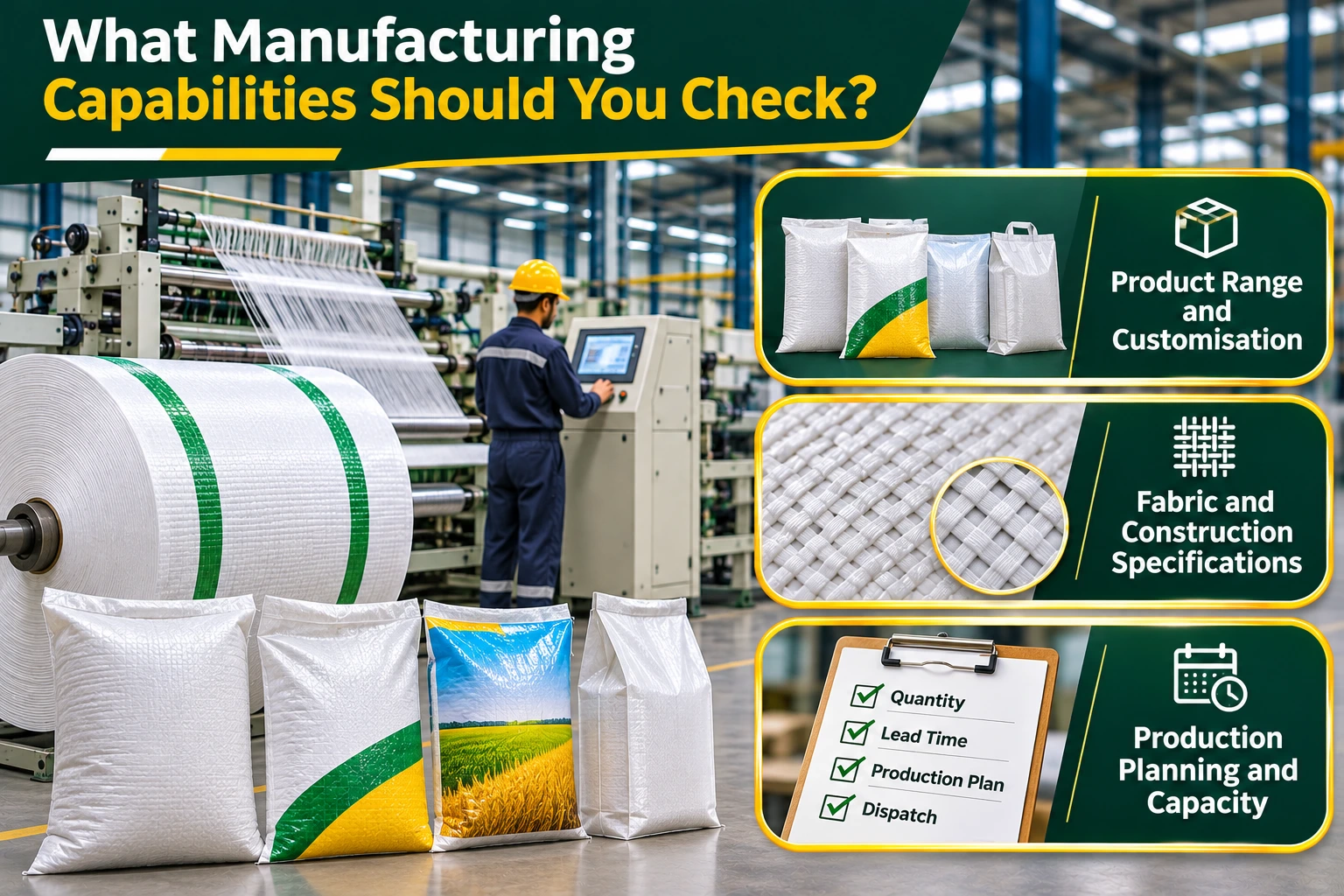
Start by confirming that the manufacturer can supply the exact type of packaging required. General claims about manufacturing PP woven bags do not automatically establish the ability to produce every construction or specification.
Product range and customisation
Determine whether the supplier can manufacture the required bag type, dimensions, capacity and closure. Depending on the supplier's capabilities, requirements may include conventional PP woven sacks, BOPP laminated bags, printed packaging, gusseted bags or other specialised constructions.
If the order requires custom dimensions, printing artwork or a particular fabric specification, request written confirmation that the supplier can meet those requirements.
Oberon Polypack's official product catalogue lists PP woven bags, PP woven fabric and BOPP bags. Buyers can use the catalogue to identify relevant product categories before discussing the details of a proposed order.
Fabric and construction specifications
A technically capable supplier should be able to discuss the material and construction requirements relevant to the application.
Important specifications may include fabric GSM, denier, weave construction, bag width and length, stitching, closure and lamination where applicable.
GSM means grams per square metre and describes the mass of fabric per unit area. Denier describes the linear mass of a fibre or yarn. Neither measurement alone determines the performance of a finished bag.
Ask the supplier to document the agreed values, tolerances and construction details rather than relying on a general product description.
Production planning and capacity
The supplier should explain how the proposed order fits its production schedule. Buyers should confirm the required quantity, expected production lead time, sample approval schedule, dispatch date and any dependencies that could affect delivery.
Request evidence appropriate to the size and importance of the order, such as a written production plan or confirmation of the processes required. Do not assume that a manufacturer with a large facility will necessarily be the best fit for every order.
How Should You Evaluate PP Woven Bag Quality?
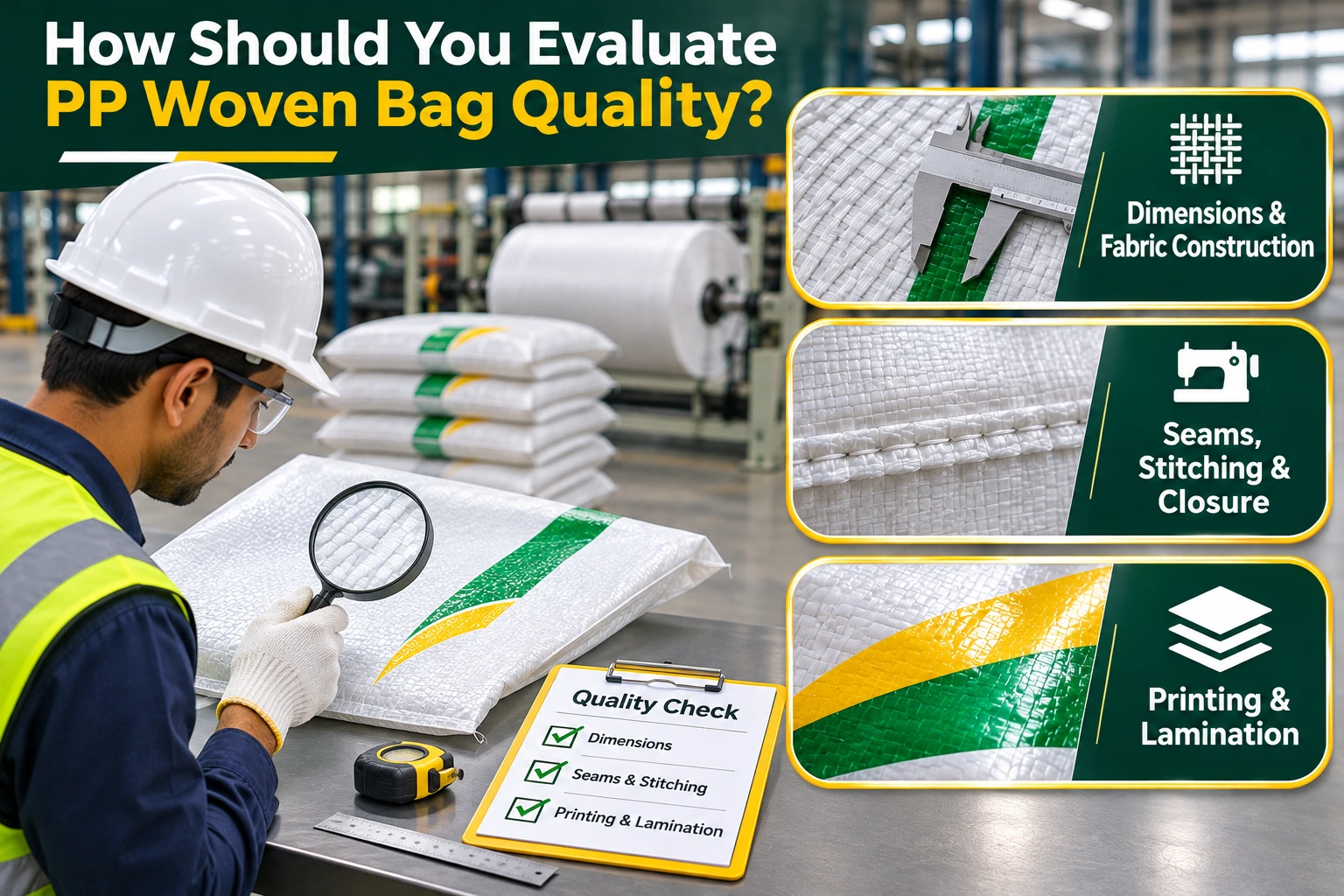
Quality evaluation should begin with a written specification that defines what the finished packaging must meet.
The appropriate checks depend on the bag construction, product, intended use and risks associated with failure. There is no single universal test or acceptance limit that applies to every PP woven bag.
Dimensions and fabric construction
Confirm the nominal bag dimensions and permitted dimensional tolerances. Check whether measurements refer to the flat bag, gusseted construction or another specified configuration.
Verify the fabric GSM, weave and other agreed material characteristics. If fabric strength is important, identify the relevant test method and acceptance criteria before production.
Seams, stitching and closure
Inspect stitching consistency, seam position, loose threads, skipped stitches and other visible defects. Where the bag uses another closure method, assess the relevant construction and closure integrity.
The required seam performance depends on the product weight, bag design, handling conditions and intended distribution process. Buyers should specify their requirements instead of assuming every bag needs the same strength.
Printing and lamination
For printed or BOPP laminated bags, confirm the approved artwork, colours, design placement and finish. Check for visible printing defects, peeling, scuffing or other issues relevant to the specification.
The approved sample should be compared with production output using agreed criteria. A visual check may identify defects, but it cannot establish every material or mechanical property.
Where fabric strength testing is relevant, ASTM International publishes ASTM D5035-11(2024), a test method for determining the breaking force and elongation of many textile fabrics. Its applicability should be assessed for the specific material and construction; it should not automatically be treated as a complete finished-bag test.
What Certifications and Test Reports Should Buyers Request?
Request documentation that is relevant to the product, the manufacturing process and the intended market. Then verify that each document applies to the supplier and product under consideration.
A quality-management certificate, for example, concerns the management system within its stated scope. It does not independently prove that every bag produced by the company meets a particular strength, hygiene or performance requirement.
For a certification, check the issuing organisation, certificate number, validity, scope and certified legal entity. Where appropriate, use a recognised verification service such as IAF CertSearch to investigate accredited management-system certification information.
Depending on the order, buyers may also request relevant material specifications, inspection records, test reports, food-contact documentation or destination-specific compliance documents.
Confirm the issuing laboratory or organisation, report date, test method, sample identification and the specific property evaluated. A report for a different material, product design or production batch may not demonstrate compliance for the order being purchased.
Not every PP woven bag requires the same certification or testing. The requirements should follow the product, application, customer specification and applicable regulations.
Why Should You Request Samples Before a Bulk Order?
Sample approval allows buyers to evaluate the proposed construction before committing to full production. It is particularly important for customised bags, new suppliers and applications with specific filling or performance requirements.
A practical sample approval process follows these steps:
- Share the product application, bag dimensions, fabric requirements, printing artwork and closure details.
- Request representative samples made to the proposed specification.
- Check the dimensions, fabric construction, stitching, printing and other relevant features.
- Where practical, evaluate the sample with the intended product and filling process.
- Conduct relevant tests against criteria agreed by the buyer and supplier.
- Document the approval, outstanding corrections and accepted deviations.
- Confirm in writing that bulk production will follow the approved specification.
Retain an identified reference sample or an appropriate record of the approved construction. Include the artwork version, specification revision and relevant inspection criteria.
A sample demonstrates the characteristics of the sample examined. It does not guarantee that every bag in a later production batch will be identical. Buyers should agree on suitable production inspection and acceptance procedures for the order's risk and volume.
How to Compare PP Woven Bag Manufacturer Quotations
Quotations should be compared on a like-for-like basis. Two prices are not directly comparable if they cover different fabric specifications, printing requirements, quantities, quality checks or delivery terms.
| Evaluation factor | What to compare | Why it matters |
|---|---|---|
| Product specifications | Dimensions, GSM, construction and closure | Ensures both suppliers quote the intended bag |
| Printing and lamination | Artwork, print requirements and finish | Clarifies the quoted product scope |
| Quality requirements | Inspection procedures, tests and acceptance criteria | Establishes what quality evidence is included |
| Order quantity | Minimum order and agreed production quantity | Clarifies purchasing commitments |
| Lead time | Sample approval, production and dispatch schedule | Supports inventory planning |
| Packaging and shipping | Protective packaging, freight and delivery terms | Helps establish the total delivered cost |
| Payment terms | Deposit, balance and payment schedule | Clarifies financial obligations |
| Documentation | Commercial and applicable compliance documents | Supports procurement and shipment requirements |
| Defect resolution | Agreed procedure for discrepancies and rejected goods | Establishes how quality issues will be handled |
Compare the total expected purchasing cost, not only the unit price. Freight, packaging, inspection, payment conditions and the handling of defective goods may affect the overall commercial outcome.
The lowest quotation is not automatically the least expensive option if it excludes required specifications or creates additional work for the buyer.
How to Verify Production Capacity and Delivery Reliability
Ask the supplier to confirm that the requested quantity can be manufactured and dispatched within the agreed schedule. Production planning should account for sample approval, artwork confirmation, raw materials, manufacturing, inspection and shipment preparation.
Where practical, request a written timeline identifying the important milestones. Clarify how the supplier will communicate a delay, a material shortage or a proposed specification change.
A useful assessment also considers the supplier's approach to quality checks, packaging, dispatch and issue resolution. Buyers may request a factory assessment, virtual meeting or other appropriate verification when the order value or business risk justifies it.
Do not rely solely on a sales representative's verbal estimate. Record the agreed quantity, delivery date, specification and any conditions that could change the schedule.
Supplier reliability is best evaluated through relevant evidence, clear commitments and the supplier's ability to answer technical and commercial questions consistently.
How to Evaluate a PP Woven Bag Manufacturer for Export Orders
Export procurement adds documentation, logistics and destination-market requirements to the normal supplier evaluation process.
Before confirming the order, identify the destination country, product application, required labelling and any applicable regulatory or importer-specific conditions. Confirm which party is responsible for each document and when it must be provided.
For exports from India, the Directorate General of Foreign Trade identifies the bill of lading or airway bill, commercial invoice-cum-packing list, and shipping bill or bill of export among the mandatory export documents, subject to applicable requirements and exceptions. See the DGFT Foreign Trade Policy documentation.
Additional documentation may be required depending on the product, transaction and destination. Confirm requirements with the importer, freight forwarder and relevant authorities rather than treating one checklist as sufficient for every shipment.
Also establish the agreed delivery terms, shipping arrangements, document deadlines and responsibility for freight-related activities. Clear coordination helps prevent avoidable discrepancies between the purchase order, goods and shipping documents.
Common Mistakes When Choosing a PP Woven Bag Supplier
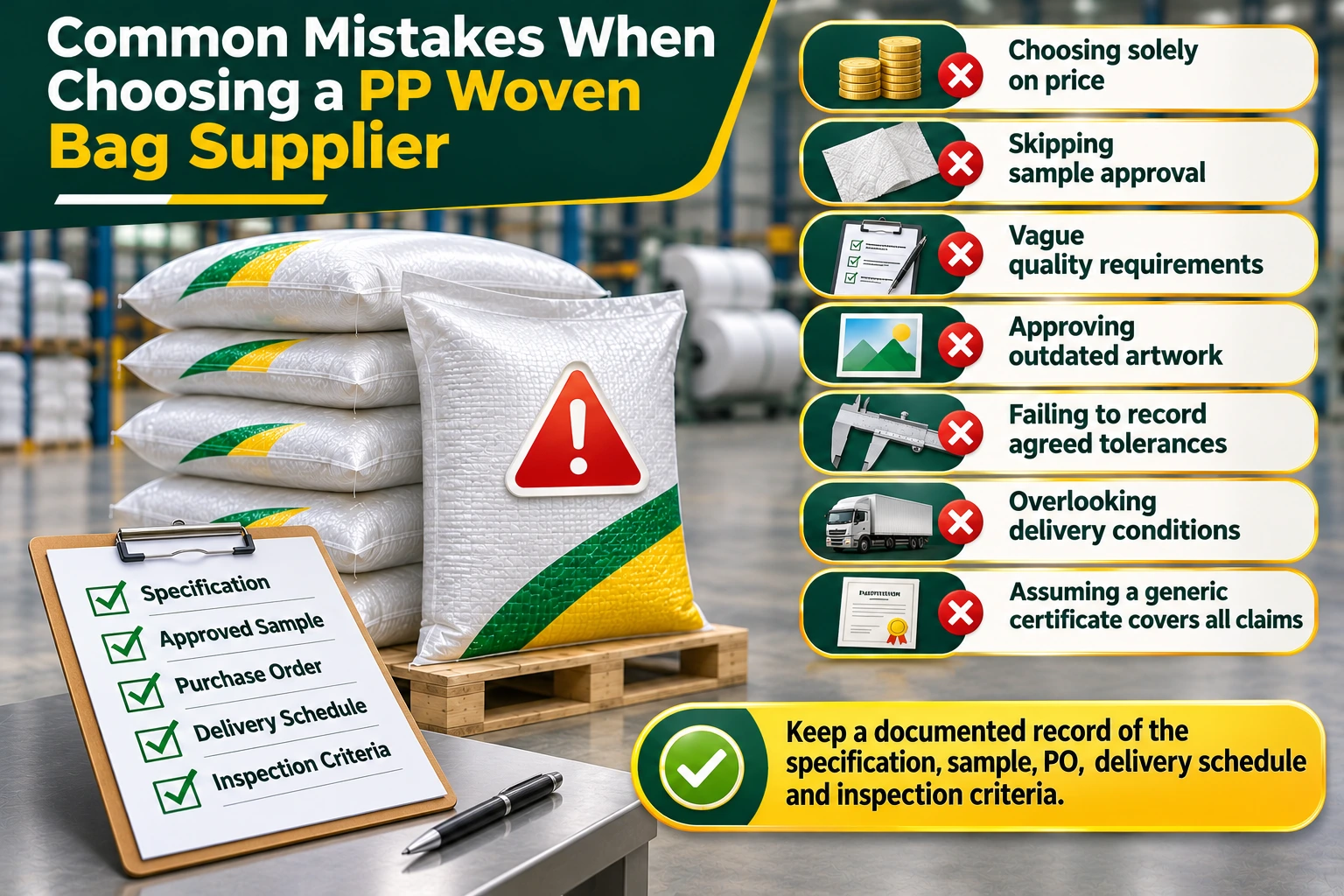
The most common procurement mistakes arise when buyers commit to an order before the specifications and acceptance requirements are clear.
Choosing solely on price can result in comparisons between products that are not equivalent. Skipping sample approval can leave important differences undiscovered until production or filling. Vague quality requirements can also make it difficult to resolve disputes about defects.
Other mistakes include approving outdated artwork, failing to record agreed tolerances, overlooking delivery conditions and assuming that a generic certificate proves every product claim.
Reduce these risks by keeping a documented record of the specification, approved sample, quotation, purchase order, delivery schedule and inspection criteria. Agree on how deviations will be reported and resolved before production begins.
PP Woven Bag Manufacturer Evaluation Checklist
Use this checklist to organise the evidence collected during supplier assessment. A status should only be marked complete after the relevant evidence has been reviewed.
| Checkpoint | Evidence to request or review | Status |
|---|---|---|
| Product capability | Written confirmation of the required bag construction | Pending verification |
| Technical specification | Approved dimensions, fabric and closure details | Pending verification |
| Sample approval | Recorded evaluation and sample acceptance | Pending verification |
| Quality assurance | Relevant inspection procedures and test reports | Pending verification |
| Certifications | Current documents with applicable scope | Pending verification |
| Commercial quotation | Comparable specifications and complete pricing terms | Pending verification |
| Production schedule | Written lead-time and delivery commitments | Pending verification |
| Export documentation | Confirmation of applicable transaction requirements | Pending verification |
| Order terms | Written agreement on payment, quality and discrepancies | Pending verification |
This checklist is a procurement aid, not a certification of supplier suitability. The final decision should reflect the order's technical requirements, commercial risk and available evidence.
Questions to Ask Before Placing a Bulk Order
Before approving the purchase order, ask the supplier:
- Can you manufacture the specified dimensions, fabric construction, printing and closure?
- Which quality checks and relevant test reports can you provide?
- Can representative samples be evaluated and approved before bulk production?
- What production and dispatch schedule can you confirm in writing?
- Which certificates and shipment documents are available or required?
- How will defects, specification deviations and delivery changes be handled?
- Which costs are included in the quotation, and which are excluded?
- What final approvals or documents are needed before the order is released?
The answers should be specific enough to support a purchasing decision. If a technical or commercial point remains unclear, resolve it before committing to production.
Conclusion: Choose a PP Woven Bag Manufacturer Based on Evidence
A reliable PP woven bag manufacturer should be evaluated against the buyer's actual specifications, quality expectations, delivery requirements and commercial terms. Product capability, sample approval, relevant documentation and a clear production plan provide a stronger basis for procurement than price comparisons alone.
Before placing a bulk order, document the required construction, agree on acceptance criteria, review representative samples and confirm the quotation and delivery terms in writing. These steps help buyers make an informed decision without assuming that any supplier can meet requirements that have not been verified.
Oberon Polypack supplies PP woven bags, woven fabrics and BOPP laminated packaging. Buyers can review the official product range and contact the team to discuss bag dimensions, fabric specifications, printing requirements, sample evaluation and bulk-order planning.
Frequently Asked Questions
1. How do I choose a PP woven bag manufacturer?
Compare the supplier's relevant manufacturing capabilities, technical specifications, quality procedures, sample performance, commercial terms and delivery commitments. Verify important claims and document the agreed requirements before ordering.
2. What should I check before placing a bulk order for PP woven bags?
Confirm dimensions, fabric construction, GSM, closure, printing, quality criteria, sample approval, order quantity, lead time, payment terms and delivery arrangements. Include relevant documentation requirements in the purchase order.
3. Why are samples important when selecting a bag manufacturer?
Samples allow buyers to inspect the proposed construction and assess suitability before full production. They reduce uncertainty but do not replace appropriate production quality checks.
4. Which quality tests may be relevant for PP woven bags?
Depending on the application, buyers may require dimensional checks, fabric mass measurements, relevant tensile testing, seam assessments, closure inspection or printing and lamination checks. Test methods and acceptance limits should be agreed for the specific product.
5. How do I compare quotations from different PP woven bag suppliers?
Ensure the quotations cover the same bag dimensions, material specifications, printing, quality requirements, quantities, delivery terms and payment conditions. Compare the full expected cost rather than the unit price alone.
6. What documents should I request from a manufacturer?
Depending on the order, request the technical specification, quotation, approved sample record, relevant test reports, applicable certificates, purchase-order confirmation and required shipment documents. Verify the scope and relevance of each document.
7. How can I reduce quality and delivery risks when ordering PP woven bags?
Approve representative samples, document the final specification, agree on inspection criteria, confirm the production schedule and establish a written process for managing defects or delays. Use additional supplier verification where the order's risk justifies it.