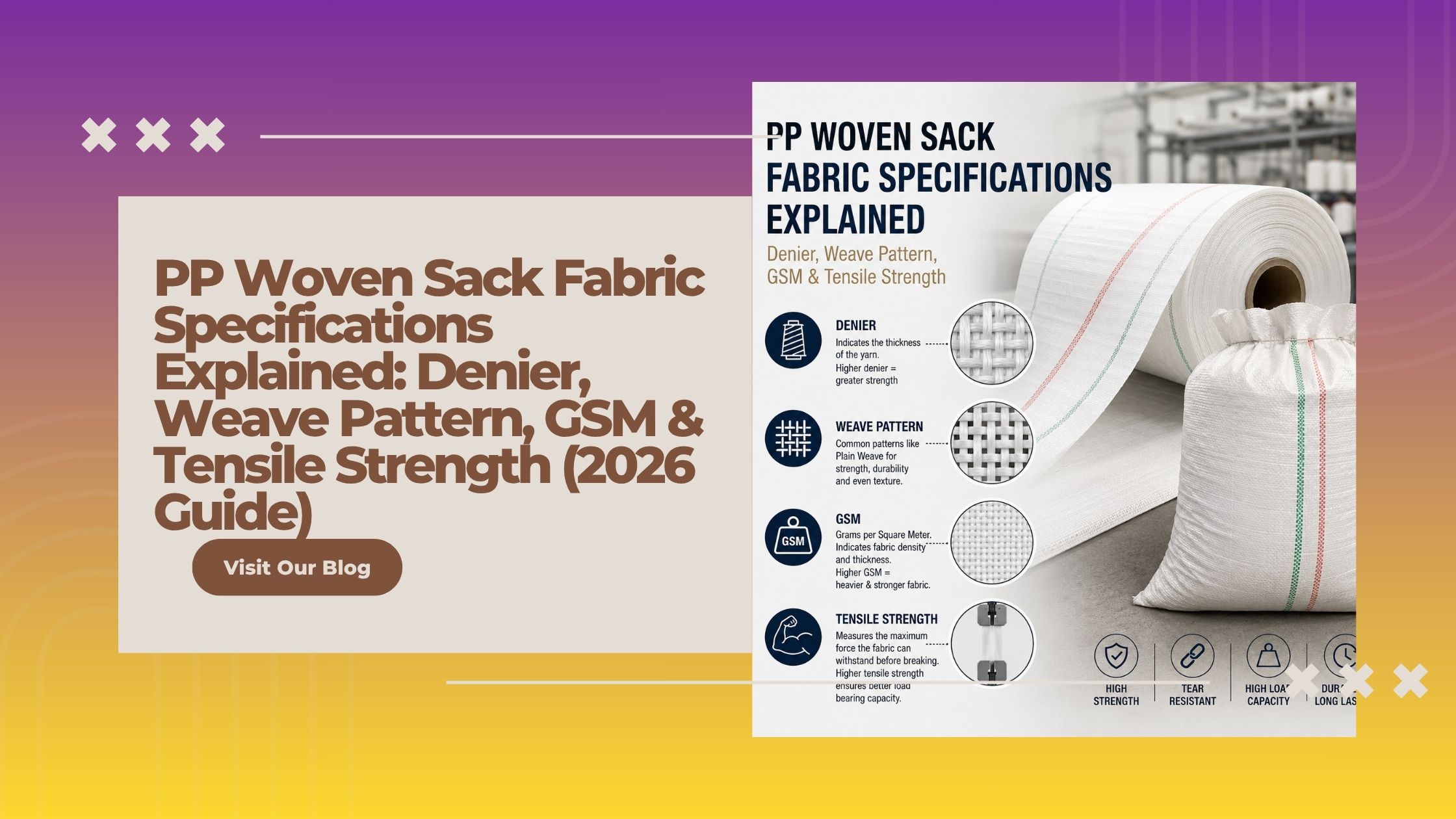
When selecting packaging materials, many buyers focus on the finished bag while overlooking the fabric that determines its strength and performance. In reality, every durable woven sack begins with carefully engineered fabric specifications. Factors such as denier, weave pattern, GSM, and tensile strength directly influence how well a bag performs during filling, storage, transportation, and long-term use. Understanding these specifications enables businesses to choose packaging materials that meet both operational requirements and customer expectations.
Whether you manufacture rice bags, fertilizer sacks, cement packaging, animal feed bags, or industrial bulk packaging, choosing the right PP Woven Sack Fabric is essential for ensuring consistent product quality. A well-designed woven fabric not only improves load-bearing capacity but also supports better printing, enhanced durability, and greater reliability throughout the supply chain. If you'd like to understand how woven fabric is produced before exploring its specifications, our guide on PP Woven Fabric Manufacturing explains the complete production process from raw materials to finished rolls.
This comprehensive guide explains the key specifications of PP Woven Sack Fabric, including denier, weave pattern, GSM, tensile strength, and fabric construction. You'll also learn how different specifications affect packaging performance and how to select the most suitable woven fabric for various industrial applications.
What Is PP Woven Sack Fabric?
PP Woven Sack Fabric is a high-strength industrial fabric manufactured by weaving stretched polypropylene tapes into a durable woven structure. It serves as the primary material for producing woven sacks, BOPP laminated bags, valve bags, shopping bags, FIBC bags, agricultural packaging, and numerous other industrial packaging products.
Unlike ordinary plastic films, woven polypropylene fabric consists of interlaced tapes that distribute weight evenly across the material. This woven construction provides exceptional tensile strength while maintaining flexibility and lightweight characteristics. As a result, the fabric performs reliably in demanding environments where heavy loads, rough handling, and extended storage periods are common.
Manufacturers produce PP woven fabric in various widths, colours, GSM ranges, weave densities, and surface finishes to meet the diverse needs of global industries. Depending on customer requirements, the fabric may also undergo lamination, UV treatment, colour customisation, or additional processing to improve moisture resistance and printability.
Today, woven polypropylene fabric is recognised as one of the most versatile packaging materials available because it combines durability, cost efficiency, recyclability, and excellent manufacturing flexibility.
Understanding Polypropylene Woven Fabric
Polypropylene woven fabric begins as virgin polypropylene granules that are melted, extruded into thin tapes, stretched to increase strength, and woven together using high-speed circular loom machines. This manufacturing process produces an engineered fabric capable of carrying substantial loads while resisting tearing, punctures, and abrasion.
The performance of the finished fabric depends on several technical parameters. Tape quality, denier, weave density, GSM, fabric width, and weaving precision all contribute to the final product's mechanical properties. Even small adjustments to these specifications can significantly influence how the fabric behaves during bag manufacturing and practical use.
Because different industries have unique packaging requirements, manufacturers produce woven polypropylene fabric in numerous configurations. Lightweight fabrics are commonly used for retail and agricultural packaging, while heavier specifications are selected for industrial sacks, construction materials, and bulk handling applications.
Why Fabric Specifications Matter
Every packaging application places different demands on woven fabric. A rice bag, for example, requires a different balance of strength, flexibility, and printability than a cement sack or a fertilizer bag. This is why understanding fabric specifications is essential when selecting packaging materials.
Denier determines tape thickness and contributes to tensile strength. Weave pattern affects fabric stability and load distribution. GSM influences overall weight and durability, while tensile strength measures the fabric's ability to withstand pulling forces without failure. Together, these characteristics determine whether the finished bag performs reliably throughout transportation, storage, and handling.
Selecting inappropriate specifications can result in unnecessary material costs or inadequate packaging performance. Fabric that is too light may tear under heavy loads, while excessively heavy fabric may increase production costs without providing meaningful benefits for the intended application.
Manufacturers therefore evaluate customer requirements carefully before recommending specific fabric constructions. Factors such as product weight, storage conditions, transportation methods, environmental exposure, and printing requirements all influence the most suitable specification.
For buyers, understanding these technical parameters makes it easier to compare suppliers, interpret product specifications, and select packaging materials that deliver consistent long-term performance.
Why Specifications Are Important for Export Packaging
Export packaging often experiences significantly greater mechanical stress than products distributed within domestic markets. Woven sacks may remain stacked in warehouses for extended periods, travel thousands of kilometres by sea, and pass through multiple loading and unloading operations before reaching the end customer.
To perform reliably under these demanding conditions, export-quality polypropylene fabric must maintain consistent strength, dimensional stability, and weave integrity throughout production. Accurate specifications ensure that every roll meets customer expectations regardless of production batch or destination market.
This is particularly important for businesses shipping food products, chemicals, construction materials, and agricultural commodities, where packaging failures can result in product loss, damaged reputation, and increased logistics costs.
Before selecting woven fabric, buyers should understand the core specifications that define product quality. Among these, denier, weave pattern, GSM, tensile strength, and fabric dimensions are the most influential factors affecting the performance of every PP woven sack.
Key Specifications of PP Woven Sack Fabric
Understanding the technical specifications of PP Woven Sack Fabric helps buyers select materials that match their packaging requirements. While two woven fabrics may appear similar, differences in denier, weave pattern, GSM, tensile strength, and fabric dimensions can significantly affect product performance.
Manufacturers carefully control each specification during production to achieve the desired balance of strength, flexibility, weight, and cost efficiency. Selecting the right combination ensures the finished sacks perform reliably throughout filling, transportation, storage, and end use.
What Is Denier?
Denier is one of the most important specifications in PP Woven Sack Fabric because it measures the thickness and linear density of the polypropylene tapes used during weaving. Simply put, denier indicates how thick or fine each tape is, which directly influences the strength and durability of the finished woven fabric.
In technical terms, denier refers to the weight in grams of 9,000 metres of polypropylene tape. A higher denier means thicker tapes with greater load-bearing capacity, while a lower denier produces lighter and more flexible fabric.
Manufacturers select different denier values depending on the intended application. Lightweight packaging products typically use finer tapes to reduce material consumption, whereas industrial sacks carrying heavy products require thicker tapes capable of withstanding higher loads.
For example, packaging for food products or retail goods may use moderate denier tapes to balance strength and appearance, while pp woven 100 kg bag fabric requires significantly higher tape strength to ensure safe handling under demanding conditions.
Choosing the appropriate denier improves not only bag performance but also production efficiency by ensuring the fabric contains exactly the amount of material needed for the intended application.
Understanding Weave Pattern
The weave pattern refers to the way polypropylene tapes are interlaced during the weaving process. It plays a major role in determining the fabric's structural stability, flexibility, air permeability, and resistance to tearing.
Most woven polypropylene fabric is produced using a plain weave structure where warp and weft tapes cross each other at regular intervals. This construction distributes applied loads evenly across the fabric while maintaining dimensional stability during handling and transportation.
Manufacturers can adjust weave density by increasing or decreasing the number of tapes per inch in both warp and weft directions. Higher weave density generally produces stronger, more compact fabric with improved resistance to stretching and puncture.
However, increasing weave density also affects fabric weight and production costs. Manufacturers therefore optimize the weave pattern according to customer requirements rather than simply maximising tape count.
Modern circular loom technology ensures consistent weaving throughout every production batch, helping maintain uniform strength and appearance across each PP woven roll.
GSM of PP Woven Sack Fabric
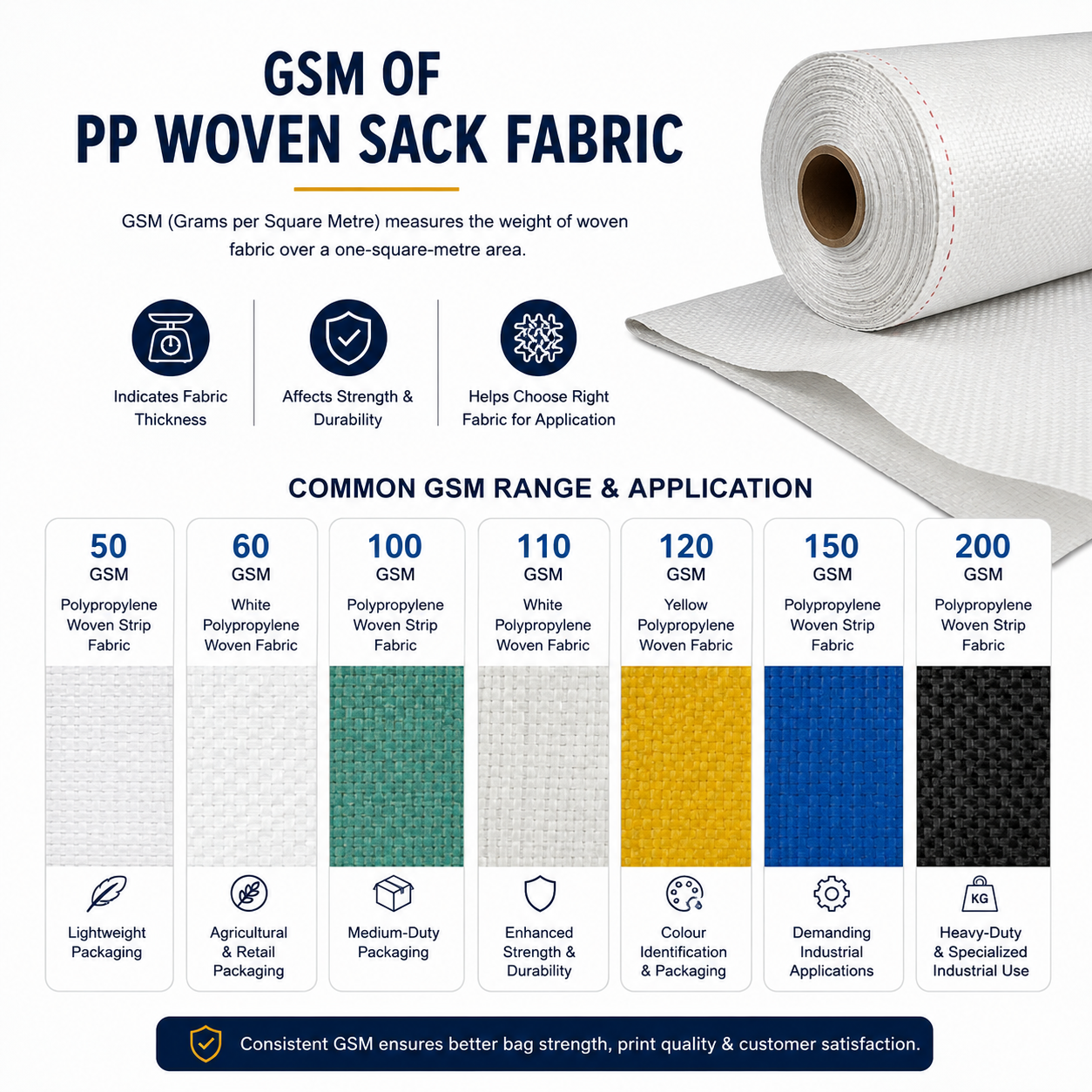
GSM, or Grams per Square Metre, measures the weight of woven fabric over a one-square-metre area. It is one of the most frequently referenced specifications because it provides a quick indication of the fabric's thickness and overall material usage.
A higher GSM generally means the fabric contains more polypropylene material, which can improve durability and load-bearing capacity. However, selecting the highest GSM is not always the best solution. The ideal specification depends on the application, product weight, and transportation conditions.
Manufacturers produce woven polypropylene fabric across a wide range of GSM values to satisfy different industrial requirements. Lightweight products may require lower GSM fabrics, while heavy-duty industrial packaging typically benefits from stronger fabric constructions.
Examples include:
- 50 GSM polypropylene woven strip fabric for lightweight packaging applications.
- 60 GSM white polypropylene woven fabric commonly used for agricultural and retail packaging.
- 100 GSM polypropylene woven strip fabric suitable for medium-duty packaging.
- 110 GSM white polypropylene woven fabric designed for enhanced strength and durability.
- 120 GSM yellow polypropylene woven fabric frequently used where colour identification is important.
- 150 GSM polypropylene woven strip fabric for demanding industrial applications.
- 200 GSM polypropylene woven strip fabric intended for heavy-duty packaging and specialised industrial products.
Manufacturers carefully maintain GSM consistency during production because even minor variations can affect bag strength, printing performance, and customer satisfaction.
Tensile Strength Explained
Tensile strength measures the maximum pulling force that woven polypropylene fabric can withstand before breaking. It is one of the most important indicators of overall fabric performance because it directly relates to how much weight a finished bag can safely carry.
Unlike GSM, which measures weight, tensile strength evaluates mechanical performance. Two fabrics with similar GSM values may exhibit different tensile strengths depending on tape quality, denier, weave density, and manufacturing precision.
Manufacturers test tensile strength in both warp and weft directions using specialised laboratory equipment. These tests verify that the woven structure maintains sufficient resistance to stretching, tearing, and heavy loading throughout the product's intended service life.
High tensile strength is particularly important for packaging products such as fertilizer bags, cement sacks, industrial chemicals, minerals, and export packaging, where bags experience repeated lifting, stacking, and transportation.
By carefully balancing tape properties, weave pattern, and production quality, manufacturers produce woven fabrics that provide reliable mechanical performance without unnecessary material consumption.
Fabric Width and Roll Length
Fabric dimensions are equally important specifications because they determine manufacturing efficiency and compatibility with downstream bag production.
Manufacturers supply polypropylene roll products in various widths depending on the intended bag size and production process. Wider rolls improve productivity for certain industrial applications, while narrower rolls may better suit specialised packaging products.
Roll length also varies according to customer requirements and production capabilities. Longer rolls reduce machine changeovers during bag manufacturing, improving operational efficiency and reducing material waste.
In addition to standard fabric sheets and rolls, manufacturers may also supply customised dimensions tailored to specific converting equipment. This flexibility allows packaging manufacturers to optimise production while maintaining consistent product quality.
Specialised products such as pp woven colour fabric, pp transparent roll fabric, and PP laminated woven fabric are also available in customised widths and roll lengths to support diverse industrial applications and premium packaging requirements.
When selecting woven fabric, buyers should evaluate not only the material specifications but also the roll dimensions to ensure compatibility with their manufacturing processes.
How These Specifications Work Together
Although denier, weave pattern, GSM, tensile strength, and fabric dimensions are discussed individually, they function as an integrated system. Changing one specification often influences several others.
For example, increasing denier may improve tensile strength but also increase GSM. A tighter weave pattern can enhance durability while reducing air permeability. Similarly, selecting laminated fabric improves moisture resistance and printability but changes the overall fabric construction.
Experienced manufacturers evaluate all these factors together rather than optimising a single parameter in isolation. This balanced approach produces woven polypropylene fabric that meets customer requirements for strength, durability, appearance, processing efficiency, and cost-effectiveness.
If you're looking for a deeper understanding of how these specifications are achieved during production, our guide on PP Woven Fabric Manufacturing explains how extrusion, tape stretching, weaving, and quality control influence the final fabric properties.
Standard GSM Specifications for PP Woven Sack Fabric
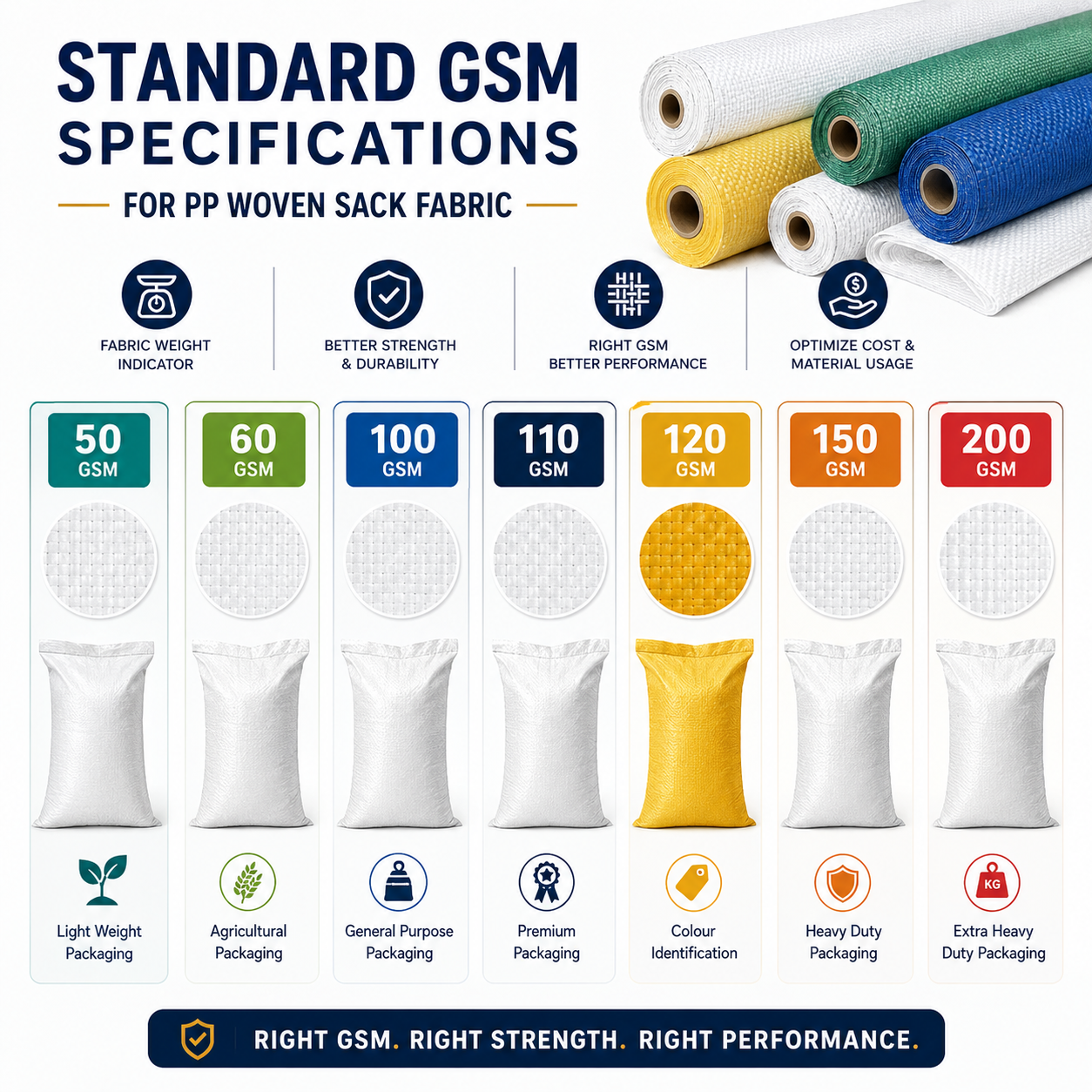
GSM is one of the first specifications buyers review when selecting PP Woven Sack Fabric because it directly affects strength, durability, flexibility, and material consumption. However, GSM should never be evaluated in isolation. A well-designed woven fabric balances GSM with denier, weave pattern, and tensile strength to achieve the desired performance for a specific application.
Manufacturers produce polypropylene woven fabric in a wide range of GSM values to meet the needs of different industries. Lighter fabrics are ideal for retail and agricultural packaging, while heavier fabrics are designed for industrial sacks carrying cement, chemicals, minerals, and other high-load products.
The following sections explain the most common GSM specifications used across the packaging industry and where each one performs best.
50 GSM Polypropylene Woven Strip Fabric
50 GSM polypropylene woven strip fabric is among the lightest woven fabrics used in industrial packaging. It is designed for products that require flexibility and economical material usage rather than maximum load-bearing capacity.
This specification is commonly selected for lightweight agricultural packaging, shopping bags, promotional packaging, and products with relatively low filling weights. Because the fabric contains less material, it also contributes to lower packaging costs while maintaining adequate strength for suitable applications.
Although lightweight, manufacturers still maintain consistent weave density and tape quality to ensure dependable performance during handling and transportation.
60 GSM White Polypropylene Woven Fabric
The 60 GSM white polypropylene woven fabric specification offers a practical balance between strength and flexibility. Its clean white appearance also makes it suitable for packaging applications where branding and printing quality are important.
This fabric is frequently used for agricultural products, flour packaging, sugar bags, and certain food-grade applications where moderate load capacity and an attractive appearance are equally valuable.
Manufacturers often combine this specification with optional lamination to improve moisture resistance and create a smoother surface for high-quality printing.
100 GSM Polypropylene Woven Strip Fabric
The 100 GSM polypropylene woven strip fabric is one of the most versatile specifications available. It provides excellent mechanical strength while remaining lightweight enough for efficient manufacturing and transportation.
This GSM range is commonly chosen for rice packaging, animal feed, fertilizers, chemicals, and various industrial products that require dependable performance under normal handling conditions.
Many businesses consider this specification an ideal compromise between durability and material efficiency because it performs well across a wide variety of packaging applications.
110 GSM White Polypropylene Woven Fabric
The 110 GSM white polypropylene woven fabric offers additional strength compared with lighter specifications while maintaining an attractive appearance suitable for printed packaging.
Its increased material weight provides improved puncture resistance, dimensional stability, and load-bearing capacity. As a result, this specification is frequently used for premium food packaging, export products, and heavy-duty agricultural applications.
The white fabric also supports vibrant printing, making it an excellent choice for brands that require professional product presentation alongside reliable packaging performance.
120 GSM Yellow Polypropylene Woven Fabric
The 120 GSM yellow polypropylene woven fabric combines heavy-duty performance with colour identification advantages. Coloured woven fabrics are widely used when products must be distinguished quickly during warehousing, transportation, or inventory management.
Industrial sectors such as chemicals, minerals, fertilizers, and construction materials often specify coloured woven fabrics to simplify product identification while maintaining high mechanical strength.
Manufacturers can also produce customised colour shades using specialised masterbatches while maintaining consistent physical properties throughout production.
150 GSM Polypropylene Woven Strip Fabric
For demanding industrial applications, 150 GSM polypropylene woven strip fabric provides significantly greater durability and resistance to mechanical stress.
Its heavier construction makes it suitable for packaging products that experience rough handling, prolonged storage, or repeated transportation. Applications include industrial chemicals, construction materials, minerals, animal feed, and heavy agricultural products.
The higher material content also improves puncture resistance and structural stability, making this specification suitable for larger bags carrying substantial loads.
200 GSM Polypropylene Woven Strip Fabric
The 200 GSM polypropylene woven strip fabric represents one of the strongest standard specifications used in woven packaging applications. It is designed for products requiring exceptional load-bearing performance and long-term durability.
Heavy industrial sacks, specialised export packaging, bulk material handling, and demanding engineering applications frequently utilise this specification. The increased GSM provides outstanding resistance to tearing, stretching, and abrasion even under challenging operating conditions.
Although heavier fabrics involve greater material consumption, they often reduce packaging failures in high-load applications, resulting in lower overall operational costs.
Selecting the Appropriate GSM
Choosing the right GSM requires understanding both the product being packaged and the conditions the packaging will encounter throughout its lifecycle. Selecting a heavier fabric than necessary increases material costs, while choosing fabric that is too light may compromise bag performance.
When evaluating GSM, buyers should consider:
- Product weight and bulk density.
- Filling and handling methods.
- Transportation distance and storage conditions.
- Moisture exposure and environmental factors.
- Printing and branding requirements.
- Customer specifications and export standards.
Experienced manufacturers assess these factors together before recommending the most suitable woven fabric specification. This ensures that the packaging delivers reliable performance while remaining economically efficient.
Why GSM Alone Does Not Define Fabric Quality
A common misconception is that a higher GSM automatically means better fabric. In reality, fabric quality depends on the interaction of several technical specifications rather than a single measurement.
For example, a lower GSM fabric manufactured with premium polypropylene resin, accurate denier control, and precise weaving may outperform a heavier fabric produced with inconsistent tape quality. Similarly, strong tensile properties and balanced weave density often contribute more to overall bag performance than GSM alone.
This is why professional buyers evaluate complete fabric specifications—including denier, weave pattern, tensile strength, and manufacturing quality—before making purchasing decisions.
If you're selecting fabric for food packaging applications, our guide on Rice Packaging Bags explains how fabric specifications influence packaging strength, printing quality, and export performance.
Common Types of PP Woven Sack Fabric
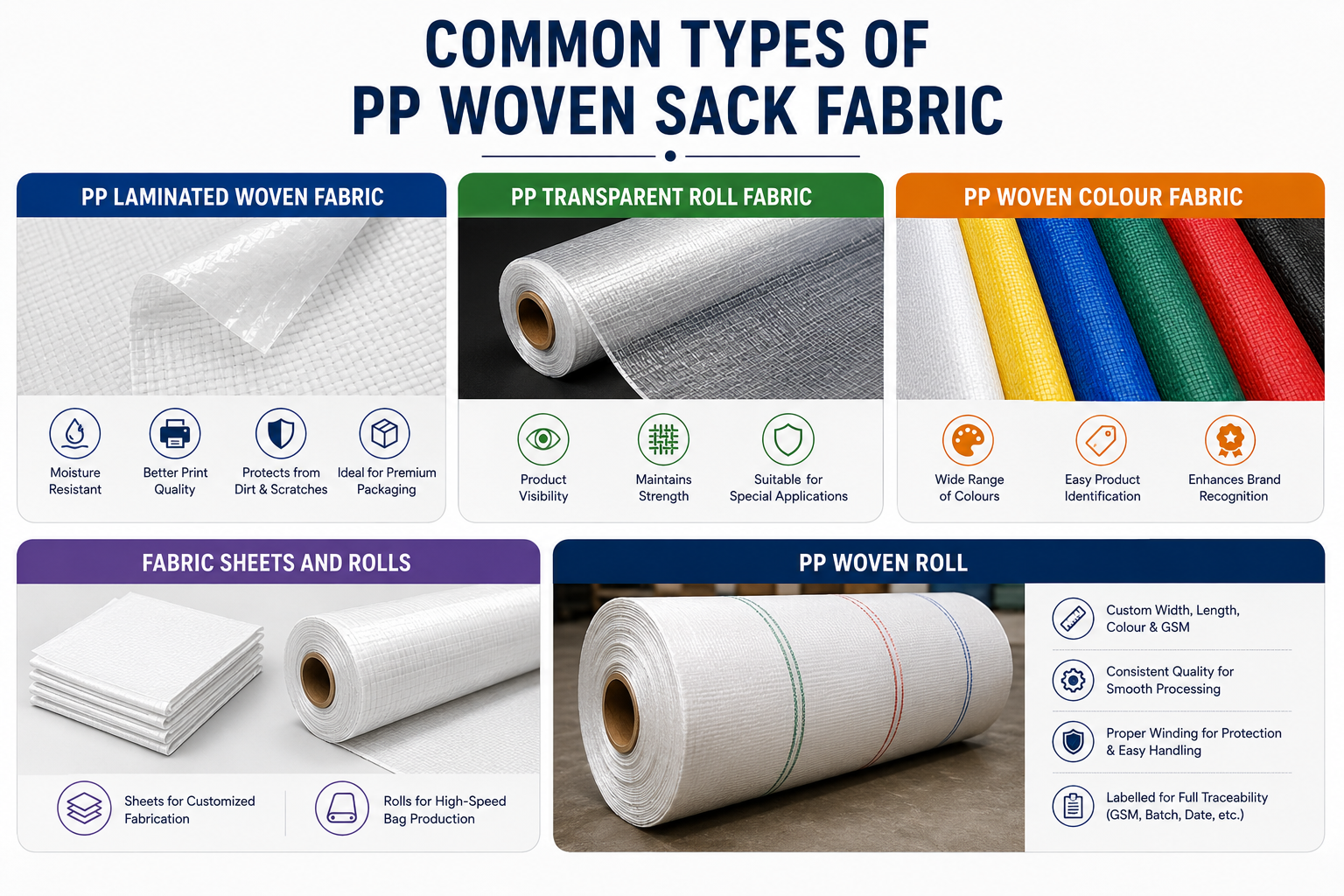
Modern packaging applications require more than a single type of woven fabric. Depending on the product, storage conditions, printing requirements, and transportation environment, manufacturers produce several variations of PP Woven Sack Fabric. Each type is engineered to deliver specific performance characteristics while maintaining the strength and durability associated with woven polypropylene.
Understanding these fabric types helps buyers choose materials that align with their packaging objectives rather than relying solely on GSM or tensile strength.
PP Laminated Woven Fabric
PP laminated woven fabric is manufactured by applying a thin polypropylene coating or BOPP film over the woven substrate. This additional layer improves moisture resistance, surface smoothness, and print quality, making it one of the most popular choices for premium packaging.
The laminated surface protects printed graphics from scratches, dirt, and moisture while providing a professional retail appearance. Industries such as rice, flour, sugar, pet food, and fertilizers commonly prefer laminated fabric because it combines excellent mechanical strength with attractive product presentation.
Another advantage is improved resistance to environmental conditions during transportation and warehouse storage. For export packaging, laminated woven fabric helps maintain both product quality and visual appeal over long shipping distances.
PP Transparent Roll Fabric
PP transparent roll fabric is produced for specialised applications where partial product visibility or unique packaging aesthetics are required. While not as widely used as standard woven fabric, transparent rolls are valuable for products that benefit from visual inspection before purchase.
Manufacturers carefully control transparency while preserving the woven structure's mechanical properties. These fabrics are commonly converted into packaging where visibility enhances consumer confidence without sacrificing durability.
PP Woven Colour Fabric
Colour-coded packaging plays an important role in many industries. PP woven colour fabric allows manufacturers to distinguish different product grades, production batches, or customer brands while maintaining identical mechanical performance.
Available in white, yellow, blue, green, red, black, and customised shades, coloured woven fabrics simplify warehouse management and improve product identification throughout the supply chain. The colour is incorporated using high-quality masterbatches during production, ensuring consistency across every manufacturing batch.
In addition to identification, coloured fabrics contribute to stronger brand recognition, particularly in retail packaging where visual appearance influences purchasing decisions.
Fabric Sheets and Rolls
Manufacturers supply fabric sheets and rolls depending on customer production requirements. Continuous rolls are typically preferred by automated bag manufacturers because they reduce machine downtime and improve production efficiency.
Fabric sheets, on the other hand, are suitable for specialised converting operations, customised fabrication, or industrial applications where individual cut pieces are required.
The availability of both formats provides flexibility for businesses operating different manufacturing processes while maintaining consistent material specifications.
PP Woven Roll
The PP woven roll is the standard supply format used by most packaging manufacturers. Rolls are available in customised widths, lengths, colours, and GSM specifications to match downstream converting equipment.
Properly wound rolls maintain consistent tension and protect the fabric from wrinkles, contamination, and damage during transportation. Each roll is typically labelled with essential information such as GSM, width, colour, batch number, production date, and quality inspection details, ensuring complete traceability.
High-quality winding also contributes to smoother bag manufacturing by allowing uninterrupted feeding into cutting, stitching, laminating, and printing equipment.
How Specifications Affect Bag Performance
Every specification of PP Woven Sack Fabric contributes to the overall performance of the finished packaging. Rather than acting independently, denier, weave pattern, GSM, tensile strength, and fabric construction work together to determine how a woven sack performs under real operating conditions.
Selecting the correct combination of specifications ensures that packaging remains reliable from production through transportation, warehousing, and final use.
Load Carrying Capacity
Load capacity depends primarily on tensile strength, denier, weave density, and overall fabric construction. Higher-quality woven fabrics distribute weight evenly across the woven structure, reducing stress concentrations that may lead to tearing or failure.
Heavy-duty applications such as pp woven 100 kg bag fabric require stronger tape construction and carefully controlled weaving to safely support substantial product weights.
Printing Quality
Packaging has become an important marketing tool, particularly for food and retail products. Fabric specifications influence how clearly graphics, logos, and product information appear on the finished bag.
Laminated woven fabrics provide a smoother printing surface, allowing higher-resolution graphics and vibrant colours. Consistent weave density also improves print registration and overall appearance, helping brands maintain a professional image across domestic and export markets.
Moisture Resistance
Although woven polypropylene naturally resists moisture, packaging used in humid environments or long-distance transportation often benefits from additional protection.
Laminated fabrics, coated surfaces, and optional inner liners improve resistance to water vapour and external contaminants. This helps preserve packaged products such as rice, flour, sugar, fertilizers, and chemicals throughout storage and transportation.
Durability During Transportation
Packaging experiences repeated lifting, stacking, compression, and handling throughout the supply chain. Strong woven fabric with balanced specifications minimises the risk of punctures, seam failures, and tearing during these operations.
Export packaging places even greater demands on woven sacks because products often travel thousands of kilometres through multiple logistics stages before reaching the end user.
Storage Performance
Long-term storage requires packaging that maintains its structural integrity under varying environmental conditions. Properly manufactured woven polypropylene fabric resists deformation, stretching, and deterioration while maintaining dimensional stability during warehouse storage.
Optional UV stabilisation further improves outdoor storage performance by protecting the fabric against prolonged sunlight exposure.
Choosing the Right Fabric for Different Applications
Different industries require different fabric specifications. Choosing the most suitable woven fabric involves balancing performance, cost efficiency, and customer expectations.
The following examples illustrate how specifications typically vary across common applications:
Rice and Food Packaging
Food packaging prioritises hygiene, print quality, and moderate load capacity. Medium GSM woven fabrics combined with lamination provide excellent strength while supporting attractive retail branding.
Fertilizer and Chemical Bags
Industrial chemicals and fertilizers require stronger woven structures capable of resisting abrasion and heavy handling. Higher denier tapes and increased tensile strength improve reliability throughout transportation and storage.
Cement Bags
Cement packaging demands exceptional puncture resistance and load-bearing performance. Higher GSM woven fabrics with robust weave patterns help withstand the harsh conditions commonly encountered on construction sites.
PP Woven 100 kg Bag Fabric
Bulk handling applications require specialised heavy-duty fabric engineered for extremely high loads. These products typically utilise thicker tapes, increased weave density, and superior tensile properties to ensure safe handling during industrial operations.
PP Woven 2.5 Gram Gold Fabric
Specialised applications such as pp woven 2.5 gram gold fabric require carefully engineered material specifications tailored to unique customer requirements. Manufacturers often customise tape denier, weave density, colour, and finishing processes to achieve the desired balance between precision, appearance, and mechanical performance.
Selecting the correct fabric specification not only improves packaging reliability but also reduces unnecessary material usage and long-term operational costs.
If you're interested in understanding how these fabric specifications are achieved during production, our guide on PP Woven Fabric Manufacturing explains the complete manufacturing process from extrusion to quality testing.
PP Woven Sack Fabric Specification Comparison
| Specification | Lightweight Fabric | Medium-Duty Fabric | Heavy-Duty Fabric |
|---|---|---|---|
| Typical GSM | 50–70 GSM | 80–120 GSM | 150–200 GSM |
| Denier | Low | Medium | High |
| Weave Density | Moderate | Balanced | High |
| Tensile Strength | Moderate | High | Very High |
| Print Quality | Good | Excellent | Excellent |
| Moisture Resistance | Good | Excellent (with lamination) | Excellent |
| Common Applications | Shopping bags, agriculture | Rice, flour, food packaging | Cement, fertilizer, industrial sacks |
| Cost Efficiency | High | Excellent | Moderate |
This comparison demonstrates that there is no universal "best" specification. The ideal PP Woven Sack Fabric depends on the product being packaged, transportation requirements, storage conditions, and customer expectations. By evaluating all technical parameters together, businesses can select packaging materials that deliver reliable performance while optimising manufacturing and logistics costs.
How Manufacturers Test PP Woven Sack Fabric
Manufacturing high-quality PP Woven Sack Fabric involves much more than producing woven rolls. Every batch must undergo rigorous quality testing to verify that it meets customer specifications and performs reliably in real-world applications. Leading manufacturers implement quality control throughout the production process rather than relying solely on final inspection.
These tests help ensure consistency in fabric weight, strength, dimensions, appearance, and overall durability. For industries such as food packaging, agriculture, construction, and chemicals, reliable quality testing reduces the risk of packaging failures and improves customer confidence.
GSM Testing
GSM testing confirms that the fabric weight remains consistent across the entire production batch. Quality inspectors cut standard-sized fabric samples and measure their weight using calibrated laboratory equipment to calculate grams per square metre.
Maintaining uniform GSM is essential because variations can affect bag strength, material consumption, printing performance, and customer specifications. Even small inconsistencies may create challenges during bag manufacturing or reduce packaging performance.
Tensile Strength Testing
Tensile testing measures the maximum pulling force that the woven fabric can withstand before failure. Samples are tested in both warp and weft directions using universal tensile testing machines to verify mechanical performance.
Consistent tensile strength demonstrates that extrusion, tape stretching, and weaving have been properly controlled during manufacturing. This test is particularly important for heavy-duty industrial packaging where bags are exposed to repeated lifting, stacking, and transportation.
Fabric Width Inspection
Accurate fabric width ensures compatibility with automated bag manufacturing equipment. Quality inspectors regularly measure fabric width throughout production to verify compliance with customer tolerances.
Maintaining precise dimensions improves production efficiency while reducing material waste during cutting, stitching, and conversion into finished packaging products.
Denier Testing
Since denier directly influences tape strength and fabric performance, manufacturers routinely monitor tape dimensions during production. Advanced testing equipment verifies that polypropylene tapes meet the specified denier range before weaving begins.
Consistent denier contributes to uniform tensile strength, balanced weave construction, and reliable bag performance across every production batch.
Visual Quality Inspection
In addition to laboratory testing, every PP woven roll undergoes detailed visual inspection before packaging and dispatch. Inspectors examine the fabric for weaving defects, broken tapes, holes, colour inconsistencies, contamination, edge defects, and surface imperfections.
Many modern production facilities also use automated optical inspection systems capable of detecting defects in real time. Combining advanced technology with experienced quality inspectors helps maintain consistently high manufacturing standards.
How to Choose a Reliable Polypropylene Woven Fabric Manufacturer
Choosing the right supplier has a direct impact on packaging quality, production efficiency, and long-term business success. While pricing is always an important consideration, buyers should also evaluate manufacturing capabilities, technical expertise, quality assurance systems, and export experience.
A reliable polypropylene woven fabric manufacturer consistently produces woven fabric that meets agreed specifications while providing dependable customer support and on-time deliveries.
Manufacturing Capability
Modern manufacturing facilities equipped with advanced extrusion lines, circular looms, lamination systems, and automated inspection equipment are generally better positioned to produce consistent, high-quality woven fabric.
Manufacturing capacity also influences lead times and the supplier's ability to fulfil large-volume orders without compromising quality.
Custom Fabric Options
Different industries require different fabric specifications. An experienced manufacturer should be able to customize GSM, denier, weave density, fabric width, colour, lamination, UV stabilisation, and roll dimensions according to customer requirements.
This flexibility enables businesses to optimise packaging performance while avoiding unnecessary material costs.
Quality Assurance
Reliable manufacturers implement documented quality management procedures covering raw material inspection, in-process monitoring, laboratory testing, and final product verification.
Requesting tensile strength reports, GSM records, inspection documentation, and batch traceability information helps buyers evaluate a supplier's commitment to consistent quality.
Export Standards
Businesses serving international markets should work with manufacturers familiar with export packaging requirements. Experience in global markets often indicates stronger quality systems, improved documentation, and better understanding of international customer expectations.
Companies such as Oberon Polypack focus on manufacturing woven polypropylene solutions that combine consistent quality, customised specifications, and dependable production processes for domestic and international customers.
Conclusion
Understanding the specifications of PP Woven Sack Fabric is essential for selecting packaging materials that deliver reliable performance throughout the supply chain. Denier, weave pattern, GSM, tensile strength, fabric dimensions, and lamination all work together to determine the strength, durability, printability, and long-term performance of woven packaging. By evaluating these specifications as a complete system rather than individually, businesses can make informed purchasing decisions that balance quality, efficiency, and cost.
Whether you're sourcing woven fabric for food packaging, agriculture, chemicals, or industrial applications, working with an experienced manufacturer helps ensure consistent quality and dependable performance. Oberon Polypack offers customised woven polypropylene solutions designed to meet diverse packaging requirements with precision-engineered fabric specifications. To explore our products or request a customised quotation, visit our PP Woven Fabric page or Contact Us today.
For additional information on textile testing methods and material standards, you can refer to ASTM International or the Textile Institute for globally recognised technical resources.
Frequently Asked Questions
1. What is PP Woven Sack Fabric?
PP Woven Sack Fabric is a woven material manufactured from polypropylene tapes interlaced on circular loom machines. It is widely used for producing woven sacks, food packaging bags, fertilizer bags, cement sacks, shopping bags, and various industrial packaging products due to its excellent strength, durability, and cost efficiency.
2. What GSM is best for PP woven sacks?
The ideal GSM depends on the intended application. Lightweight packaging generally uses lower GSM fabrics, while heavy-duty products such as cement, fertilizers, and industrial bulk packaging require higher GSM for increased strength. Manufacturers typically recommend the most appropriate specification based on bag size, product weight, and handling conditions.
3. What does denier mean in PP woven fabric?
Denier measures the thickness and linear density of polypropylene tapes used to manufacture woven fabric. Higher denier tapes generally provide greater tensile strength and improved load-bearing capacity, making them suitable for demanding industrial packaging applications.
4. How is tensile strength tested?
Tensile strength is measured using specialised laboratory equipment that applies controlled pulling forces to fabric samples until failure occurs. Testing is performed in both warp and weft directions to verify the woven fabric's mechanical performance and ensure compliance with customer specifications.
5. What is the difference between laminated and non-laminated PP woven fabric?
Laminated PP woven fabric includes an additional polypropylene coating or BOPP film that improves moisture resistance, print quality, and surface appearance. Non-laminated fabric offers excellent strength and breathability while being more suitable for applications where lamination is not required.